Contents
- Quick answer: there is no verified 2026 David Sinclair supplement list
- Where the supplement-list claims come from
- NMN, resveratrol, metformin, and other commonly repeated items
- What human NAD+ precursor evidence actually supports
- Why copying the routine is a poor safety strategy
- A better 2026 buyer checklist than copying a famous stack
- Targeted NAD support vs broad mitochondrial support
- A practical decision path
- Bottom line
- Frequently asked questions
Quick answer: there is no verified 2026 David Sinclair supplement list
Search results often present a current David Sinclair supplement stack with exact doses, brands, and a tidy daily schedule. The source trail is less tidy. A detailed December 2021 podcast transcript documents Sinclair discussing personal use of NMN and resveratrol, plus prescription metformin. That interview is a dated snapshot, not proof of what he takes in 2026, not a product endorsement, and not a protocol for other people.
The useful takeaway is not to copy a famous researcher's routine. It is to separate public statements from third-party retellings, separate a biomarker change from a health outcome, and compare any supplement on its own evidence, label, testing, price, and safety. Human studies show that some NAD+ precursors can change NAD-related biomarkers, but a 2026 systematic review still found clinical effectiveness for anti-aging or wellness outcomes inconclusive.
What this guide can responsibly say
- Documented snapshot: Sinclair described taking NMN and resveratrol in a 2021 long-form interview.
- Not a supplement: metformin is a prescription drug and should never be added or changed by copying an online routine.
- Not verified: pages labeled as a 2026 stack may be updating the headline rather than the underlying source.
- Evidence boundary: raising an NAD-related blood marker does not by itself prove longer life, more energy, or disease prevention.
- No endorsement: David Sinclair has not endorsed Advanced Mitochondrial Formula, and this article does not imply that he has.
Source-checked summary
| Claim | What is documented | Responsible interpretation |
|---|---|---|
| Sinclair takes NMN | He described taking NMN in a December 2021 interview. | A dated personal disclosure, not a current prescription or universal dose. |
| Sinclair takes resveratrol | He described his personal resveratrol routine in the same interview. | Personal use does not settle mixed human outcome evidence. |
| His stack includes metformin | He discussed personal use under medical context. | Metformin is a prescription drug, not a longevity supplement. |
| This is his 2026 protocol | No current first-party source reviewed for this article verifies a complete 2026 list. | Treat exact current-stack claims as unverified unless they link to a dated primary source. |
Where the supplement-list claims come from
A primary source tells you what was actually said and when. For this topic, the clearest accessible source is the transcript of Sinclair's December 2021 appearance on the Huberman Lab podcast. It includes timestamped discussions of resveratrol, NAD, NMN, NR, metformin, berberine, timing, and personal use. The Sinclair Lab site is useful for understanding his research focus, but it is not a consumer supplement schedule.
Many commercial articles turn that snapshot into a present-tense list, add products mentioned in other years, and attach a new year to the title. Some also list brands even when the primary discussion did not provide a brand endorsement. This creates false precision: a reader sees a clean 2026 routine while the supporting material may be a book, interview, social post, or second-hand summary from several years earlier.
How much weight should each source carry?
| Source type | What it can establish | What it cannot establish |
|---|---|---|
| Dated first-person interview | What someone said they did at that time. | A current routine, medical suitability, or product effectiveness. |
| Research-lab page | The lab's scientific interests and published work. | A consumer protocol or endorsement of a retail supplement. |
| Randomized human trial | Results for a defined compound, dose, group, and duration. | That every retail product works or that results apply to everyone. |
| Affiliate or brand article | A product interpretation or shopping angle. | Independent confirmation of a public figure's current routine. |
NMN, resveratrol, metformin, and other commonly repeated items
The most defensible way to read a celebrity-scientist stack is item by item. Ask whether the source documents personal use, a research discussion, or a real recommendation. Then ask whether the human evidence supports the outcome being advertised. Those are separate tests, and passing the first does not guarantee the second.
Claim audit by item
| Item | Public-source context | Evidence and buying caution |
|---|---|---|
| NMN | Sinclair described taking NMN in the 2021 interview and discussed it as an NAD+ precursor. | Human trials show biomarker activity, but health outcomes remain inconsistent and product quality still matters. |
| Resveratrol | He described personal use and discussed extensive preclinical work. | Mechanistic and animal findings do not prove human lifespan extension; interactions and dose context matter. |
| Metformin | He discussed personal use and timing in the interview. | It is a prescription diabetes drug with contraindications, monitoring needs, and interaction concerns. Do not self-prescribe it for longevity. |
| Berberine | It was discussed in the interview, including past personal use before metformin. | Discussion does not make it a current stack item or a safe metformin substitute; it can affect glucose and interact with medicines. |
| Quercetin | It appeared in the broader discussion and personal preparation description. | That mention is not proof of a fixed daily dose, current use, or anti-aging benefit. |
| Vitamin D, K2, fisetin, or spermidine | These often appear in third-party list articles assembled from multiple dates and sources. | Verify each item against a dated primary source instead of assuming one complete, current stack. |
Three distinctions list articles often blur
- Taking something personally is not the same as recommending it to the public.
- Discussing a molecule in research is not the same as endorsing a finished supplement.
- A biological mechanism or animal result is not the same as a clinically meaningful human benefit.
What human NAD+ precursor evidence actually supports
NAD is central to cellular metabolism, and NAD-related biology is a legitimate research field. That makes NMN and NR plausible research targets. It does not make every consumer outcome equally established. The strongest recurring human finding is target engagement: in some trials, oral precursors changed NAD-related metabolites or blood biomarkers over weeks or months.
A 2026 PRISMA-guided review found 33 human intervention studies and concluded that oral NR and NMN generally showed biochemical target engagement and short-term tolerability. Effects on functional, metabolic, vascular, and other healthspan outcomes were heterogeneous, often null, or limited to specific endpoints. The review called clinical effectiveness for anti-aging and wellness inconclusive.
A 2024 meta-analysis of eight randomized trials involving 342 mainly non-diabetic middle-aged or older adults found no significant benefit for fasting glucose, insulin, HbA1c, insulin resistance, or lipid measures across the included short-term NMN trials. This does not prove NMN can never help any endpoint. It does show why a pathway story should not be converted into a promise of better energy, metabolism, or longer life.
Evidence ladder for a supplement claim
| Evidence level | Reasonable conclusion | Conclusion to avoid |
|---|---|---|
| Cell or animal research | The mechanism is worth studying. | The same dose will extend human lifespan. |
| Human biomarker change | The compound engaged a measured pathway in that trial. | Users will feel more energetic or avoid age-related disease. |
| Small short-term randomized trial | The measured result is informative for that population and duration. | Long-term benefit and safety are settled. |
| Replicated meaningful outcomes | Confidence increases when independent trials agree. | Every commercial product is equivalent to the studied material. |
Why copying the routine is a poor safety strategy
A public figure's age, diagnoses, laboratory results, prescriptions, family history, diet, exercise, clinician supervision, and tolerance are not yours. Even an accurately reported personal routine leaves out the clinical context needed to judge whether it is appropriate for another person. Combining several products also makes it harder to identify which ingredient caused a side effect or changed a laboratory result.
Ask a healthcare professional before experimenting if you
- Take prescription medicines, especially for blood sugar, blood pressure, clotting, or cancer treatment.
- Are pregnant or breastfeeding, have kidney or liver disease, have a cancer history, or are preparing for surgery.
- Have new, severe, persistent, or unexplained fatigue instead of a clearly defined supplement-shopping question.
- Plan to combine NMN, NR, resveratrol, berberine, quercetin, metformin, or a multi-ingredient mitochondrial formula.
- Want to use laboratory testing to guide treatment or medication decisions.
Stop treating the purchase as a longevity experiment if you develop a concerning reaction. Severe symptoms, fainting, breathing difficulty, chest pain, signs of an allergic reaction, or a marked change in blood sugar require prompt medical attention rather than online protocol troubleshooting. General educational content cannot diagnose the cause.
A better 2026 buyer checklist than copying a famous stack
If you still want to compare a NAD-related product, make the product earn your trust independently. A familiar scientist's name cannot substitute for an accurate Supplement Facts panel, identity testing, batch controls, realistic claims, and a clear return policy. The checklist also protects against paying a premium for a delivery term or proprietary blend that the seller does not substantiate.
Seven checks before checkout
| Check | What good transparency looks like | Reason to pause |
|---|---|---|
| Exact form | The label distinguishes NMN, NR, NAD, NADH, niacinamide, or a blend. | The page uses NAD booster as if every form were interchangeable. |
| Amount per serving | Individual active amounts and serving count are easy to find. | A proprietary blend hides doses or changes the serving definition. |
| Testing | The seller explains identity, purity, contaminants, and batch documentation. | Third-party tested appears without a lab, standard, result, or certificate process. |
| Finished-product evidence | Claims match studies on the same form and a comparable dose. | Animal or ingredient studies are presented as proof for the retail bottle. |
| Safety | Warnings, allergens, storage, and interaction prompts are visible. | The page implies natural means risk-free. |
| Value | You can calculate cost per serving and identify recurring billing. | A bundle discount hides the true monthly cost or return conditions. |
| Endorsement language | Any relationship is disclosed and verifiable. | A researcher's name or photo is used to imply approval without a primary source. |
Start with one clearly defined goal, not a long stack. A narrow product makes dose, cost, and tolerance easier to track. If your real goal is broad cellular-energy support rather than specifically raising an NAD-related marker, compare that different category on its own merits instead of adding several separate bottles because they appeared in a celebrity routine article.
Targeted NAD support vs broad mitochondrial support
A targeted NAD strategy usually centers on one precursor or related form, such as NMN, NR, or direct NAD. A broad mitochondrial formula combines ingredients aimed at several cellular-energy pathways. Those are different purchasing hypotheses. The first is easier to isolate; the second may be more convenient but creates more variables and overlap.
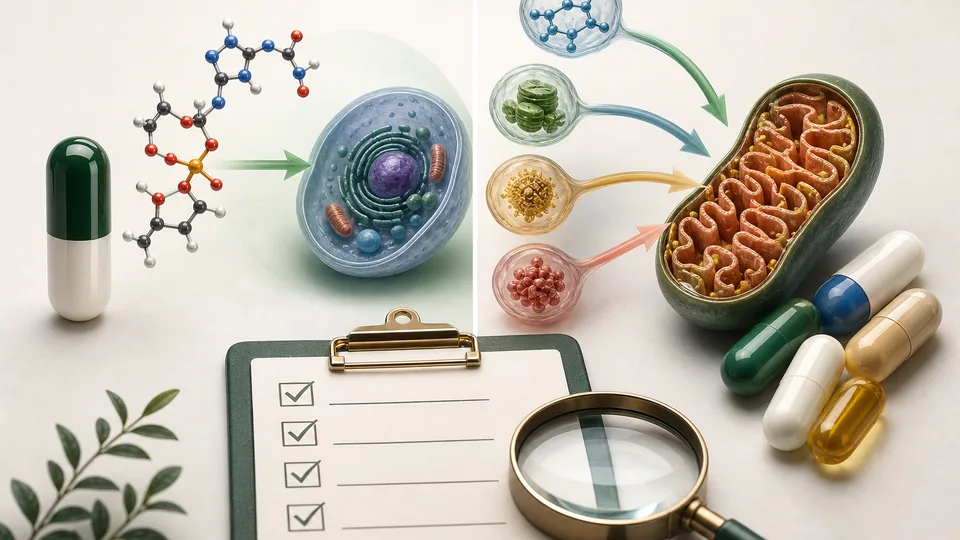
Which strategy matches the question?
| Decision point | Targeted NAD-related product | Broad mitochondrial formula |
|---|---|---|
| Primary question | Do I want to evaluate one NAD precursor or form? | Do I want several mitochondrial-support ingredient categories in one routine? |
| Main advantage | Simpler dose, evidence, cost, and tolerance tracking. | Convenience when the full label matches ingredients you would otherwise compare separately. |
| Main drawback | A narrow pathway may not match a broad energy goal. | More overlap, interaction review, and difficulty identifying cause and effect. |
| Evidence question | Does the studied form and dose match the bottle? | Does evidence for separate ingredients justify claims for the finished combination? |
Where Advanced Mitochondrial Formula fits
- It is a broad multi-ingredient mitochondrial support formula, not an NMN, NR, or direct NAD product.
- It includes NAD-adjacent niacinamide alongside ingredients discussed for other mitochondrial and antioxidant pathways.
- David Sinclair has not endorsed the product; his name should not be used as a reason to buy it.
- This site may earn a commission from the official offer link at no extra cost to you.
- Judge the current label, price, guarantee, interactions, and fit independently before ordering.
A practical decision path
Use this order before buying
- Define the outcome you want to evaluate in plain language and decide whether unexplained symptoms need medical assessment first.
- Choose between a targeted NAD-related product and a broad mitochondrial formula before comparing brands.
- Read the Supplement Facts panel, not just the front-label category or a public figure's name.
- Check human evidence for the same form, dose range, population, duration, and outcome you care about.
- Review medication, condition, pregnancy, surgery, and supplement-overlap questions with a qualified professional.
- If you proceed, avoid changing several products at once and keep expectations tied to measurable, realistic outcomes.
This sequence is less exciting than a famous protocol, but it produces a more defensible purchase. It also leaves room for the correct conclusion to be no supplement, a simpler single ingredient, a broader formula, or a clinician evaluation before any experiment.
Bottom line
David Sinclair's public discussions helped make NMN, resveratrol, NAD biology, and longevity supplements visible to a large audience. They did not create a universally appropriate protocol. The most detailed primary source reviewed here is a 2021 snapshot, while current human evidence supports biological activity more clearly than it supports broad anti-aging, energy, or wellness outcomes.
Use the name as a prompt to investigate the science, not as a shortcut around it. Verify dates, distinguish personal use from endorsement, keep prescription drugs outside self-experimentation, and make every retail product stand on its own label, testing, safety, value, and evidence.
Frequently asked questions
What supplements does David Sinclair take in 2026?
No complete current 2026 routine was verified from a first-party source for this article. A December 2021 interview documents Sinclair discussing personal use of NMN and resveratrol, along with prescription metformin. Pages that label those older disclosures as a 2026 stack should be checked for an actually new primary source.
Does David Sinclair recommend NMN to everyone?
A description of personal use is not a universal recommendation. NMN research shows NAD-related biomarker activity, but health outcomes remain mixed and long-term anti-aging effectiveness is not established. Suitability depends on the product, medications, conditions, and clinical context.
Did David Sinclair endorse Advanced Mitochondrial Formula?
No endorsement was identified, and this article does not imply one. Advanced Mitochondrial Formula is a broad multi-ingredient mitochondrial support product, not an NMN, NR, or direct NAD supplement. It should be judged independently on its label, evidence limits, safety, price, and guarantee.
Is NMN better than resveratrol for longevity?
There is no strong basis for declaring either one a proven human longevity supplement. They involve different biological questions, and evidence from biomarkers, animal models, or short trials does not demonstrate that either extends human lifespan. Compare the exact outcome and evidence rather than ranking the names.
Should I copy a longevity supplement stack one item at a time?
Copying items gradually may be easier to track than starting everything together, but it still does not establish that the routine is appropriate or useful for you. Prescription drugs should never be copied, and supplements deserve medication, condition, dose, testing, and interaction review first.
Sources and further reading
- The Sinclair Lab at Harvard Medical School: Research
- Huberman Lab: David Sinclair interview and transcript (December 2021)
- PubMed: 2026 systematic review of NAD+ supplementation for anti-aging and wellness
- PubMed: 2024 meta-analysis of NMN effects on glucose and lipid metabolism
- NIH Office of Dietary Supplements: Dietary Supplements, What You Need to Know
- NIH NCCIH: Using Dietary Supplements Wisely