
Contents
- Quick verdict: B3 is essential nutrition; NMN is a targeted NAD+ precursor
- First, clarify what 'B3' means on the label
- How NMN and B3 reach NAD+: same destination, different entry points
- Human evidence: established nutrition versus early supplement trials
- Which option makes more sense for your actual goal?
- Safety: do not compare milligrams one for one
- Where Advanced Mitochondrial Formula fits in the NMN vs B3 decision
- A buyer checklist that works for both categories
- Bottom line: choose the question before choosing the supplement
- Frequently asked questions
Quick verdict: B3 is essential nutrition; NMN is a targeted NAD+ precursor
NMN and vitamin B3 both connect to NAD+ metabolism, but they are not equivalent supplements. Vitamin B3 is an essential nutrient category that includes nicotinic acid, commonly called niacin, and nicotinamide, commonly called niacinamide. NMN, or nicotinamide mononucleotide, is a compound farther along the NAD+ salvage pathway and is sold as a targeted NAD+ precursor.
The practical answer is not that the molecule closer to NAD+ automatically wins. B3 has established nutritional requirements and a long history of use, while NMN has small, relatively short human trials showing that oral supplementation can raise some NAD-related blood measures. Neither fact proves that a healthy person will feel more energetic, age more slowly, or benefit from a particular retail product.
NMN vs B3 at a glance
| Question | NMN | Vitamin B3 |
|---|---|---|
| What is it? | A specific NAD+ precursor, usually sold as a stand-alone healthy-aging supplement. | An essential vitamin category that includes niacin and niacinamide. |
| Why do people take it? | Usually to target NAD+ metabolism with a newer precursor. | To meet nutritional needs or for a clinician-directed use of a specific B3 form. |
| What is well established? | NMN participates in NAD+ biosynthesis; early human trials have measured NAD-related markers. | Humans need niacin equivalents from food, and deficiency causes pellagra. |
| What remains uncertain? | Long-term safety and meaningful healthy-aging outcomes in broad populations. | Whether taking more than an adequate intake improves energy in someone who is not deficient. |
| Main buyer caution | Purity, storage, testing, regulatory context, and claims that outrun short trials. | The form matters: niacin and niacinamide differ in flushing, dose, and clinical use. |
The shortest decision rule
- Do not use NMN as a substitute for an identified nutrient deficiency or medical evaluation.
- Do not assume a high-dose B3 supplement is a cheaper version of NMN; the forms and safety profiles differ.
- If you want a targeted NAD+ experiment, compare NMN with NR and insist on clear dose and testing information.
- If you want broader mitochondrial support, compare that category separately instead of calling every product an NAD booster.
First, clarify what 'B3' means on the label
A comparison labeled NMN vs B3 can be misleading because B3 is not one bottle ingredient. Nutrition guidance uses niacin as an umbrella term for nicotinic acid, nicotinamide, and related niacin equivalents from food. Supplement labels may say niacin, nicotinic acid, niacinamide, nicotinamide, inositol hexanicotinate, or a blend. Those names should not be treated as interchangeable.
Nicotinic acid is the form most associated with skin flushing at supplemental doses. Niacinamide generally does not cause the same flush, but high supplemental intakes can still create safety concerns. NMN is chemically related to nicotinamide yet includes an added phosphate and ribose component. The body can connect all of these compounds to NAD biology through different routes, conversions, and control points.
Plain-English label translation
| Label term | What it means | What to check |
|---|---|---|
| Niacin or nicotinic acid | A vitamin B3 form used in nutrition and, at much higher doses, in clinician-managed contexts. | Amount per serving, flushing warning, medication overlap, and whether a clinician recommended it. |
| Niacinamide or nicotinamide | A B3 form used in foods, multivitamins, and many multi-ingredient formulas. | Total daily amount across products and whether marketing confuses it with NMN. |
| NMN | Nicotinamide mononucleotide, a direct precursor in the NAD+ salvage pathway. | Dose, identity and purity testing, certificate of analysis, storage, and realistic claims. |
| Vitamin B complex | A blend that may contain niacin or niacinamide with other B vitamins. | The exact B3 form and amount rather than the blend name. |
How NMN and B3 reach NAD+: same destination, different entry points
NAD+ is a coenzyme used in redox reactions, cellular energy metabolism, and enzyme systems involved in stress responses and DNA repair. Cells can make and recycle it through several pathways. Nicotinic acid can enter through the Preiss-Handler pathway. Nicotinamide can be recycled through the salvage pathway, where the enzyme NAMPT helps convert it to NMN and another enzyme then converts NMN to NAD+.
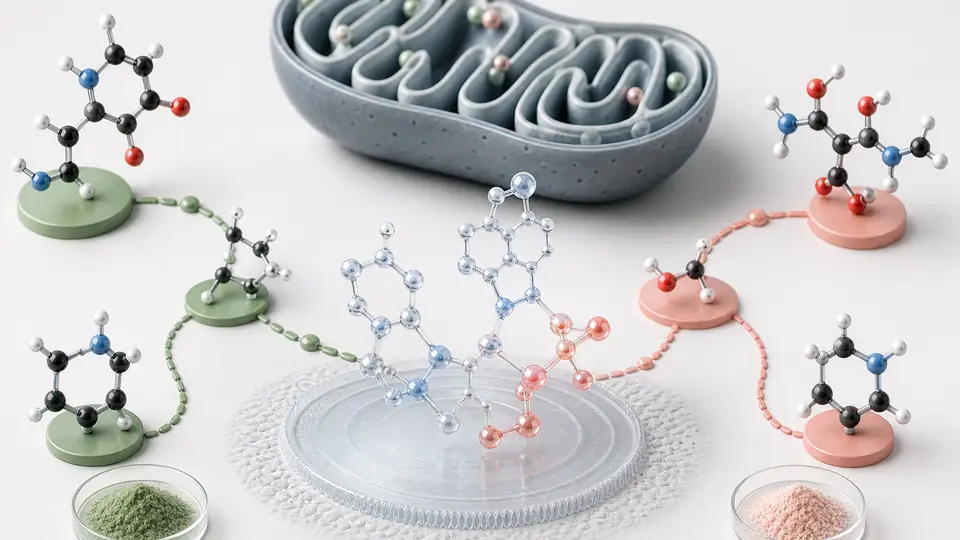
Taking NMN appears to bypass the NAMPT step required to turn nicotinamide into NMN. That sounds like a decisive advantage, but human biology is regulated rather than a simple assembly line. Absorption, tissue distribution, breakdown, baseline nutrient status, enzyme activity, dose, and health context all matter. A shorter pathway on a diagram is a mechanism hypothesis, not proof of superior energy, exercise, or longevity results.
What the pathway can and cannot tell you
- It can explain why NMN, niacin, and niacinamide all appear in NAD+ conversations.
- It cannot show that one retail product reaches the tissue a buyer cares about.
- It cannot convert a rise in a blood biomarker into proof of slower aging or less fatigue.
- It cannot replace a finished-product test for identity, purity, contaminants, and shelf stability.
Human evidence: established nutrition versus early supplement trials
B3 and NMN sit on very different evidence foundations. Niacin is an essential nutrient with established intake recommendations, known food sources, a recognized deficiency disease, and well-described dose-related adverse effects. That foundation supports getting enough B3. It does not show that progressively larger supplemental amounts improve energy or healthy aging in people whose nutrition is already adequate.
NMN research asks a newer question: can supplying this particular precursor raise NAD-related measures and produce useful outcomes? Small randomized trials have reported increases in blood NAD+ or related metabolites over periods such as 8 to 12 weeks. Some trials also report changes in selected functional or metabolic outcomes, while others are designed mainly around safety and biomarkers. The populations, doses, outcomes, and commercial involvement vary, so the results should not be generalized into a guaranteed benefit.
How to grade the evidence
| Claim | Evidence reading | Practical conclusion |
|---|---|---|
| Vitamin B3 is required for normal health. | Established nutritional evidence. | Meet needs through food and appropriate supplementation when needed. |
| NMN can raise a blood NAD-related measure in some trial settings. | Supported by several small, short human trials. | A biomarker effect is plausible, but product quality and study context matter. |
| NMN is better than B3 for energy. | Not established by a large head-to-head outcomes trial. | Do not infer a winner from pathway diagrams or marketing language. |
| Either supplement reverses aging. | Not established in humans. | Treat this as a red-flag claim, not a buying reason. |
| A multi-ingredient formula works because one ingredient supports NAD biology. | Requires evidence for the actual formula and outcome. | Judge ingredient plausibility separately from finished-product proof. |
The fairest conclusion is asymmetrical: B3 wins on certainty about essential nutrition, while NMN is the more targeted but less mature healthy-aging experiment. There is no strong basis for saying one universally produces more day-to-day energy than the other. Persistent fatigue deserves evaluation for sleep, anemia, thyroid problems, medication effects, mood conditions, infection, cardiopulmonary issues, and other causes before it becomes a supplement comparison.
Which option makes more sense for your actual goal?
Start with the job you expect the product to do. A nutritional gap, a curiosity about NAD+ biomarkers, and a desire for broad mitochondrial support are three different decisions. Treating them as one question encourages buyers to overpay, duplicate ingredients, or expect a supplement to solve an unexplained symptom.
Goal-based decision guide
| Your goal | Sensible starting point | Why |
|---|---|---|
| Meet basic vitamin B3 needs | Food first; use an ordinary supplement only when diet or clinical advice justifies it. | This is a nutrition question, not a longevity-stack question. |
| Try a targeted NAD+ precursor | Compare NMN with NR, then evaluate dose, testing, price, and evidence limits. | This keeps the decision inside the precursor category. |
| Avoid niacin flushing | Do not assume every B3 form flushes; verify niacin versus niacinamide with a professional. | Form matters more than the word B3 alone. |
| Use fewer bottles for broad mitochondrial support | Compare a transparent multi-ingredient formula with a focused single-ingredient plan. | Convenience and ingredient overlap become central. |
| Address new or unexplained fatigue | Healthcare evaluation before supplement shopping. | A supplement trial can delay attention to a treatable cause. |
Questions that improve the decision
- Am I comparing a nutrient requirement, a biomarker strategy, or a symptom claim?
- Does the label name the exact B3 form or merely say a vitamin blend?
- Does the NMN seller provide lot-specific identity and purity evidence rather than a generic badge?
- Am I already getting niacinamide from a multivitamin, energy product, or mitochondrial formula?
- What outcome will I track, and what would make me stop rather than keep escalating the dose?
Safety: do not compare milligrams one for one
A 250 mg NMN capsule and a 250 mg niacin tablet are not comparable doses. They are different compounds with different evidence, adverse-effect patterns, and intended uses. Nicotinic acid can cause warmth, redness, itching, or tingling known as flushing. High-dose niacin or niacinamide can create more serious concerns, including liver-related effects, and should not be used casually because the product is inexpensive or familiar.
Short NMN trials have generally reported tolerability in selected participants, but short-term tolerance is not the same as established long-term safety for every adult. Trial findings may not cover pregnancy, active cancer treatment, significant liver or kidney disease, complex medication use, or years of continuous supplementation. Product contamination or substitution is also a separate risk that an ingredient trial cannot rule out.

Ask a clinician or pharmacist before using either when
- you take glucose-lowering, blood-pressure, cholesterol, anticoagulant, or multiple prescription medicines
- you have liver or kidney disease, gout, diabetes, unexplained bruising, or a history of significant reactions to supplements
- you are pregnant, breastfeeding, preparing for surgery, receiving cancer treatment, or managing a diagnosed metabolic condition
- fatigue is new, worsening, severe, paired with chest pain or shortness of breath, or affecting normal daily activity
- you plan to combine several NAD-related products or use amounts far above an ordinary multivitamin
Where Advanced Mitochondrial Formula fits in the NMN vs B3 decision
Advanced Mitochondrial Formula is not an NMN supplement. The reviewed formula uses niacinamide as one part of a broader mitochondrial-support stack alongside ingredients such as CoQ10, PQQ, acetyl-L-carnitine, D-ribose, alpha-lipoic acid, magnesium, and plant compounds. That makes it relevant to a different buyer: someone comparing the convenience of a multi-ingredient formula with purchasing one targeted NAD+ precursor.
Its niacinamide content provides a B3-related connection to NAD metabolism, but that does not make the formula equivalent to NMN, prove that it raises NAD+ to the same degree, or validate every energy claim. The appropriate comparison is broad formula versus targeted precursor: ingredient coverage, disclosed amounts, overlap with current supplements, safety, price per serving, guarantee terms, and the strength of claims made for the finished product.
Who may prefer each route
- A careful NMN buyer may prefer one disclosed precursor and the ability to judge that ingredient separately.
- A broad-formula buyer may value fewer bottles and multiple mitochondrial-support ingredient categories.
- A minimalist buyer may prefer food, sleep, resistance and aerobic exercise, and correction of identified deficiencies before either option.
- Anyone taking medicines or stacking supplements should check the full formula for overlap rather than focusing only on niacinamide.
Affiliate disclosure: MitoEnergy Reviews may earn a commission if you purchase Advanced Mitochondrial Formula through the link below. That relationship does not change the category distinction: the product is presented as a broad mitochondrial-support option, not as NMN and not as a treatment for fatigue or disease.
A buyer checklist that works for both categories
NMN and B3 products should not be scored as if they were interchangeable, but the same disciplined buying process can filter weak offers. Capture the label and policy before checkout because formulations, package sizes, subscriptions, and guarantees can change.
Before you buy
- Exact identity: NMN, nicotinic acid, niacinamide, or another named form rather than vague NAD support.
- Amount per serving and servings per day, including totals from every supplement you already use.
- Lot-specific testing for identity, purity, heavy metals, and microbes, with a certificate that matches the product lot when possible.
- Clear manufacturer and seller contact details, storage instructions, expiration information, and an understandable return policy.
- A price-per-day calculation based on the labeled serving, not the largest discount headline.
- Claims limited to support language rather than treating fatigue, reversing age, repairing mitochondria, or preventing disease.
- A plan to evaluate tolerance and a defined reason to stop if the product causes symptoms or provides no useful value.
Red flags by category
| Red flag | Why it matters |
|---|---|
| B3 label does not name the form | You cannot judge flushing risk, dose context, or whether it matches the seller's explanation. |
| NMN seller relies only on pathway diagrams | Mechanism visuals do not establish finished-product identity, absorption, or health outcomes. |
| Generic 'third-party tested' badge with no report | The claim may not show what was tested, by whom, or whether the report matches your lot. |
| Guaranteed anti-aging or instant energy | These claims are stronger than the available evidence and ignore other causes of low energy. |
| Hidden subscription or unclear refund process | A low first-order price may not represent the real cost or cancellation burden. |
Bottom line: choose the question before choosing the supplement
NMN vs B3 has no single winner because the products answer different questions. Vitamin B3 is essential nutrition, and getting enough matters. NMN is a targeted precursor with promising biomarker data but incomplete evidence for long-term, person-important outcomes. A closer biochemical step to NAD+ is interesting; it is not a guarantee of better energy, healthy aging, or value.
Use ordinary nutrition logic for B3, trial-quality and product-quality logic for NMN, and formula-level logic for Advanced Mitochondrial Formula. Most importantly, do not use any of them to self-treat persistent or unexplained fatigue. That separation keeps the decision cautious, comparable, and much less vulnerable to marketing hype.
Frequently asked questions
Is NMN a form of vitamin B3?
NMN is not usually labeled as vitamin B3. It is a nicotinamide-derived nucleotide and a precursor in the NAD+ salvage pathway. Niacin and niacinamide are recognized vitamin B3 forms. They are related through NAD metabolism but are not interchangeable label terms.
Does vitamin B3 raise NAD+ like NMN?
B3 compounds are precursors the body can use to make NAD+, and adequate intake is essential. NMN enters the salvage pathway at a different point and small trials show changes in blood NAD-related measures. There is not a simple head-to-head basis for saying one produces better real-world energy or healthy-aging outcomes for everyone.
Is NMN better than niacinamide?
Not universally. NMN is a more targeted and generally more expensive NAD+ precursor experiment. Niacinamide is an established B3 nutrient used at very different amounts and in different products. The better fit depends on whether the goal is nutrition, a targeted biomarker strategy, or broad formula convenience.
Can I take NMN and vitamin B3 together?
Do not assume that related pathways make the combination more effective. Combining products may add cost and total nicotinamide-related exposure without proven extra benefit. A clinician or pharmacist should review the exact forms, amounts, medicines, conditions, and other supplements before you stack them.
Does Advanced Mitochondrial Formula contain NMN?
The reviewed formula is not an NMN product. It includes niacinamide within a broader mitochondrial-support blend. Verify the current Supplement Facts panel before buying because formulas can change, and judge it as a multi-ingredient product rather than a substitute for NMN.
Which is more likely to cause flushing, NMN or B3?
Flushing is most associated with nicotinic acid, a B3 form, especially at supplemental amounts. Niacinamide does not usually create the same flush, while NMN has a different short-term tolerability profile. Lack of flushing does not prove that a dose is appropriate or risk-free.
Should I take NMN or B3 for fatigue?
Neither should be treated as a default remedy for unexplained fatigue. Low energy can have nutritional, sleep, medication, mental-health, endocrine, infectious, cardiovascular, and other causes. New, persistent, severe, or worsening fatigue should be assessed by a qualified healthcare professional before a supplement trial.
Sources and further reading
- NIH Office of Dietary Supplements: Niacin Fact Sheet for Health Professionals
- Clinical Evidence for Targeting NAD Therapeutically: systematic review
- Safety and efficacy of NMN in healthy subjects: randomized 12-week trial
- NMN in healthy middle-aged adults: randomized dose-dependent trial
- FDA: FDA 101 - Dietary Supplements
- Advanced BioNutritionals official Advanced Mitochondrial Formula offer page