Contents
- Quick answer: PQQ and CoQ10 are related to mitochondria, but they are not interchangeable
- Why PQQ and CoQ10 appear in the same mitochondrial conversation
- What human research says about PQQ, CoQ10, and the combination
- Should you take PQQ and CoQ10 together?
- How to compare PQQ and CoQ10 supplement labels
- Safety, side effects, and medication questions
- Where PQQ and CoQ10 fit in Advanced Mitochondrial Formula
- Bottom line
- Frequently asked questions
Quick answer: PQQ and CoQ10 are related to mitochondria, but they are not interchangeable
Pyrroloquinoline quinone, usually shortened to PQQ, and coenzyme Q10, or CoQ10, are both sold for mitochondrial support. The connection is biologically plausible, but the ingredients do different jobs. CoQ10 participates in the mitochondrial electron transport chain and also acts as an antioxidant. PQQ is a redox-active compound studied for antioxidant signaling and pathways associated with mitochondrial biogenesis, mostly in laboratory and animal models.
That distinction matters at checkout. CoQ10 has a much larger human research literature, although results vary by condition and do not prove a general energy benefit for healthy adults. PQQ has smaller human trials, often focused on cognitive tests rather than everyday energy or exercise capacity. Evidence that the two can be combined is not the same as evidence that every PQQ-CoQ10 product is synergistic.
PQQ and CoQ10 at a glance
| Question | PQQ | CoQ10 |
|---|---|---|
| Primary biology discussed | Redox activity and signaling linked with mitochondrial biogenesis in preclinical research. | Electron transfer in mitochondrial energy metabolism plus antioxidant activity. |
| Human evidence | Limited, with small trials centered mainly on cognition and selected biomarkers. | Broader, but highly dependent on the population, outcome, dose, and clinical context. |
| Evidence for more everyday energy | Not established for the general healthy population. | Not established as a predictable result for every healthy buyer. |
| Key buying issue | Verify the exact PQQ form, amount, and product-specific testing. | Check the form, amount, serving directions, interactions, and total cost. |
| Can they be combined? | They appear together in some products and studies, but combination claims must match the actual finished product. | Combination use still requires an overlap and medication review. |
Why PQQ and CoQ10 appear in the same mitochondrial conversation
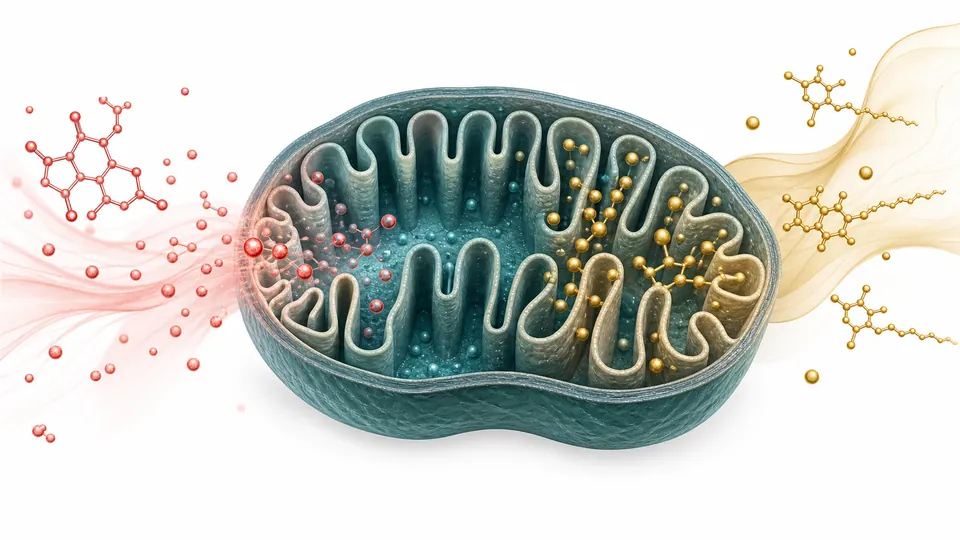
Mitochondria help convert energy from food into ATP through a regulated network. CoQ10 has a direct, established role within that network: in its oxidized and reduced forms, it transfers electrons between complexes in the inner mitochondrial membrane. The body makes CoQ10, and the compound is also available as supplements commonly labeled ubiquinone or ubiquinol.
PQQ has a different story. It is a redox cofactor in some microorganisms and is present in small amounts in foods. Supplement marketing often emphasizes laboratory findings involving PGC-1 alpha and other signaling connected with mitochondrial biogenesis. Those experiments can help explain a research hypothesis, but cell and animal findings do not show that an oral PQQ capsule creates more functional mitochondria or noticeable energy in a person.
Keep these evidence levels separate
- Biochemical role: a compound participates in a known pathway.
- Preclinical signal: an effect appears in cells or animals under controlled conditions.
- Ingredient trial: a defined dose and form is tested in a specific group of people.
- Combination trial: two or more ingredients are tested together, so the result cannot be assigned automatically to either one.
- Finished-product evidence: the exact commercial formula is tested for the same outcome promoted to buyers.
What human research says about PQQ, CoQ10, and the combination
PQQ research in humans is still modest. A randomized 12-week study enrolled 64 healthy Japanese adults ages 40 to under 80 who reported age-related forgetfulness; 58 completed the trial. The PQQ group received 21.5 mg of PQQ disodium salt per day and showed differences from placebo on several computerized cognitive measures. This supports further study of that form and population, not a conclusion about energy, longevity, or every PQQ product.
Another double-blind placebo-controlled study used 20 mg per day for 12 weeks in adults ages 20 to 65 and reported age-dependent differences on cognitive tests. Again, the tested outcome was brain function, not fatigue relief or mitochondrial performance in daily life. A 2024 review summarizes additional small PQQ studies and reports that coadministration with CoQ10 produced greater cognitive changes in one research program, but a review-level statement should not be turned into a universal synergy claim.
CoQ10 has been studied far more widely, especially in people with diagnosed conditions. That larger literature is not uniformly positive. The National Center for Complementary and Integrative Health describes cardiovascular results as inconclusive, notes that the overall evidence does not support a meaningful reduction in statin-associated muscle pain, and says the small available evidence suggests little meaningful blood-pressure effect. These conclusions do not make CoQ10 useless; they show why the outcome and population must be named precisely.
How much can each evidence type prove?
| Evidence | Reasonable conclusion | Overreach to avoid |
|---|---|---|
| PQQ cognition trials | Specific PQQ preparations deserve more study for selected cognitive outcomes. | PQQ reliably increases energy, reverses aging, or works for every age group. |
| CoQ10 clinical literature | CoQ10 may have context-specific uses and is not equally supported for every promoted outcome. | A large study count proves a general wellness benefit. |
| PQQ plus CoQ10 research | A defined combination may be studied as its own intervention. | Any bottle containing both ingredients is synergistic. |
| Mitochondrial mechanisms | Both ingredients have legitimate reasons to appear in mitochondrial research. | Mechanistic relevance guarantees a felt change in energy or cognition. |
| Customer reviews | They can reveal taste, capsule, shipping, or tolerance patterns. | They establish efficacy or predict an individual's result. |
Should you take PQQ and CoQ10 together?
There is no general rule that healthy adults need both. Combining them may be convenient when a clearly labeled product fits a specific goal, but a two-ingredient story should not bypass basic questions: Is each amount disclosed? Does the research match those forms and amounts? Is the claim about cognition, a biomarker, a diagnosed condition, or simply vague energy support?
Taking two ingredients also makes self-observation less clear. If sleep, digestion, headache, energy, or another symptom changes, you may not know which ingredient mattered. Adding a PQQ-CoQ10 product on top of a multivitamin, standalone CoQ10, an energy blend, or a broad mitochondrial formula can create duplicate exposure without adding better evidence.
A cautious decision sequence
- Write down the outcome you are trying to evaluate instead of using a broad goal such as better mitochondria.
- Check whether persistent fatigue, cognitive change, chest symptoms, weakness, or exercise intolerance needs medical evaluation first.
- List every medication and supplement, then identify duplicate CoQ10, PQQ, antioxidant, magnesium, carnitine, or energy-blend ingredients.
- Prefer a transparent formula that identifies forms and amounts per daily serving.
- Set a realistic review point and avoid changing several other habits or products at the same time.
How to compare PQQ and CoQ10 supplement labels
Front-label phrases such as mitochondrial energy, cellular renewal, or advanced antioxidant support do not tell you what was tested. Turn the bottle around. The useful comparison is built from the exact ingredient name, form, amount per serving, servings per day, other active ingredients, testing documentation, and daily cost.

PQQ-CoQ10 buyer checklist
| Check | Useful signal | Reason to slow down |
|---|---|---|
| PQQ identity | The label names PQQ and its form, often a disodium salt. | Only a proprietary mitochondrial complex appears. |
| CoQ10 identity | The panel distinguishes ubiquinone, ubiquinol, or another clearly defined form. | The form is hidden while absorption claims dominate the page. |
| Amounts | Milligrams per serving and daily servings are unambiguous. | Research doses are quoted without showing the product's dose. |
| Combination evidence | The seller identifies evidence on the exact formula or clearly labels ingredient-only evidence. | Separate PQQ and CoQ10 studies are presented as proof of the blend. |
| Quality | Identity and contaminant testing are described, with useful batch documentation available. | Third-party tested appears without the laboratory, scope, or certificate context. |
| Value | Daily cost is compared with a focused single ingredient and a broader formula. | A large bundle is pushed before tolerance, overlap, and return terms are clear. |
Safety, side effects, and medication questions
CoQ10 is generally described as well tolerated, with possible mild digestive upset or insomnia. The more important issue for many buyers is interaction context. NCCIH notes potential interactions with warfarin and insulin and warns that CoQ10 may not be compatible with some cancer treatments. Do not adjust an anticoagulant, diabetes medicine, or cancer treatment around a supplement without the treating professional.
PQQ has a shorter human-use record and fewer independent clinical data. Small trials using defined PQQ disodium salt preparations have not created a complete safety map for every dose, product, age group, pregnancy, health condition, or long-term combination. A product containing both ingredients also inherits the cautions of its other components.
Ask a clinician or pharmacist before use if
- You take warfarin, insulin, glucose-lowering medication, cancer treatment, or other prescription medicines.
- You are pregnant or breastfeeding, are buying for a child, or have liver, kidney, heart, bleeding, or metabolic concerns.
- You already use CoQ10, ubiquinol, PQQ, a multivitamin, an antioxidant blend, or a broad mitochondrial formula.
- You have surgery planned or have previously reacted to a multi-ingredient supplement.
- Fatigue, cognitive changes, weakness, shortness of breath, fainting, chest pain, or unexplained weight change is new, severe, persistent, or worsening.
Where PQQ and CoQ10 fit in Advanced Mitochondrial Formula
The official Advanced Mitochondrial Formula offer discusses both PQQ and CoQ10 within a wider stack that also includes niacinamide, D-ribose, acetyl-L-carnitine, alpha-lipoic acid, magnesium, plant compounds, and BioPerine. It should therefore be judged as a broad mitochondrial-support formula, not as a controlled PQQ-and-CoQ10 trial.
The practical advantage is convenience: one product covers several ingredient categories. The tradeoff is reduced control over dose selection and attribution. A cautious buyer should compare the current Supplement Facts panel with every existing supplement, consider whether a narrower product would answer the goal more clearly, and avoid treating research on one ingredient as proof of the finished formula.
Single ingredient, PQQ-CoQ10 pair, or broad formula?
| Decision point | Single ingredient | PQQ plus CoQ10 | Advanced Mitochondrial Formula |
|---|---|---|---|
| Best reason to compare | You want to evaluate one defined variable. | You specifically want a transparent two-ingredient strategy. | You prefer one routine spanning several mitochondrial-support categories. |
| Dose control | Highest. | Moderate when both amounts are disclosed. | Lower because many ingredients must fit the same serving. |
| Attribution | Easiest to interpret. | A response can belong to either ingredient or the combination. | Benefits or side effects are hardest to assign. |
| Overlap review | Narrowest, but still necessary. | Check existing CoQ10, PQQ, and antioxidant products. | Check the complete stack, including BioPerine and medication context. |
| Evidence question | Does this form and amount match the relevant study? | Was this exact pair tested for the promoted outcome? | Is there finished-product evidence proportional to the sales claim? |
Bottom line
PQQ and CoQ10 both belong in an evidence-aware mitochondrial-support discussion, but for different reasons. CoQ10 has a direct role in mitochondrial electron transfer and a larger, mixed human evidence base. PQQ has interesting redox and signaling biology plus a smaller group of human trials, mainly around cognition. Neither record proves predictable energy or anti-aging results for a general healthy buyer.
If you compare them together, require more than a synergy headline. Verify the forms, amounts, testing, daily cost, complete formula, interactions, and whether the evidence matches the promised outcome. A broad formula such as Advanced Mitochondrial Formula may be convenient, but it should be evaluated as its own multi-ingredient product. Persistent symptoms and medication questions come before supplement shopping.
Frequently asked questions
What is the difference between PQQ and CoQ10?
CoQ10 participates directly in electron transfer within mitochondrial energy metabolism and also has antioxidant roles. PQQ is a different redox-active compound studied for signaling, antioxidant effects, and mitochondrial-biogenesis pathways. They are not substitutes for each other.
Can you take PQQ and CoQ10 together?
They are sold together, but combination use is not automatically necessary or better. Check both amounts, existing supplement overlap, medications, health conditions, and whether evidence exists for the exact product and outcome.
Do PQQ and CoQ10 increase energy?
Both have plausible links to mitochondrial biology, but human evidence does not show that either ingredient reliably creates noticeable everyday energy in every healthy adult. New or persistent fatigue should be medically evaluated rather than explained by a supplement theory.
Is PQQ the same as ubiquinol?
No. PQQ is pyrroloquinoline quinone. Ubiquinol is the reduced form of CoQ10. A label should identify them separately and disclose the amount of each.
Who should be cautious with CoQ10?
People taking warfarin, insulin or other glucose-lowering medicines, or some cancer treatments should discuss CoQ10 with their treating professional. Medication use, surgery, pregnancy, chronic conditions, and supplement overlap also justify professional review.
Does Advanced Mitochondrial Formula contain PQQ and CoQ10?
The official offer page discusses both ingredients within a broader multi-ingredient formula. Check the current Supplement Facts panel before buying, because ingredient and package details can change, and do not assume isolated-ingredient studies prove the complete product.
Sources and further reading
- PubMed: PQQ disodium salt and cognitive function in healthy volunteers
- PubMed: PQQ disodium salt and brain function in younger and older adults
- PubMed: Review of PQQ effects on brain function and physiological processes
- NCCIH: Coenzyme Q10
- FDA: FDA 101 - Dietary Supplements
- Advanced BioNutritionals official Advanced Mitochondrial Formula offer page