
Contents
- Quick answer: the best mitochondrial supplement depends on the job you need it to do
- How to think about mitochondrial supplements without falling for hype
- Ingredient categories buyers usually compare
- Single ingredient or broad formula: which makes more sense?
- Where Advanced Mitochondrial Formula fits in the comparison
- A practical buyer checklist before you choose any mitochondrial supplement
- Our cautious ranking logic
- Bottom line: choose by fit, not by the biggest mitochondrial promise
- Frequently asked questions
Quick answer: the best mitochondrial supplement depends on the job you need it to do
The best mitochondrial supplement is not the product with the longest ingredient list or the strongest energy promise. It is the option whose ingredients, dose transparency, safety profile, price, and evidence level match your situation. For many buyers, that means comparing single-ingredient choices like CoQ10 or acetyl-L-carnitine against broader mitochondrial support formulas that combine several nutrients in one serving.
If you are buying because of new, severe, persistent, or unexplained fatigue, pause the supplement search and talk with a healthcare professional first. If you are a generally healthy adult comparing wellness products for energy metabolism and healthy aging support, use this guide as a label-reading and buyer-fit framework rather than a medical recommendation.
Best-fit summary
- Best simple starting point: a single ingredient with a transparent dose, such as CoQ10, when you want fewer variables.
- Best broad-stack approach: a multi-ingredient formula when you want CoQ10, PQQ, acetyl-L-carnitine, B vitamin support, antioxidants, and minerals in one product.
- Best evidence posture: cautious. Some ingredients have human data for specific contexts, but broad energy and healthy-aging claims are often stronger than the evidence.
- Best safety rule: check medications, conditions, surgery timing, pregnancy, cancer history, kidney or liver disease, and unexplained fatigue before buying.
- Commercial disclosure: this site may earn a commission if you buy Advanced Mitochondrial Formula through our affiliate links. That does not change our cautions or our recommendation to verify the label and ask a clinician when appropriate.
Fast comparison of common mitochondrial supplement approaches
| Supplement approach | Why buyers consider it | Main caution |
|---|---|---|
| CoQ10 or ubiquinol | Commonly discussed for mitochondrial energy pathways and antioxidant activity. | Single ingredient is easier to judge, but it is not a broad mitochondrial stack. |
| PQQ | Marketed around mitochondrial biogenesis and healthy aging support. | Human evidence and finished-product relevance should be checked carefully. |
| Acetyl-L-carnitine | Often positioned around fatty-acid transport and cellular energy metabolism. | May not fit everyone, especially with certain health histories or medication questions. |
| NAD boosters, B3, NMN, or NR | Used to support NAD+ related pathways in healthy-aging discussions. | Forms differ, evidence varies, and stronger anti-aging claims deserve skepticism. |
| Broad mitochondrial formulas | Convenient way to compare several support ingredients in one product. | More ingredients can mean more overlap, side-effect questions, and harder self-observation. |
How to think about mitochondrial supplements without falling for hype
Mitochondria are involved in cellular energy metabolism, but that does not mean every supplement marketed for mitochondria will noticeably change how you feel. A better buyer question is narrower: which ingredient role is the product trying to support, how transparent is the dose, and what level of evidence exists for the exact claim being made?
A product can be reasonable to compare as a wellness supplement while still being inappropriate for a medical problem. This distinction matters for energy-related searches. Low energy after 40 or 50 can be influenced by sleep, exercise, protein intake, medications, stress, anemia, thyroid issues, depression, sleep apnea, infections, heart problems, and many other factors. A supplement should not be used to diagnose, treat, cure, or prevent those conditions.
Evidence levels to separate before buying
| Evidence type | What it can tell you | What it cannot prove |
|---|---|---|
| Human clinical research | May show effects in a defined population, dose, and time frame. | Does not automatically prove that a different finished formula will work for you. |
| Mechanistic or animal research | Can explain why an ingredient is biologically interesting. | Does not prove real-world energy benefits in supplement buyers. |
| Traditional use or marketing language | Can show why a product is positioned a certain way. | Should not be treated as proof of effectiveness or safety. |
| Customer reviews | Can reveal taste, shipping, refund, and tolerance patterns. | Cannot establish medical benefit, cause and effect, or typical results. |
Ingredient categories buyers usually compare
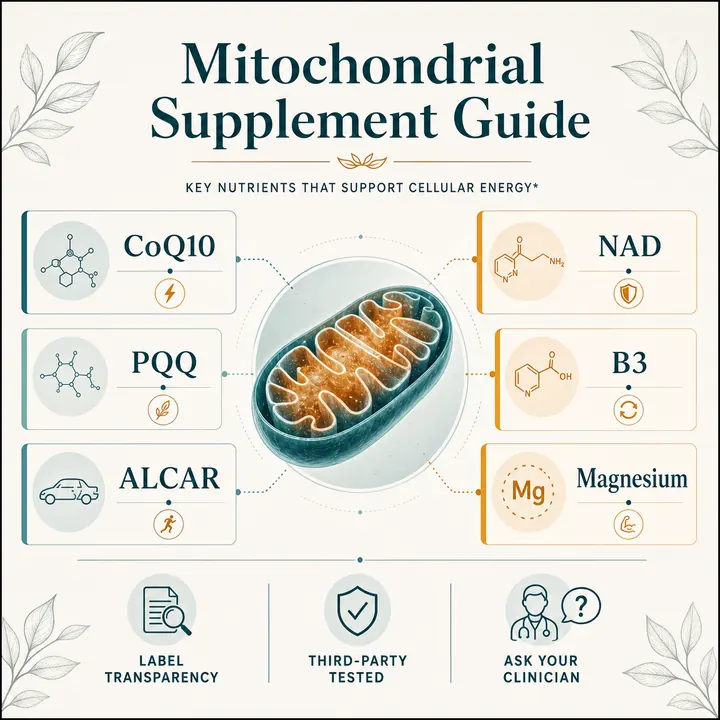
Most mitochondrial supplement labels are built from a few recurring categories: electron transport and antioxidant support, NAD-related metabolism, nutrient transport, polyphenols, minerals, and absorption enhancers. The names sound technical, but the buyer task is practical. Identify what is included, how much is included, whether the dose is disclosed, and whether it overlaps with products you already take.
Common ingredients and the buyer question each one raises
| Ingredient or group | Typical mitochondrial-support angle | Buyer question |
|---|---|---|
| CoQ10 | Energy-pathway and antioxidant support language. | Is it ubiquinone or ubiquinol, what is the dose, and do you take heart-related or blood-thinner medication? |
| PQQ | Mitochondrial biogenesis and healthy-aging marketing. | Is the dose clear, and is the claim based on the ingredient or the finished formula? |
| Acetyl-L-carnitine | Fatty-acid transport and cellular energy metabolism. | Do you have medication, seizure-history, thyroid, or stimulant-sensitivity questions? |
| Niacinamide, NAD, NMN, or NR | NAD+ pathway support and healthy-aging interest. | Which form is used, how much is present, and are you already taking a B-complex or NAD booster? |
| Alpha-lipoic acid | Antioxidant and glucose-metabolism-adjacent positioning. | Do you use diabetes medication or need blood sugar monitoring? |
| Curcumin, quercetin, resveratrol, or itadori extract | Polyphenol and oxidative-stress support language. | Could it affect blood thinners, surgery timing, liver or kidney issues, or other supplements? |
| Magnesium | Mineral cofactor involved in many normal body processes. | Which form and amount are used, and does it overlap with other magnesium products? |
| BioPerine or piperine | Absorption-support marketing. | Could changing absorption matter for prescriptions or sensitive supplements? |
Single ingredient or broad formula: which makes more sense?
A single-ingredient supplement is usually easier to evaluate. You know what changed, you can compare dose and price more cleanly, and you can stop or adjust with fewer confounding variables. That makes single ingredients attractive when you are cautious, sensitive to supplements, taking medications, or trying to understand tolerance.
A broad formula can still make sense when convenience is the priority. Instead of buying CoQ10, PQQ, acetyl-L-carnitine, B vitamin support, alpha-lipoic acid, botanicals, minerals, and absorption support separately, some buyers prefer one product with a single serving routine and one refund policy. The tradeoff is that the broader the stack, the more important label review becomes.
Decision table: simpler trial vs broader stack
| If this sounds like you | A better first comparison may be | Why |
|---|---|---|
| You want to know exactly what caused a benefit or side effect. | Single-ingredient option. | Fewer variables make self-observation easier. |
| You already take several supplements or medications. | Single-ingredient option or clinician-reviewed plan. | Overlap and interactions are easier to check. |
| You want one bottle that covers several mitochondrial-support categories. | Broad formula. | Convenience may matter more than ingredient isolation. |
| You are comparing Advanced Mitochondrial Formula specifically. | Broad formula review. | It is not just a CoQ10 or NAD product; evaluate the whole stack. |
| You have unexplained fatigue or a diagnosed condition. | Medical evaluation before supplement shopping. | A supplement buyer guide cannot rule out underlying causes. |
Where Advanced Mitochondrial Formula fits in the comparison
Advanced Mitochondrial Formula fits this guide as a broad mitochondrial support formula, not as the only possible answer and not as a disease treatment. The sales page highlights ingredients such as niacinamide, D-ribose, itadori extract, PQQ, acetyl-L-carnitine, CoQ10, quercetin, alpha-lipoic acid, curcumin, BioPerine, and magnesium. That makes it more of a stack decision than a single-ingredient decision.
The best reason to consider it is convenience: one formula covers several categories that mitochondrial supplement buyers commonly compare. The best reason to pause is also convenience: when many ingredients are combined, it becomes harder to know which ingredient helped, which ingredient caused a side effect, or which ingredient overlaps with your current routine.
Advanced Mitochondrial Formula buyer-fit snapshot
| May fit better when | May fit worse when |
|---|---|
| You want one broad formula rather than assembling several separate mitochondrial support ingredients. | You prefer the cleanest possible trial with one active ingredient. |
| You are comfortable reading a multi-ingredient label and checking overlap. | You already take CoQ10, magnesium, curcumin, quercetin, carnitine, or other broad energy products. |
| You value a refund policy and want to verify the current offer before ordering. | A refund policy is influencing you more than safety, medication, or budget questions. |
| You understand that the product is a wellness supplement with limited claim boundaries. | You are looking for treatment of fatigue, mitochondrial disease, memory loss, heart disease, cancer risk, or any medical condition. |
Our practical view: compare Advanced Mitochondrial Formula after you have read the ingredient list, checked the price and guarantee, and reviewed safety questions. It may be a reasonable broad-stack option for some wellness buyers, but it should not replace medical care or basic energy foundations such as sleep, protein intake, movement, hydration, and medication review.
A practical buyer checklist before you choose any mitochondrial supplement
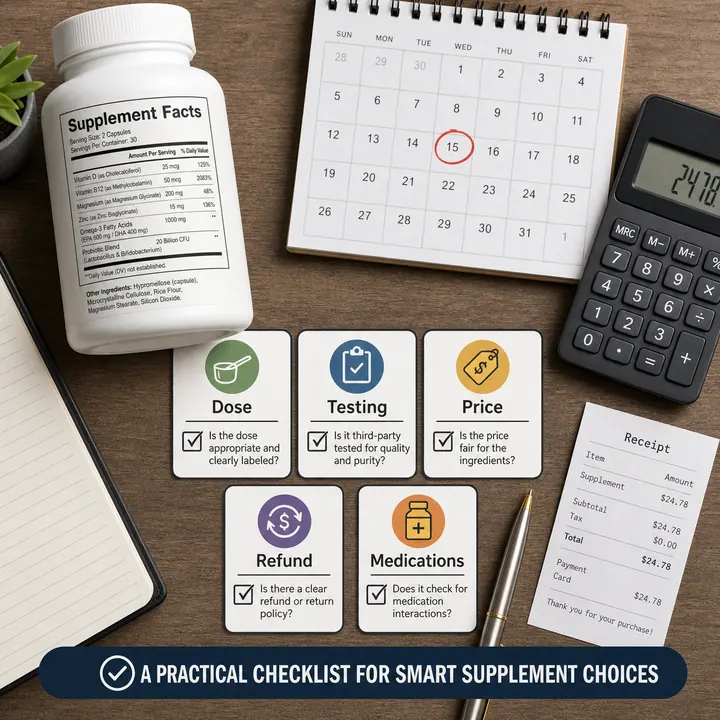
The best mitochondrial supplement comparison is not only about ingredients. It also includes dose clarity, testing, serving cost, refund terms, medication questions, and the honesty of the claims. A product with a polished sales page can still be a poor fit if the label is unclear, the price per serving is hard to verify, or the claims imply more certainty than the evidence supports.
Check these before ordering
- Full Supplement Facts panel: ingredient forms, serving size, dose, and proprietary blend details.
- Third-party testing: certificate of analysis, contaminant testing, or quality documentation when available.
- Price per serving: compare bottles, bundles, shipping, tax, subscription terms, and refund deadline.
- Claim language: avoid products that imply they cure fatigue, repair disease, reverse aging, or replace medical care.
- Medication and condition fit: ask a clinician or pharmacist when prescriptions, surgery, pregnancy, chronic disease, cancer history, kidney or liver disease, or unexplained fatigue are involved.
- Self-observation plan: track sleep, energy, digestion, mood, exercise tolerance, and side effects without adding multiple new products at once.
Red flags in mitochondrial supplement marketing
| Red flag | Why it matters |
|---|---|
| Claims to repair mitochondria or cure fatigue. | Dietary supplements should not be presented as disease treatments. |
| No clear Supplement Facts panel before purchase. | You cannot evaluate dose, overlap, or safety fit without the label. |
| Only testimonials, no claim substantiation. | Reviews can be useful, but they do not prove typical results. |
| Pressure to buy a large bundle before you know tolerance. | Bundles can lower per-bottle cost but raise practical risk if the product is not a fit. |
| Dismisses medication or health-condition questions. | Broad supplement stacks deserve more caution, not less. |
Our cautious ranking logic
We do not rank mitochondrial supplements by the loudest promise. We rank the category by how a careful adult buyer can make a lower-risk decision. That means a transparent single-ingredient product can rank well for simplicity, while a broad formula can rank well for convenience only when the label, safety cautions, and refund terms are clear enough to evaluate.
How we would compare products in this category
| Criterion | What good looks like |
|---|---|
| Ingredient clarity | Each active ingredient and amount is easy to find before checkout. |
| Evidence honesty | The seller separates ingredient research from finished-formula proof and avoids disease claims. |
| Safety fit | Medication, condition, pregnancy, surgery, and unexplained-fatigue cautions are easy to find. |
| Value | Price per serving, bundle terms, shipping, subscription status, and refund deadline are clear. |
| Use-case fit | The product explains whether it is a simple single ingredient, NAD booster, antioxidant, mineral, or broad stack. |
Under that framework, Advanced Mitochondrial Formula belongs on the broad-stack shortlist, not because every buyer needs it, but because it combines several ingredient categories that people otherwise compare separately. CoQ10 belongs on the simple-trial shortlist. NAD boosters belong in a related but separate comparison because NAD, NMN, NR, and B3 questions are not the same as a full mitochondrial formula decision.
Bottom line: choose by fit, not by the biggest mitochondrial promise
For most careful buyers, the best mitochondrial supplement decision starts with the smallest honest question. Do you want a simple ingredient trial? Compare CoQ10, acetyl-L-carnitine, or another focused option. Do you want a broader mitochondrial-support stack? Compare Advanced Mitochondrial Formula and similar formulas by ingredient clarity, safety fit, price, and refund terms.
If fatigue is new, severe, persistent, or paired with red flags, the best next step is medical evaluation, not a supplement cart. If you are comparing wellness products after that context is clear, use the label, evidence level, and buyer checklist above to keep the decision practical.
Frequently asked questions
What is the best mitochondrial supplement overall?
There is no single best mitochondrial supplement for everyone. A simple single ingredient like CoQ10 may be easier to evaluate, while a broad formula such as Advanced Mitochondrial Formula may appeal to buyers who want several mitochondrial-support ingredients in one product. The best choice depends on your goals, medications, health history, budget, and comfort with a multi-ingredient stack.
Do mitochondrial supplements really increase energy?
Some ingredients are involved in normal cellular energy metabolism, and some have been studied in specific contexts. That does not mean every mitochondrial supplement will noticeably increase energy for every buyer. New, severe, persistent, or unexplained fatigue should be discussed with a healthcare professional before buying supplements.
Is Advanced Mitochondrial Formula a NAD supplement?
Advanced Mitochondrial Formula is better described as a broad mitochondrial support formula. It includes niacinamide, a vitamin B3 form connected to NAD-related metabolism, but it is not the same thing as a standalone NAD, NMN, or NR supplement.
Are CoQ10 and PQQ enough for mitochondrial support?
CoQ10 and PQQ are two common ingredients in mitochondrial-support discussions, but enough depends on the buyer's goal and context. Some people prefer a focused single-ingredient or two-ingredient comparison, while others prefer a broader formula. Either way, safety, dose transparency, and claim quality matter.
Who should ask a clinician before taking mitochondrial supplements?
Ask a clinician or pharmacist first if you take prescription medication, use blood thinners, have diabetes or blood pressure concerns, have kidney or liver disease, have a cancer history, are pregnant or breastfeeding, have surgery scheduled, or have new, severe, persistent, or unexplained fatigue.