
Contents
- Quick answer: start with the reason for low energy, not the most dramatic label
- Before buying, check whether the problem is really a supplement problem
- Build an energy baseline before adding another bottle
- What common energy-support supplement categories can and cannot tell you
- Read the label before you read the testimonials
- Match the supplement approach to the decision you are actually making
- Where Advanced Mitochondrial Formula fits in this comparison
- Safety questions deserve more weight than a promise of extra energy
- A simple process for testing an energy supplement responsibly
- Bottom line: choose a defined goal, a readable label, and realistic expectations
-
Frequently asked questions
- What are the best supplements for energy after 40?
- Can a mitochondrial supplement fix persistent fatigue?
- Are B vitamins or niacinamide guaranteed to increase energy?
- Are NAD, NMN, and NR the same kind of supplement?
- Is Advanced Mitochondrial Formula an energy supplement for adults over 40?
- How long should I try an energy supplement?
Quick answer: start with the reason for low energy, not the most dramatic label
The best supplements for energy after 40 are not one universal product. The sensible choice depends on why energy feels lower, what your diet and routine already cover, which ingredient category you are considering, and whether the product label gives you enough information to judge it. For a generally healthy adult, a supplement can be one small part of an energy-support plan. It should not be used to diagnose, treat, cure, or prevent a medical condition.
A practical order is: check for new or unexplained fatigue, tighten the basics of sleep, food, hydration, and movement, then compare one supplement category at a time. This keeps a bold claim about cellular energy in proportion to what the product and the evidence can actually show.
A useful shortlist before you buy
- Start with a single, defined goal such as correcting a documented nutrient gap, supporting a training routine, or comparing mitochondrial-support ingredients for general wellness.
- Treat NAD, NMN, NR, B vitamins, CoQ10, PQQ, D-ribose, and broad formulas as different categories rather than interchangeable energy pills.
- Prefer a fully disclosed Supplement Facts panel, a clear serving size, batch or quality information, and a realistic cost per serving.
- Ask a healthcare professional or pharmacist first if fatigue is new, severe, persistent, unexplained, or occurring alongside medication use or a chronic condition.
- Affiliate disclosure: MitoEnergy Reviews may earn a commission if you buy through some links in this article. That does not change the safety cautions or the need to verify current product information.
What shoppers usually mean by an energy supplement
| Category | What it is trying to support | What to verify |
|---|---|---|
| B vitamins or niacinamide | Normal energy metabolism and, in some products, NAD-related pathways. | The exact B3 form, amount, other sources of the same nutrient, and whether a deficiency is actually present. |
| CoQ10 or ubiquinol | Mitochondrial electron-transfer and antioxidant roles. | Form, amount, medication questions, and whether a single ingredient is preferable to a blend. |
| PQQ or acetyl-L-carnitine | Pathways commonly discussed in mitochondrial signaling or fuel transport. | How much is included, what human evidence applies, and whether the ingredient fits your health history. |
| NAD, NMN, or NR products | NAD-related metabolism and healthy-aging research. | The exact molecule, dose, testing, delivery claims, and the difference between a biomarker result and a felt outcome. |
| Broad mitochondrial formulas | Convenience across several cellular-energy, antioxidant, and nutrient pathways. | Ingredient overlap, proprietary blends, interactions, price, and whether a multi-ingredient trial is easy to evaluate. |
Before buying, check whether the problem is really a supplement problem
Feeling less energetic after 40 can reflect a crowded schedule, less regular movement, poor sleep, or a change in eating habits. It can also overlap with anemia, thyroid problems, sleep apnea, depression, infection, medication effects, menopause-related changes, or other health issues. Those possibilities cannot be sorted out by a supplement label.
A healthcare professional is the better first stop when fatigue is new, worsening, persistent, or out of proportion to your routine. Seek prompt medical care for urgent symptoms such as chest pain, trouble breathing, fainting, sudden weakness, confusion, or other symptoms that feel serious. A supplement trial should never delay an evaluation for a potentially important problem.
Questions worth answering before you shop
- When did the change in energy begin, and is it constant or tied to a particular time of day?
- Has sleep duration or quality changed, including snoring, frequent waking, or daytime sleepiness?
- Have meals, protein intake, hydration, alcohol, caffeine, or physical activity changed?
- Did a new prescription, over-the-counter medicine, or supplement appear before the change?
- What result would count as useful, and how would you notice it without relying on a vague promise to feel younger?
Build an energy baseline before adding another bottle
A short baseline makes supplement decisions more honest. For one or two weeks, note sleep, meals, hydration, movement, caffeine, alcohol, and the time your energy changes. You are not trying to create a perfect health score. You are looking for obvious gaps and a stable reference point so that a new product does not get credit for a routine change.

The foundations to check first
| Foundation | What to observe | Why it matters for supplement decisions |
|---|---|---|
| Sleep | Bedtime consistency, waking, snoring, and daytime sleepiness. | A supplement cannot compensate for an untreated sleep problem. |
| Food | Regular meals, enough protein, fruit and vegetables, and unplanned restriction. | A nutrient gap and a complicated stack are different problems. |
| Hydration | Fluid intake, heat, exercise, and alcohol patterns. | Dehydration can feel like low energy and can confuse a short supplement trial. |
| Movement | Walking, resistance exercise, and how recovery feels. | Physical activity supports function, but a new exercise plan can also change fatigue temporarily. |
| Medication review | New medicines, dose changes, and all current supplements. | Interactions and overlapping ingredients may matter more than a marketing claim. |
These basics are not a dismissal of supplements. They are the context that helps you decide whether you need a targeted nutrient, a clinician conversation, or simply a more sustainable routine.
What common energy-support supplement categories can and cannot tell you
The phrase cellular energy support sounds precise, but it can describe very different ingredients. Mitochondria convert fuel into usable energy inside cells, while a person's experience of energy also depends on sleep, mood, fitness, illness, medication, and daily demands. A pathway role is worth understanding, but it is not a guarantee of better stamina.
A cautious comparison of categories
| Ingredient category | Why it attracts attention | The evidence question |
|---|---|---|
| B vitamins and niacinamide | B vitamins participate in normal metabolism, and niacinamide is connected to NAD metabolism. | Is the product filling a real nutritional gap, or implying that more is automatically better? |
| CoQ10 | CoQ10 is involved in mitochondrial electron transfer and is available as ubiquinone or ubiquinol. | Does the exact form and outcome studied match the product and the buyer's reason for using it? |
| PQQ | PQQ is discussed in redox and mitochondrial-signaling research. | How much human evidence exists for the specific outcome, dose, and finished product? |
| Acetyl-L-carnitine | Carnitine compounds are related to fatty-acid transport into mitochondria. | Does the population studied resemble the buyer, and are medication or health-history cautions relevant? |
| D-ribose | D-ribose is connected to nucleotide and ATP biology. | Do small studies or mechanistic explanations justify the product's broader energy promise? |
| NAD, NMN, and NR | These products are marketed around NAD-related pathways and healthy aging. | Does a change in a measured NAD-related marker translate into a meaningful everyday outcome? |
The most responsible comparison is ingredient-specific. A study of one isolated ingredient does not prove that every combination product works the same way, and a change in a biomarker does not automatically prove improved energy, memory, mobility, or lifespan.
Read the label before you read the testimonials
A product can sound sophisticated and still be difficult to evaluate. Start with the Supplement Facts panel and work outward. The goal is not to find a label with the most ingredients. It is to find a product whose identity, amount, quality signals, price, and safety questions are clear enough for a fair decision.
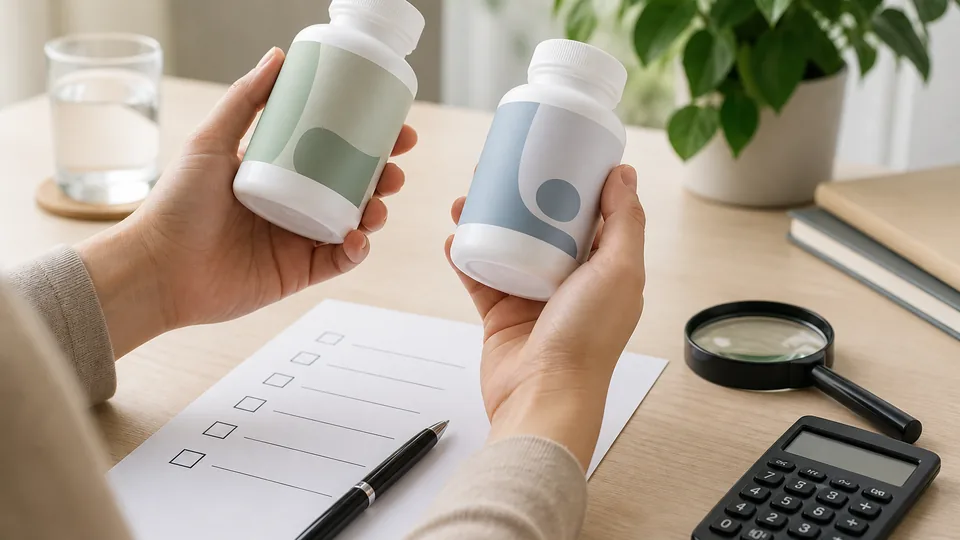
Seven label and offer checks
- Active identity: Is the ingredient named plainly, including the specific B3, carnitine, CoQ10, NAD-related, or botanical form?
- Amount per serving: Is the amount disclosed for each active, or hidden inside a proprietary blend?
- Serving instructions: Is the serving size clear, and does the number of capsules match the price comparison?
- Quality information: Can you find the manufacturer, lot information, testing language, storage guidance, and contact details?
- Overlap: Are you already taking another product with the same B vitamins, magnesium, antioxidants, stimulants, or absorption enhancer?
- Total cost: What is the price per serving after shipping, subscription terms, taxes, and bundle conditions?
- Exit plan: Is the return policy easy to locate, and are you buying more product than you can reasonably evaluate?
Third-party testing can be useful, but a vague badge is not the same as accessible, batch-specific information. Ask what was tested, by whom, and whether the result applies to the product in your hand.
Match the supplement approach to the decision you are actually making
Once the label is clear, decide whether you want a narrow experiment or a broad convenience formula. Neither is automatically superior. A single ingredient gives you fewer variables. A broad formula may reduce the number of bottles on the counter, but it also makes it harder to know what caused a benefit, side effect, or lack of change.
Which approach may fit which buyer question?
| Buyer question | Approach to compare | Main tradeoff |
|---|---|---|
| Do I need to correct a known nutrient gap? | A targeted nutrient chosen with food or clinician context. | More focused, but unnecessary if the gap is only assumed. |
| Am I specifically comparing NAD-related products? | Direct NAD, NMN, NR, or a B3-related option with a transparent label. | The category names are not interchangeable, and evidence may be biomarker-focused. |
| Do I want a mitochondrial ingredient with fewer variables? | A single ingredient such as CoQ10, when appropriate for the buyer. | Simpler to track, but it does not cover every pathway in a broad formula. |
| Do I prefer one product with several commonly discussed ingredients? | A broad mitochondrial-support formula. | Convenient, but overlap, interactions, and personal fit are harder to isolate. |
| Am I looking for an immediate stimulant effect? | A caffeine or stimulant product is a different decision from mitochondrial support. | Short-term alertness is not proof of improved cellular energy or healthy aging. |
This distinction helps prevent a common mismatch: using a broad mitochondrial formula when you want a precise answer about one nutrient, or using a stimulant when your real concern is persistent fatigue that deserves evaluation.
Where Advanced Mitochondrial Formula fits in this comparison
Advanced Mitochondrial Formula is best understood as a broad mitochondrial-support supplement, not as a pure NAD, NMN, or NR product. The offer is positioned around a combination of ingredients discussed in cellular energy, antioxidant, NAD-related, and nutrient-absorption contexts. That may appeal to an adult who prefers one combined product instead of assembling several separate bottles.
The tradeoff is the same one that applies to most multi-ingredient formulas: a longer ingredient list can make the product convenient, but it can also make dose control, overlap checks, and personal cause-and-effect harder. The sales page's package prices, serving directions, and guarantee terms can change, so verify the current label and checkout details before ordering.
It may be worth comparing if
- You are a generally healthy adult comparing broad mitochondrial-support products for a wellness routine.
- You prefer a combined formula that includes several commonly discussed energy-related ingredients.
- You are comfortable checking the full ingredient list and asking a clinician or pharmacist about possible interactions.
- You want to compare convenience and package value rather than chase a guaranteed result.
It is not a good shortcut if
- You need an explanation for new, severe, persistent, or unexplained fatigue.
- You want a pure NAD, NMN, NR, CoQ10, or other single-ingredient product with tight dose control.
- You are taking multiple medicines, preparing for surgery, pregnant or breastfeeding, or managing a complex condition without professional guidance.
- You are expecting a guaranteed change in energy, memory, mobility, aging, or disease risk.
Safety questions deserve more weight than a promise of extra energy
Natural does not mean risk-free, and a blend can contain several ingredients with separate cautions. Keep a current list of prescriptions, over-the-counter medicines, and supplements. A pharmacist can often help identify duplicate nutrients or possible interactions, while a clinician can help decide whether fatigue needs evaluation before any experiment.
Pause and ask a professional first if you
- Have new, severe, persistent, or unexplained fatigue or a diagnosed condition affecting energy.
- Are pregnant, breastfeeding, preparing for surgery, or recovering from a procedure.
- Take prescription medicines, especially when the product includes multiple botanicals, minerals, antioxidants, or absorption enhancers.
- Have kidney or liver disease, a cancer history or active treatment, bleeding concerns, blood-sugar concerns, or a previous reaction to a listed ingredient.
- Are considering several overlapping NAD, B-vitamin, stimulant, mitochondrial, or antioxidant products at the same time.
If a product causes a new or concerning symptom, stop and seek appropriate advice rather than adding another supplement to counter it. Keep the bottle and label available so a clinician or pharmacist can review the exact ingredients and serving instructions.
A simple process for testing an energy supplement responsibly
If the label fits your situation and a professional has not raised a concern, keep the trial measurable and modest. The goal is to learn whether the product fits your routine, not to prove a marketing story.
Use this five-step comparison process
- Write down the specific reason you are considering the product and the outcome you would realistically notice.
- Record the current label, serving instructions, price, seller, lot information, and return terms before ordering.
- Change one major supplement variable at a time whenever practical, so the result is easier to interpret.
- Track sleep, energy timing, exercise recovery, digestion, and any unwanted symptoms using the same short daily notes.
- Review the result honestly. No clear benefit, an unwanted effect, or a worsening underlying symptom is a reason to pause rather than keep buying.
Do not extend a trial simply because a product was expensive, and do not treat a money-back guarantee as evidence that the supplement works. A guarantee is a purchase policy; it is not a clinical outcome.
Bottom line: choose a defined goal, a readable label, and realistic expectations
For adults over 40, the best energy-support decision often starts outside the supplement aisle. Check sleep, food, hydration, movement, medication changes, and the possibility of a health problem first. Then compare ingredients by their actual role, the evidence for the specific outcome, safety context, dose transparency, and total cost.
A targeted ingredient may make sense when you have a clear reason and want fewer variables. A broad mitochondrial formula may make sense when convenience is the priority and the full label fits your situation. Neither approach guarantees more energy, reverses aging, or replaces medical care.
Frequently asked questions
What are the best supplements for energy after 40?
There is no universal best supplement for energy after 40. The better choice depends on the reason for low energy, diet and routine, the exact ingredient and amount, safety context, and the outcome supported by evidence. Common categories include B vitamins, CoQ10, PQQ, acetyl-L-carnitine, D-ribose, NAD-related products, and broad mitochondrial formulas, but they are not interchangeable.
Can a mitochondrial supplement fix persistent fatigue?
A mitochondrial supplement should not be treated as a fix for persistent fatigue. Fatigue can have many causes, including sleep problems, medication effects, anemia, thyroid issues, depression, infection, and other health conditions. New, severe, worsening, or unexplained fatigue deserves professional evaluation.
Are B vitamins or niacinamide guaranteed to increase energy?
No. B vitamins support normal biological processes, and correcting a documented deficiency may be useful, but taking more is not automatically better. Niacinamide is a form of vitamin B3 connected to NAD metabolism, not a guarantee of a noticeable energy change.
Are NAD, NMN, and NR the same kind of supplement?
No. Direct NAD products, NMN, NR, niacin, niacinamide, and broad blends represent different ingredients or strategies. Compare the exact Supplement Facts panel, amount, testing, evidence, and safety context instead of treating the names as interchangeable.
Is Advanced Mitochondrial Formula an energy supplement for adults over 40?
It is positioned as a broad mitochondrial-support formula that combines several ingredients discussed in cellular energy, antioxidant, NAD-related, and healthy-aging contexts. It may suit someone comparing a combined formula, but it is not a guaranteed energy treatment and should be checked against the current label, price, guarantee, and personal health situation.
How long should I try an energy supplement?
There is no universal trial length that proves a supplement works. Follow the current label and professional advice, track a defined outcome, and stop to seek help if symptoms are concerning. Do not use a long supplement trial to postpone evaluation of persistent or worsening fatigue.