Contents
- Quick answer: a cancer-risk claim cannot be inferred from NAD biology alone
- Why NAD and cancer appear together in research headlines
- What human NAD supplement studies can and cannot show
- Active cancer treatment and survivorship change the decision
- Start with the label: NAD is a category, not a complete ingredient description
- Where a broad mitochondrial formula fits after the safety questions
- Bottom line: use the care plan, not a pathway headline, to answer a cancer question
-
Frequently asked questions
- Can NAD supplements cause cancer?
- Could raising NAD help a tumor grow?
- Can someone with cancer take NMN, NR, or another NAD supplement?
- Is niacinamide the same as NAD or NMN for cancer-risk questions?
- Does a short human trial prove an NAD supplement is safe for cancer survivors?
- What should I bring to a supplement appointment?
Quick answer: a cancer-risk claim cannot be inferred from NAD biology alone
There is no good human evidence showing that an ordinary over-the-counter NAD-related supplement causes cancer, and there is no reliable evidence that taking one prevents or treats cancer. That is a statement about what current evidence can establish, not a guarantee that every product, dose, combination, or long-term use is risk-free. Products sold as NAD supplements may contain direct NAD+, NADH, NMN, NR, niacinamide, niacin, or a broad blend, so the safety question starts with the exact label.
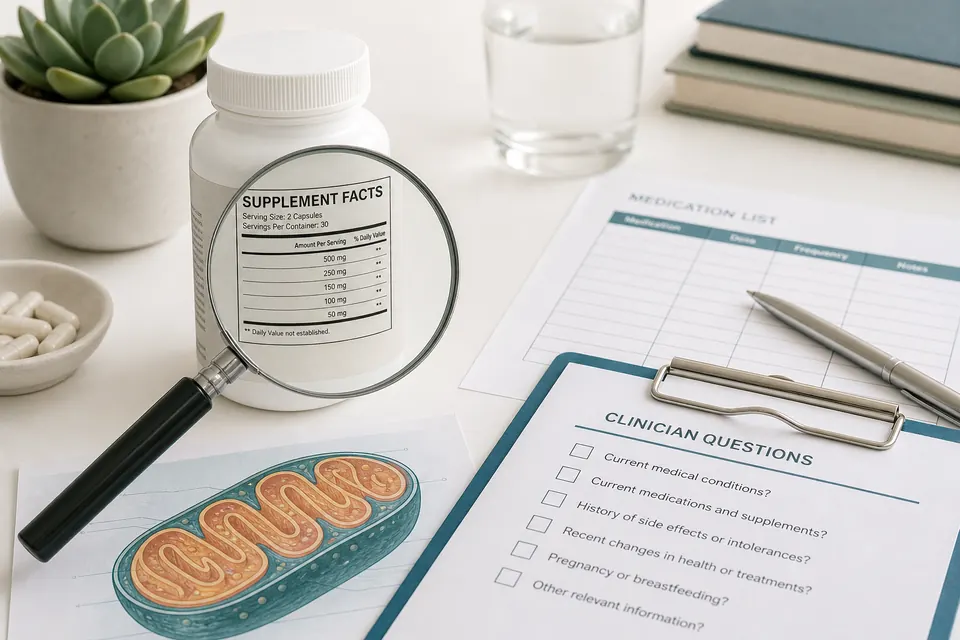
NAD metabolism is actively studied in cancer biology because cells need redox and energy pathways, and tumors can change how they use nutrients. Cell, animal, and drug-development findings can raise a reasonable research question without proving that a consumer supplement changes cancer risk in people. Anyone with active cancer, a cancer history, ongoing treatment, or unexplained symptoms should take the actual Supplement Facts panel to the oncology or primary-care team before starting, stopping, or combining products.
Keep these answers separate
- Cancer biology question: NAD pathways may be relevant to some tumors and are being studied in laboratories and clinical research.
- Supplement safety question: a pathway finding does not establish that an oral NAD, NMN, NR, or niacinamide product causes cancer in consumers.
- Treatment question: an NAD-related supplement is not a cancer treatment and should not replace oncology care.
- Personal decision question: the ingredient form, amount, other actives, medicines, diagnosis, and treatment plan determine whether a clinician review is needed.
What the headline question really contains
| Question | What can be said carefully |
|---|---|
| Can NAD supplements cause cancer? | A class-wide causal link has not been established in human supplement research. That is not proof of zero risk for every formula or situation. |
| Could NAD metabolism matter in cancer? | Yes, NAD pathways are studied in tumor metabolism and treatment research, but this does not translate into a consumer dose or outcome. |
| Can a supplement prevent or treat cancer? | No. Do not use a supplement as a substitute for screening, diagnosis, surgery, radiation, systemic therapy, or follow-up care. |
| What should a person with cancer do? | Ask the treating team to review the full label, timing, dose, and possible overlap before making a change. |
Why NAD and cancer appear together in research headlines
NAD+ is a coenzyme involved in redox reactions, energy metabolism, and repair-related enzyme systems. Cancer cells can reprogram metabolism as they grow, and researchers study whether changing NAD-producing or NAD-consuming enzymes affects tumor survival, immune response, or sensitivity to a treatment. Those studies often examine a specific enzyme, inhibitor, tumor model, or laboratory condition rather than a retail supplement taken by a person.
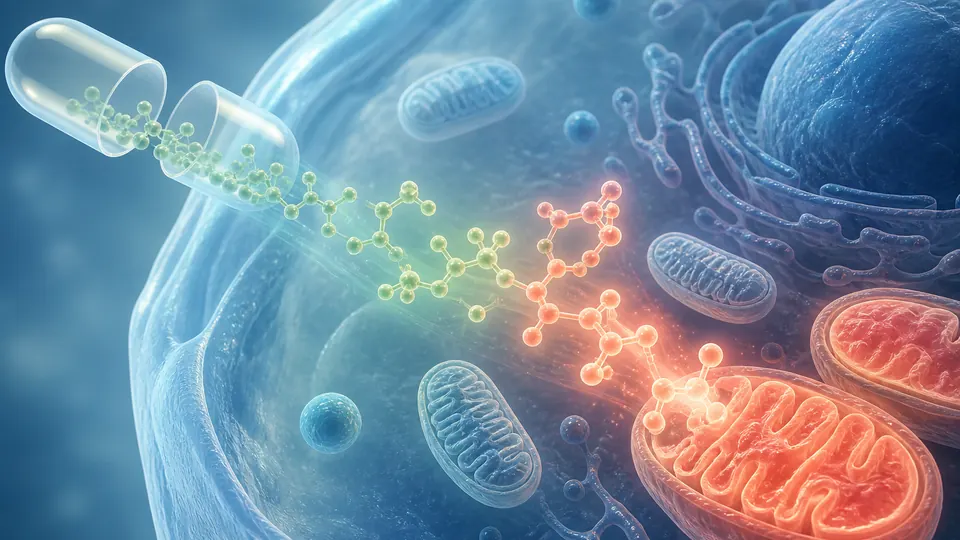
The same pathway can also be described too loosely in marketing. A compound may be involved in a cellular process, a study may measure a biomarker, and an advertisement may promise protection or more energy. Those are three different claims. The cancer-risk question needs human safety and outcome evidence for the actual ingredient, amount, duration, and population, not only a plausible mechanism.
Evidence level and the inference it permits
| Evidence source | Reasonable conclusion | Conclusion it cannot support alone |
|---|---|---|
| Cell or biochemical study | A pathway or target may deserve further research. | That a capsule causes or prevents cancer in people. |
| Animal tumor model | A defined intervention may affect a tumor model under controlled conditions. | That the same dose, exposure, and effect applies to a human supplement buyer. |
| Cancer drug or enzyme-inhibitor trial | A selected treatment strategy can be tested in a defined clinical setting. | That a wellness supplement is an equivalent cancer therapy or risk modifier. |
| Short NAD precursor supplement trial | Researchers can assess a stated dose, biomarker, and short-term tolerability in a selected group. | Long-term cancer incidence or safety for every product and medical condition. |
What human NAD supplement studies can and cannot show
Human studies of NAD-boosting compounds are useful because they measure real participants, defined products, and stated outcomes. They are also varied. A 2023 review found differences in ingredient, dose, route, population, duration, and endpoint across the literature. Some trials report changes in NAD-related blood or tissue measures, while others examine exercise, metabolic, or functional outcomes. None of those designs automatically answers whether a particular retail supplement changes a person's lifetime cancer risk.
The limits matter especially for cancer questions. Cancer can take years to develop, and a small four-week or twelve-week tolerance study is not designed to detect a rare or delayed outcome. A study in healthy adults may also exclude people receiving chemotherapy, immunotherapy, hormone therapy, or other medicines. A lack of a signal in a short trial is reassuring only within that narrow design; it is not a universal safety certificate.
How to read a human study without overextending it
| Study detail | Why it matters for a buyer | What remains unknown |
|---|---|---|
| Exact active ingredient | NMN, NR, niacinamide, direct NAD+, and NADH are not interchangeable exposures. | Whether the result applies to a different form or blend. |
| Dose and duration | The amount and time frame define what was actually tested. | Whether a higher amount or years of use has the same profile. |
| Participants | Age, health, medicines, and exclusion criteria shape the result. | Whether it applies to active cancer, survivors, or complex treatment. |
| Measured endpoint | A biomarker, symptom score, or performance test answers a specific question. | Whether it predicts cancer prevention, progression, or survival. |
A study result is not a product verdict
- A change in NAD-related biomarkers does not prove a change in cancer incidence.
- A short tolerability finding does not establish lifetime safety or safety during treatment.
- A result for an isolated precursor does not validate a proprietary blend with additional botanicals, vitamins, or minerals.
- A customer testimonial cannot separate a supplement effect from treatment, illness, sleep, diet, or normal symptom variation.
Active cancer treatment and survivorship change the decision
If you are receiving cancer treatment, the question is not simply whether NAD is good or bad. Your oncology team may be balancing treatment effectiveness, organ function, nutrition, symptoms, clinical-trial rules, and interactions with medicines or procedures. A supplement can contain several actives that are relevant to that plan even when the front label highlights only NAD, cellular energy, or healthy aging.

Situations that call for a clinician-first answer
| Situation | Why self-starting is a poor shortcut |
|---|---|
| Active chemotherapy, radiation, immunotherapy, targeted therapy, or hormone therapy | The care team needs the full ingredient list and timing to judge treatment, monitoring, and interaction questions. |
| A history of cancer or current survivorship care | Long-term prevention and recurrence questions need individualized medical guidance, not a supplement promise. |
| A new lump, unexplained weight loss, bleeding, persistent pain, or worsening fatigue | A supplement should not delay evaluation of a possible medical problem. |
| Several prescriptions, liver or kidney disease, or an upcoming procedure | Added vitamins, botanicals, and minerals may change the safety review even if the NAD-related ingredient is familiar. |
Questions to take to the oncology or pharmacy team
- Does this exact product fit my diagnosis, treatment plan, laboratory results, and current medicines?
- Should I avoid it during a treatment cycle, around a procedure, or until a specific test is complete?
- Which ingredient or dose is the main concern, and what symptom or measurement should I monitor?
- If I already started it, should I stop, taper, or simply bring the bottle for review?
- Is there a food, sleep, movement, or prescribed treatment priority that should come before a supplement?
Start with the label: NAD is a category, not a complete ingredient description
A cancer-risk discussion becomes less useful when every product is treated as the same. Direct NAD+, NADH, NMN, NR, niacinamide, and nicotinic acid have different names, forms, evidence, and dose questions. A proprietary blend may add botanicals, minerals, antioxidants, or stimulatory ingredients that create the more immediate interaction concern. Check the complete Supplement Facts panel and other-ingredients list before trying to interpret a study or review.
Label questions that prevent category confusion
| Check | Why it matters |
|---|---|
| Exact active form | NAD+, NADH, NMN, NR, niacinamide, and nicotinic acid are related to NAD metabolism but are not synonyms. |
| Amount per serving and daily directions | A study dose cannot be compared with a label that hides the amount in a blend or changes the serving size. |
| All added actives | Botanicals, minerals, vitamins, and absorption enhancers may be more relevant to a medicine or treatment interaction than the headline ingredient. |
| Testing and traceability | Lot information and meaningful testing can support identity and quality checks, but they do not prove cancer prevention or treatment. |
| Seller terms and current warnings | Directions, contraindications, storage, price, and refund terms can change and should be checked on the current product page. |
Pause when the label leaves key facts unclear
- The active form is described only as an NAD complex or proprietary blend.
- The product uses a large claim about cancer, immunity, longevity, or cellular repair without a matching human study.
- The amount per daily serving, manufacturer, lot information, or other active ingredients are difficult to verify.
- You would need to hide the supplement from your care team or use it instead of a recommended evaluation.
The NIH and FDA explain that dietary supplements are not approved in advance like prescription medicines for safety and effectiveness. That does not make every supplement harmful; it means the buyer and clinician need to inspect the actual product rather than treating a legal label, rating, guarantee, or influencer claim as proof of an outcome.
Where a broad mitochondrial formula fits after the safety questions
Advanced Mitochondrial Formula should not be treated as a pure NAD product or as a cancer-risk solution. The seller positions it as a broader mitochondrial-support formula that includes niacinamide alongside ingredients such as D-ribose, PQQ, CoQ10, acetyl-L-carnitine, plant compounds, and minerals. That wider scope may be relevant to a buyer comparing one combined formula with several single-ingredient products, but it also makes the full label and treatment context more important.
For anyone with active cancer, a cancer history, ongoing treatment, or unexplained symptoms, the independent product review belongs after a clinician conversation, not before it. The review can help translate the commercial offer into ingredient, price, guarantee, and buyer-fit questions; it cannot establish that the formula prevents cancer, supports treatment, or is appropriate for a particular diagnosis.
For readers who have cleared the general supplement question with a qualified professional, use the current Supplement Facts panel and the current seller terms when comparing any broad formula. Do not add separate NAD, NMN, NR, niacinamide, or antioxidant products casually because overlapping ingredients can change the total exposure and the interaction review.
Bottom line: use the care plan, not a pathway headline, to answer a cancer question
NAD biology is relevant to cancer research, but research relevance is not the same as proof that an NAD supplement causes cancer, prevents cancer, or treats cancer. Current human supplement studies are generally too narrow and too short to answer lifetime cancer-risk questions across every ingredient, dose, blend, and medical condition.
If cancer is part of your medical history or current care, show the complete label to your oncology team or pharmacist and follow the treatment plan they set. If symptoms are new, severe, persistent, or unexplained, seek an evaluation before trying to solve them with a supplement.
Frequently asked questions
Can NAD supplements cause cancer?
A class-wide causal link has not been established in human supplement research. That does not prove every dose, blend, or long-term use is risk-free, and it does not make an NAD-related supplement a cancer-prevention or cancer-treatment product.
Could raising NAD help a tumor grow?
NAD pathways are studied in tumor metabolism and treatment research, including laboratory and animal models. Those findings raise research questions but cannot tell a consumer whether an oral NAD, NMN, NR, or niacinamide product changes tumor growth or cancer risk.
Can someone with cancer take NMN, NR, or another NAD supplement?
The person should ask the oncology team or a pharmacist who can review the exact product, dose, treatment schedule, medicines, and medical history. Do not self-start, stop, or replace cancer treatment based on a supplement article.
Is niacinamide the same as NAD or NMN for cancer-risk questions?
No. Niacinamide is a vitamin B3 form involved in NAD metabolism, while NMN is a precursor and direct NAD products list a different active. They have different labels, doses, evidence, and safety questions.
Does a short human trial prove an NAD supplement is safe for cancer survivors?
No. Short trials in selected participants can provide limited tolerability information, but they are not designed to establish long-term cancer incidence or safety during complex treatment and survivorship care.
What should I bring to a supplement appointment?
Bring the bottle or clear label photos, Supplement Facts and other ingredients, serving directions, lot information, every prescription and over-the-counter medicine, other supplements, treatment dates, and the symptom or goal you want to discuss.
Sources and further reading
- National Cancer Institute: Risk Factors for Cancer
- NCCIH: Using Dietary Supplements Wisely
- FDA: FDA 101 - Dietary Supplements
- NIH Office of Dietary Supplements: Dietary Supplements - What You Need to Know
- Nutrients: Dietary Supplementation With NAD+-Boosting Compounds in Humans
- Frontiers in Oncology: NAD Metabolism in Cancer Therapeutics
- Frontiers in Immunology: Targeting NAD+ Metabolism - Dual Roles in Cancer Treatment
- National Cancer Institute: Complementary and Alternative Medicine