Contents
- The short answer: an NAD supplement is a category, not one ingredient
- What NAD+ does inside a cell
- The main forms you will see on an NAD supplement label
- How do NAD supplements work? The route depends on the ingredient
- What human research can and cannot show
- How to read an NAD supplement label before buying
- Safety first: when an NAD supplement should wait
- Where a broad mitochondrial formula fits
- Bottom line: define the ingredient before you compare the promise
- Frequently asked questions
The short answer: an NAD supplement is a category, not one ingredient
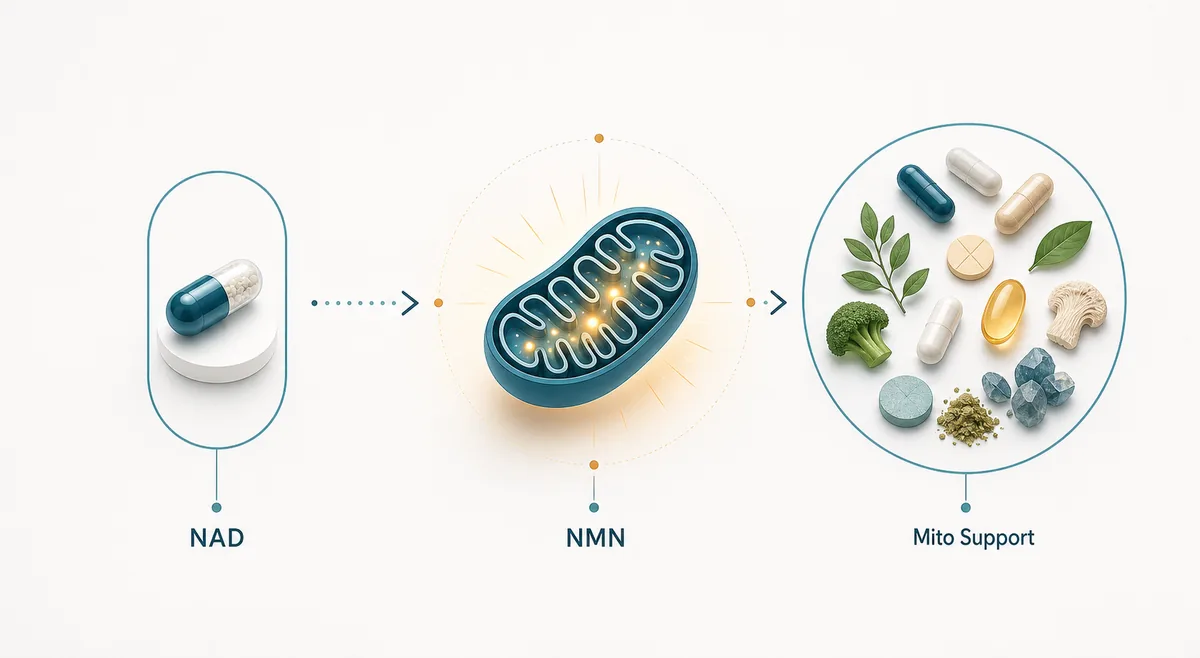
An NAD supplement is a dietary supplement marketed to support NAD-related metabolism. The phrase can describe a direct NAD+ or NADH product, a precursor such as NMN or NR, a vitamin B3 form such as niacinamide, or a broader blend that uses NAD-support language alongside mitochondrial ingredients. Those products are not interchangeable, even when their front labels all promise cellular energy or healthy aging support.
NAD+ is a coenzyme involved in redox reactions and cellular metabolism. It is not caffeine, and an NAD-related supplement should not be treated as an instant energy drink or as a treatment for fatigue. The useful first question is not which name sounds most advanced. It is what the Supplement Facts panel actually contains, how much it contains, and what evidence exists for that specific form and finished product.
Start here if you are comparing products
- Identify the active ingredient: direct NAD+, NADH, NMN, NR, niacin, niacinamide, or a multi-ingredient blend.
- Separate pathway biology from a promised result. A product can affect an NAD-related biomarker without proving noticeable energy, longevity, or disease-related benefits.
- Compare the disclosed amount, serving size, testing, delivery claims, total price, and other active ingredients before reading testimonials.
- Ask a qualified healthcare professional first if you have new or persistent symptoms, take prescription medicines, are pregnant or breastfeeding, have a chronic condition, or are preparing for surgery.
Translate the label before judging the claim
| What the product says | What it may mean | First question to ask |
|---|---|---|
| NAD+ or NADH | The product is positioned around a finished NAD-related molecule. | How are the route, stability, amount, and finished-product evidence supported? |
| NMN or NR | A precursor approach that is intended to support the body's NAD-related pathways. | Is the exact dose, identity, purity, and batch testing clear? |
| Niacin or niacinamide | A vitamin B3 form that connects to NAD metabolism but has its own dosing and safety context. | Which B3 form is present, and are other B3 products being used at the same time? |
| NAD booster or cellular energy blend | A marketing category that may combine several vitamins, botanicals, precursors, or mitochondrial ingredients. | Can every active ingredient and amount be reviewed separately? |
What NAD+ does inside a cell
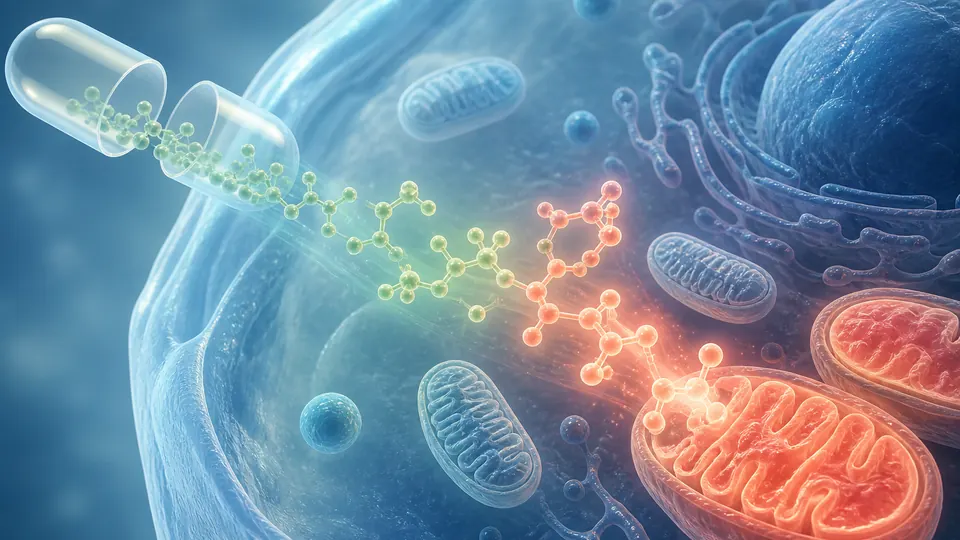
Nicotinamide adenine dinucleotide, usually shortened to NAD, exists in related oxidized and reduced forms. NAD+ can accept electrons during metabolic reactions and NADH can carry those electrons onward. This cycling is part of how cells process fuels and manage redox balance. NAD-related biology also intersects with enzymes involved in cellular maintenance, but a complicated pathway is not the same as proof that taking a particular capsule will produce a noticeable outcome.
What the biology does not tell you
- It does not tell you whether a direct NAD+ capsule, an NMN powder, an NR capsule, or a B3 supplement is the best fit for a particular person.
- It does not prove that changing a blood or tissue biomarker will translate into better stamina, memory, mobility, or lifespan.
- It does not make a multi-ingredient blend equivalent to a single-ingredient NAD precursor.
- It does not replace evaluation of new, severe, unexplained, or persistent fatigue.
The main forms you will see on an NAD supplement label
Search results often place direct NAD products, NAD precursors, B3 vitamins, liposomal liquids, patches, and broad mitochondrial formulas next to one another. Treat that as a shopping convenience, not as proof that the categories have the same absorption, evidence, or safety profile. The ingredient line is more informative than the word NAD on the bottle front.
NAD-related ingredients in plain English
| Form | What it is | What a careful buyer should not assume |
|---|---|---|
| NAD+ | The oxidized form of a coenzyme used in cellular metabolism. | A label name alone does not establish oral delivery, stability, or a meaningful real-world result. |
| NADH | A reduced form of the same coenzyme family. | Evidence for NADH should not be copied automatically to NAD+, NMN, or NR. |
| NMN | Nicotinamide mononucleotide, commonly marketed as an NAD+ precursor. | A change in NAD-related biology is not the same as a guaranteed anti-aging or energy outcome. |
| NR | Nicotinamide riboside, another NAD+ precursor with its own human research. | NR dose, testing, and finished-product evidence still need to be checked product by product. |
| Niacin or nicotinic acid | A vitamin B3 form that can contribute to NAD-related metabolism. | It is not the same as niacinamide, and flushing or other dose-related effects deserve attention. |
| Niacinamide | Nicotinamide, a non-flushing B3 form used in nutrition and some supplement formulas. | It is not interchangeable with NMN, NR, or direct NAD, and total B3 intake still matters. |
| Broad mitochondrial formula | A blend that may include B3-related nutrients plus CoQ10, PQQ, carnitine, minerals, or antioxidants. | More ingredients create more variables, overlap, and interaction questions. |
How do NAD supplements work? The route depends on the ingredient
The phrase how NAD supplements work hides an important distinction. A direct product is trying to provide a finished molecule. NMN and NR are trying to provide precursors that the body can process. Niacin and niacinamide are nutritional B3 forms that feed into related pathways. A blend may combine several routes, which can be convenient but makes it harder to know which ingredient explains a benefit or an unwanted effect.
Different routes create different evidence questions
| Approach | The claim being evaluated | What to verify |
|---|---|---|
| Direct NAD or NADH | The finished compound is supplied in the chosen format. | Route, stability, amount, absorption data, and evidence for the exact product. |
| NMN or NR precursor | The body can use the ingredient in NAD-related metabolism. | Human data for the specific precursor, trial duration, dose, product quality, and outcome. |
| Niacin or niacinamide | A B3 nutrient contributes to NAD-related metabolism. | Total B3 intake, form-specific effects, nutritional need, and other supplements. |
| Multi-ingredient blend | Several ingredients may support overlapping cellular-energy or antioxidant goals. | Every active amount, interaction risk, testing, and whether the blend hides underdosed ingredients. |
This is why a consumer review should be specific about the product form. Evidence for an oral NR trial cannot prove that a liposomal NAD liquid works better, that an NAD patch delivers its full labeled amount, or that a broad formula produces the same result. Route-matched evidence is a higher bar than a shared keyword.
What human research can and cannot show
NAD-related research is worth reading, but the evidence is easier to overstate than to summarize. Cell and animal studies can explain why a pathway is interesting. Human studies can measure biomarkers, short-term tolerance, exercise outcomes, or a specific symptom in a defined group. None of those automatically validates every supplement sold under the NAD label.
Keep the evidence level attached to the claim
| Evidence level | What it can support | What it cannot prove by itself |
|---|---|---|
| Cell or animal mechanism research | A biological hypothesis worth testing. | That a human will feel more energetic or live longer after taking a product. |
| Human biomarker study | That a defined intervention changed a measured marker in a defined group. | That the marker change is clinically meaningful or applies to a different dose or product. |
| Short human tolerance study | How a studied group responded over a limited time window. | Long-term safety, all interactions, or safety for people excluded from the study. |
| Finished-product human trial | The strongest product-specific evidence when the design and population are relevant. | A universal result for every age, health condition, dose, and goal. |
A 2023 review of NAD+-boosting compounds in humans is useful background because it brings together varied trial designs, ingredients, doses, and endpoints. Read it as a map of what has been studied, not as a blanket endorsement of the entire category. For a purchase decision, the exact Supplement Facts panel and the quality of the seller's evidence still matter.
How to read an NAD supplement label before buying
A clear label cannot guarantee a useful result, but an unclear label makes a meaningful comparison almost impossible. Start with the Supplement Facts panel rather than the front-of-bottle slogan. The goal is to understand exactly what you would take each day and whether the product can be compared with the human evidence it cites.
A practical label checklist
- Write down the exact active form and amount per serving. NAD+, NADH, NMN, NR, niacin, and niacinamide are different entries.
- Check the serving size and suggested daily use. A large number on the front panel may not be the amount delivered per day.
- Look for a complete list of vitamins, botanicals, minerals, stimulants, absorption enhancers, and proprietary blends.
- Ask whether the seller provides current third-party identity or purity testing and whether a lot-specific certificate of analysis is available.
- Compare price per serving or per month, not only the bottle price or a temporary bundle discount.
- Treat liposomal, sublingual, enhanced, and bioavailable language as claims that need support, not as evidence by themselves.
- Save the current label, checkout total, return terms, and batch information in case the product or offer changes.
Small label details that change the decision
| Detail | Why it matters | A cautious interpretation |
|---|---|---|
| Proprietary blend | Individual amounts may be hidden. | You cannot assess dose, overlap, or value well without the amounts. |
| Multiple B3 forms | Total exposure can be higher than the product name suggests. | Add up all relevant products and ask a pharmacist if the total is unclear. |
| A delivery claim | Format language may imply better absorption. | Look for route-matched testing or human data rather than relying on the adjective. |
| A dramatic testimonial | Anecdotes describe individual experiences, not controlled comparisons. | Use the testimonial to form a question, never as proof of a typical result. |
Safety first: when an NAD supplement should wait
The safety question depends on the full formula, not just the word NAD. A product may include B3 forms, botanicals, minerals, antioxidants, or absorption enhancers that change the interaction review. Short studies in selected adults do not establish that every product is appropriate for people taking medication or managing a health condition.
Talk with a healthcare professional before starting if
- You have new, severe, persistent, or unexplained fatigue, weakness, shortness of breath, chest symptoms, unexplained weight change, or other symptoms that need evaluation.
- You take prescription medicines, multiple supplements, blood thinners, diabetes medicines, or medicines with a narrow safety margin.
- You are pregnant, breastfeeding, preparing for surgery, or managing kidney, liver, heart, cancer-related, or neurological concerns.
- You have reacted to niacin, niacinamide, NMN, NR, botanicals, or a previous multi-ingredient supplement.
- The product makes disease, age-reversal, guaranteed-energy, or cure-like claims that you are relying on to delay medical care.
Stop and seek urgent medical care for severe allergic symptoms, chest pain, fainting, trouble breathing, confusion, severe weakness, or uncontrolled bleeding. Do not stop a prescribed medicine on your own. For a fuller ingredient-by-ingredient discussion, see the NAD supplement side effects guide before comparing products.
Where a broad mitochondrial formula fits
Some readers start with an NAD search but discover that they are really comparing broader cellular-energy products. Advanced Mitochondrial Formula belongs in that second category. It is not a pure NAD, NMN, or NR supplement; it is positioned as a multi-ingredient mitochondrial-support formula. That distinction matters because convenience comes with more ingredients, more interactions to review, and less ability to isolate which ingredient explains a result.
Choose the comparison that matches your goal
| If you want to evaluate | Start with | Main tradeoff |
|---|---|---|
| One NAD-related precursor | A transparent NMN or NR label with product-specific testing. | A narrower strategy is easier to track but does not prove a better outcome. |
| A direct NAD or NADH product | The finished product's route, dose, stability, and evidence. | The name may be simple while the delivery question is not. |
| Several mitochondrial-support categories in one product | A complete broad-formula label, price, safety, and guarantee review. | Convenience can reduce control over dose and tolerance tracking. |
Commercial disclosure: this site may earn a commission if you buy Advanced Mitochondrial Formula through the link below, at no extra cost to you. The disclosure does not turn a broad mitochondrial formula into a pure NAD recommendation, and it does not change the evidence or safety limits described above. Use the link to verify the current offer and label only after deciding that the category fits your question.
Bottom line: define the ingredient before you compare the promise
An NAD supplement can mean direct NAD+, NADH, NMN, NR, niacin, niacinamide, or a broad blend. The strongest buying habit is to translate the marketing label into an exact ingredient list, then match the evidence and safety questions to that form. If the label, testing, price, or claim language is unclear, uncertainty is a reason to pause rather than a reason to buy a larger bundle.
For a focused comparison, continue with the NMN vs NAD and NR vs NMN guides. For a broader cellular-energy question, compare mitochondrial support ingredients and the full formula label. Either way, a supplement should complement appropriate medical care, not stand in for it.
Frequently asked questions
Is an NAD supplement the same as NMN?
No. NAD+ is the coenzyme named on some finished products, while NMN is a precursor commonly marketed to support NAD-related pathways. They have different labels, evidence questions, and product-quality checks.
Is an NAD+ supplement the same as NR?
No. NR, or nicotinamide riboside, is another NAD+ precursor. Evidence about NR should not automatically be applied to direct NAD+, NMN, niacinamide, or a multi-ingredient blend.
Will an NAD supplement give me energy like caffeine?
NAD-related supplements are not the same as stimulant drinks, and a cellular pathway explanation is not a promise of an immediate energy effect. New or persistent fatigue should be evaluated instead of self-treated with a supplement.
What should I look for in an NAD supplement?
Look for the exact active form, amount per serving, complete ingredient list, testing information, serving directions, price per serving, and realistic claims. Be cautious with proprietary blends and delivery claims that are not supported by route-matched evidence.
Can I take an NAD supplement if I use prescription medication?
Ask a prescriber or pharmacist before starting. The answer depends on the full formula, your medicines, your health history, and the reason you are considering the supplement. Do not stop a prescribed medicine on your own.
Sources and further reading
- Cleveland Clinic: NAD+ Supplements - Can They Really Slow Down Aging?
- Nutrients review: Dietary Supplementation With NAD+-Boosting Compounds in Humans
- NIH Office of Dietary Supplements: Dietary Supplements, What You Need to Know
- FDA: Structure/Function Claims
- FTC: Health Products Compliance Guidance