Contents
- The short answer: follow the exact label, not a universal NAD schedule
- First identify what the product actually contains
- Read the Supplement Facts panel before deciding when to take it
- When to take NAD: consistency usually matters more than the clock
- Food, water, and delivery format can change tolerability
- How much NAD should you take? Use the product label, not a borrowed study dose
- Medication and health checks come before the first dose
- If a clinician says it is reasonable, make the first trial easy to evaluate
- Where Advanced Mitochondrial Formula fits in a NAD question
- Bottom line: make the routine boring and the label specific
- Frequently asked questions
The short answer: follow the exact label, not a universal NAD schedule
There is no single, clinically established clock time or personal dose that applies to every NAD supplement. The phrase NAD supplement can describe direct NAD+, NADH, NMN, nicotinamide riboside (NR), niacinamide, nicotinic acid, or a multi-ingredient blend. Those are different exposures, so the safest starting point is to identify the active ingredient, read the complete label, and follow that product's directions rather than borrowing a routine from a different bottle.
For many adults, the practical goal is a routine that is easy to follow and easy to evaluate. Timing is usually a label and tolerability question, not proof that morning, night, an empty stomach, or a particular food creates a better NAD result. If you are considering a supplement because of new, severe, persistent, or unexplained fatigue, the health question should be evaluated before a supplement schedule.
A safer starting sequence
| Step | What to do | Why it matters |
|---|---|---|
| 1. Name the active | Write down whether the product contains NAD+, NADH, NMN, NR, niacinamide, niacin, or a blend. | The product category on the front label may hide important differences. |
| 2. Read the serving | Check the serving size, amount per serving, daily directions, food instructions, and warnings. | A study dose or influencer routine is not automatically the product's appropriate direction. |
| 3. Check the context | Review medicines, other supplements, pregnancy, surgery, and health conditions with a professional when relevant. | The interaction question depends on the complete formula and your situation. |
| 4. Use one clear routine | If use is considered appropriate, take the labeled serving consistently and record timing, food, and symptoms. | A simple record makes a reaction or no-change result easier to interpret. |
This is general education, not personal dosing or medical advice. It applies to consumer oral supplements, not a clinic's intravenous NAD protocol or a prescription treatment plan. Do not increase a dose, combine several NAD products, or use a supplement to replace an evaluation for a symptom.
First identify what the product actually contains
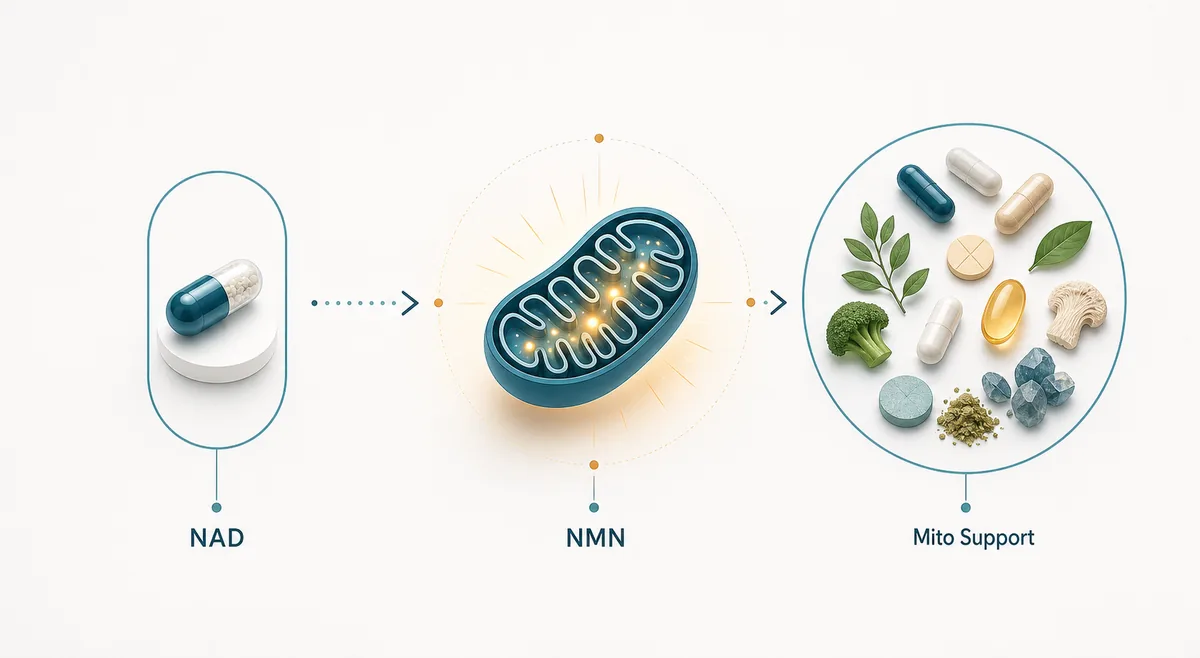
Before asking when to take NAD, ask what you are taking. NAD+ is a coenzyme involved in cellular metabolism, but an oral product may try to support that pathway with a precursor, a vitamin B3 form, a reduced NAD form, or a broad combination. Direct NAD+, NMN, NR, niacinamide, and niacin should not be treated as interchangeable just because the marketing copy uses the same NAD family language.
The label term changes the question
| Label term | What it usually means | What not to assume |
|---|---|---|
| Direct NAD+ | A finished product that lists NAD+ as an active ingredient, with its own route and formulation. | Research on oral precursors automatically proves the absorption or outcome of this product. |
| NMN | Nicotinamide mononucleotide, generally positioned as a precursor to NAD+. | An NMN study dose or result transfers directly to every NMN blend or delivery format. |
| NR | Nicotinamide riboside, a distinct NAD+ precursor with separate human studies. | NR and NMN are the same ingredient or have identical directions. |
| Niacinamide | Nicotinamide, a vitamin B3 form used in nutrition and NAD-related metabolism. | It is the same as nicotinic acid, the B3 form classically associated with flushing. |
| NAD complex | A blend that may include one NAD-related ingredient plus vitamins, minerals, botanicals, or other compounds. | The word NAD tells you the full interaction, dose, or timing profile. |
The label is more useful than the front-panel promise. If the product does not clearly identify the active form and amount, it is difficult to compare evidence, value, or safety. Start with the plain-English NAD supplement definition before deciding whether a targeted precursor or broader formula actually matches your question.
Read the Supplement Facts panel before deciding when to take it
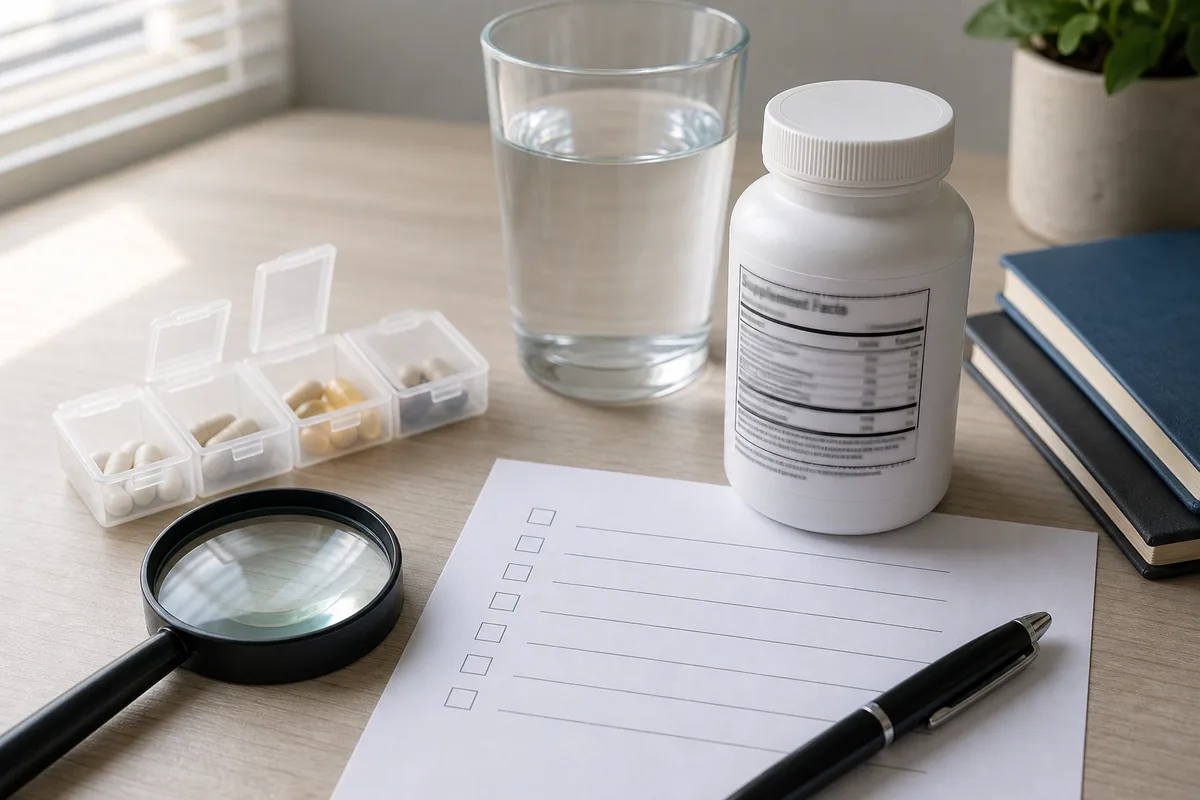
The serving size is not always the same as one capsule, one tablet, or one scoop. Look for the amount per serving, the number of servings per container, the suggested use, and whether the instructions say with food, between meals, or at a particular interval. Then read the other active ingredients. A product marketed for NAD may also contain niacinamide, magnesium, stimulatory botanicals, caffeine, sweeteners, or compounds that change the practical safety question.
Label details worth writing down
- The exact active form: direct NAD+, NADH, NMN, NR, niacinamide, niacin, or a named blend.
- The amount per serving and the serving size, including whether the label expects more than one capsule.
- Directions about food, water, storage, splitting, chewing, or combining the product with other supplements.
- Every other active ingredient and the amount of vitamin B3, magnesium, botanicals, or stimulatory compounds.
- Manufacturer, lot number, expiration date, contact information, and any available product-specific quality documentation.
- Warnings about pregnancy, medication use, medical conditions, allergies, driving, or procedures.
Questions to answer before the first serving
| Question | If the label is unclear |
|---|---|
| Is the amount listed for one capsule or the whole serving? | Do not calculate a personal dose from a marketing panel. Ask the manufacturer or a pharmacist. |
| Does it contain more than one NAD-related ingredient? | List the overlap before combining it with another NAD, NMN, NR, niacin, or multivitamin product. |
| Does it contain a proprietary blend? | Treat the undisclosed amounts as a reason to pause, because dose and interaction review are limited. |
| Does the product use a patch, liquid, lozenge, or special delivery claim? | Look for evidence matched to that finished route rather than assuming capsule research applies. |
A clean-looking label does not prove that a supplement will improve energy, aging, or any symptom. It simply makes the product possible to evaluate. Third-party testing or a lot-specific certificate of analysis can add useful quality information, but it does not prove a clinical outcome.
When to take NAD: consistency usually matters more than the clock
For consumer NAD-related supplements, human research does not establish one universal morning-versus-evening schedule for every ingredient and finished product. If the label gives a time or interval, follow it. If it does not, choose a repeatable time that fits the directions and your normal routine, then avoid changing several variables at once. A convenient schedule can improve adherence, but it should not be presented as proof of a stronger biological effect.
How to interpret common timing instructions
| Instruction or question | Practical interpretation |
|---|---|
| The label says to take it with food | Use the food instruction as written. Do not replace it with an empty-stomach routine because an online post says absorption is better that way. |
| The label does not name a time | Pick a consistent time that fits the label and is easy to remember. Morning is a routine choice, not a universal rule. |
| The product seems alerting or changes sleep | Do not keep experimenting by increasing or repeatedly shifting the dose. Pause and ask a pharmacist or clinician about the exact formula. |
| The label divides the serving across the day | Follow the stated interval rather than taking the full amount at once. Ask for clarification if the directions conflict. |
| You miss a serving | Check the product directions. Do not automatically double the next serving to make up for it. |
A simple routine is usually easier to evaluate
- Use the same labeled serving and roughly the same time for several days unless a professional tells you to change it.
- Record whether it was taken with food, without food, or alongside other new products.
- Keep caffeine, sleep, exercise, and other supplement changes visible in the same notes so a good or bad day is not overinterpreted.
- Do not treat a short-term feeling as proof that the supplement changed NAD biology or will produce a long-term benefit.
- If a new or concerning symptom appears, stop testing the schedule and ask for advice rather than chasing the perfect time.
Food, water, and delivery format can change tolerability
Food instructions are product-specific. Some people find a supplement easier on the stomach with a meal, while a product label may direct use between meals or on an empty stomach. That practical tolerance question is different from a claim that one food schedule produces superior NAD or energy outcomes. Use water unless the directions say otherwise, and do not mix, crush, split, or open a product when doing so could change a special-release or other delivery format.
Liposomal, sublingual, liquid, lozenge, and patch language also needs separate checking. A delivery label describes how the product is presented; it does not by itself prove better absorption, higher tissue NAD+, or a meaningful health outcome. Capsule research should not be used as automatic evidence for a patch or a liposomal product.
Format questions that prevent easy mistakes
| Format | What to verify |
|---|---|
| Capsule or tablet | Serving size, food direction, storage, and whether the label says to swallow whole. |
| Powder or drink mix | Serving measure, mixing instructions, stability after opening, and added stimulants or sweeteners. |
| Liquid or lozenge | Measured amount, storage, expiration after opening, and whether the route claim has finished-product evidence. |
| Patch | Named active, amount loaded versus delivered, wear directions, skin warnings, and route-matched human evidence. |
If the product's food, route, or storage instructions are hard to interpret, that is a reason to contact the seller or pharmacist before starting. A more complicated format is not automatically a better format.
How much NAD should you take? Use the product label, not a borrowed study dose
A study amount is not a universal shopping recommendation. Human trials of NMN, NR, or other NAD-boosting compounds use specific ingredients, doses, populations, durations, and exclusion criteria. A consumer product may use a different form, serving size, purity standard, combination, or route. That is why a number copied from a research paper, forum, or influencer cannot safely become a personal dose.
The same caution applies to direct NAD products and clinic protocols. Oral capsules, powders, patches, sublingual products, and intravenous services are not interchangeable. If a label encourages a high amount, a loading phase, or stacking multiple products, ask a qualified professional to review the exact product rather than assuming more will be more effective.
Dose checks that are worth doing
- Calculate the amount per labeled serving, not just the amount printed in a large front-panel headline.
- Add up overlapping niacinamide, niacin, NR, NMN, magnesium, and other actives across your current supplements.
- Check whether the directions describe a daily total, a per-capsule amount, or a divided serving.
- Do not use an IV NAD amount, a clinical trial amount, or another person's routine as a personal oral dose.
- Ask a pharmacist or clinician for individualized guidance when medication, pregnancy, a chronic condition, or a prior reaction is involved.
Evidence-aware dosing language should sound less certain than a sales page. A transparent label helps you follow directions; it does not establish that the chosen amount will raise energy, reverse aging, or treat a health problem.
Medication and health checks come before the first dose

There is no complete interaction answer for the word NAD alone. A concern may come from the NAD-related ingredient, a high-dose vitamin, a botanical, an overlapping product, or the condition being treated with a prescription. Ask a pharmacist or clinician before starting if you take prescriptions, use blood-thinning or antiplatelet medicines, manage blood pressure or glucose, have liver or kidney disease, have a cancer history or active treatment, are pregnant or breastfeeding, are preparing for surgery, or have previously reacted to supplements.
Situations that deserve individualized review
| Situation | What to bring or ask about |
|---|---|
| Prescription medicines or several over-the-counter products | Bring the bottle, full Supplement Facts panel, and a complete medication and supplement list. |
| Blood thinners, antiplatelet drugs, frequent NSAIDs, or easy bruising | Ask whether any ingredient in the whole formula could affect bleeding or bruising; never alter prescribed therapy on your own. |
| Diabetes, low blood pressure, liver disease, or kidney disease | Ask whether the active ingredients, amount, and monitoring plan fit your condition and medicines. |
| Cancer history, active treatment, pregnancy, breastfeeding, or a child who may use it | Do not infer safety from a cell pathway or adult trial. Ask the treating clinician first. |
| Upcoming surgery or procedure | Give the surgical team the complete list and follow its instructions about when to stop supplements. |
| New, severe, persistent, or unexplained fatigue | Prioritize evaluation for an underlying cause instead of treating the supplement as a diagnosis or treatment. |
Do not stop a prescribed medicine because a supplement label or online post suggests it may be helpful. If you suspect an adverse reaction, save the product and lot information, stop taking more until you receive advice, and seek urgent care for trouble breathing, facial or throat swelling, fainting, chest pain, severe weakness, confusion, uncontrolled bleeding, or another rapidly worsening symptom.
If a clinician says it is reasonable, make the first trial easy to evaluate
When a healthcare professional agrees that a product is reasonable to consider, avoid turning the first week into an uncontrolled stack. Start with the labeled directions, change one new supplement at a time when possible, and decide in advance what you are actually monitoring. A calendar reminder can improve consistency, but it cannot turn a subjective feeling into proof of an NAD-related mechanism.
Keep a short, practical record
- Date, product name, exact form, lot number if available, serving size, and time taken.
- Whether it was taken with food, water, caffeine, alcohol, or another new product.
- Sleep, meals, exercise, hydration, illness, stress, and other changes that could affect how you feel.
- New symptoms, their start time, severity, and whether they repeat after a serving.
- Questions to take to a pharmacist or clinician instead of making a self-diagnosis.
If there is no noticeable change, that is also information. Do not keep escalating the amount or add several products to force a result. If the goal is ongoing fatigue, sleep disruption, weakness, cognitive change, or exercise intolerance, return to the underlying health question rather than treating the absence of a supplement effect as a reason to buy a stronger claim.
Where Advanced Mitochondrial Formula fits in a NAD question
Advanced Mitochondrial Formula is not a pure NAD+, NMN, or NR product. The seller's current presentation describes a broader mitochondrial-support formula that includes niacinamide, D-ribose, PQQ, CoQ10, acetyl-L-carnitine, plant-derived compounds, minerals, and other ingredients. That may be relevant to someone comparing a multi-ingredient routine, but it also means the full label, total daily amount, overlap, and medication context deserve more attention than the phrase NAD support on a sales page.
Match the product question to the product category
| If your main question is | A clearer comparison starts with |
|---|---|
| Can I evaluate one NAD-related ingredient at a time? | A clearly labeled direct NAD, NMN, NR, or vitamin B3 product with a disclosed serving and evidence that matches the form. |
| Do I want several mitochondrial-support ingredients in one routine? | A complete broad-formula label, overlap review, quality information, current value, and safety discussion. |
| Could medication or a health condition change the answer? | A pharmacist or clinician review before choosing either a targeted product or a broad formula. |
Commercial disclosure: MitoEnergy Reviews may earn a commission if you buy Advanced Mitochondrial Formula through the clearly marked official-offer link below, at no extra cost to you. The affiliate relationship does not make the product a pure NAD supplement, does not prove an outcome, and does not replace label or clinician review.
Bottom line: make the routine boring and the label specific
The safest answer to how to take NAD is a process: identify the actual ingredient, follow the labeled serving and food directions, choose a consistent routine, avoid borrowed doses and automatic stacking, and ask a professional about medicines or health conditions before starting. There is no universal clock time that turns every NAD-related product into a proven energy or healthy-aging intervention.
Use timing to make a product easier to monitor, not to make a stronger promise. If the label is vague, the symptom is unexplained, or the product's route and evidence do not match, pausing is a better decision than optimizing the schedule.
Frequently asked questions
What is the best time of day to take NAD supplements?
There is no universal best time for every NAD-related ingredient or finished product. Follow the label's food and interval directions, then choose a consistent time that fits your routine. Timing may improve adherence or tolerability, but it is not proof of a stronger NAD or energy outcome.
Should I take NAD in the morning or at night?
Use the product directions first. If the label does not name a time, choose a repeatable schedule and monitor sleep and other symptoms. Do not keep shifting or increasing the serving to chase a result; ask a pharmacist or clinician if the product seems alerting or disrupts sleep.
Should NAD supplements be taken with food?
Only follow a with-food or empty-stomach instruction when it appears on the product label or comes from a professional who reviewed the exact product. Food may affect tolerability, but a practical food routine should not be presented as proof of a better NAD-related clinical outcome.
How much NAD should I take?
Use the exact serving directions for the product you are considering and do not copy a dose from a study, clinic protocol, influencer, or another person's bottle. The ingredient, route, amount, blend, and your health context all matter. Ask a pharmacist or clinician for individualized guidance when relevant.
Can I take NAD, NMN, and NR together?
Do not assume that stacking them is necessary or appropriate. They are distinct NAD-related ingredients, and a combination can create overlapping doses or add other actives. Check the complete labels and ask a qualified healthcare professional, especially if you take medication or already use a multivitamin or energy blend.
Is Advanced Mitochondrial Formula a NAD supplement?
It is better described as a broad mitochondrial-support formula rather than a pure NAD+, NMN, or NR product. The seller's materials discuss niacinamide and several other ingredients, so compare the complete current label, safety context, price, and evidence limits before treating it as an option for your goal.
Sources and further reading
- FDA: FDA 101 - Dietary Supplements
- NCCIH: Using Dietary Supplements Wisely
- NIH Office of Dietary Supplements: Niacin Fact Sheet for Health Professionals
- Nutrients: Dietary Supplementation With NAD+-Boosting Compounds in Humans
- Cleveland Clinic: NAD+ Supplements - Benefits and Risks
- FDA: How to Report a Problem With Dietary Supplements
- Advanced BioNutritionals official Advanced Mitochondrial Formula offer page