Contents
- Short answer: this is a broad mitochondrial-support stack, not a single-ingredient NAD product
- How to judge ingredient claims without over-reading them
- Ingredient roles: what each group is supposed to contribute
- Evidence levels: where the formula looks plausible and where certainty is lower
- Buyer checklist: what to verify on the label and offer page
- Bottom line
- Frequently asked questions
Short answer: this is a broad mitochondrial-support stack, not a single-ingredient NAD product
Advanced Mitochondrial Formula is built around several ingredient groups that are commonly marketed for mitochondrial and cellular-energy support: a vitamin B3 form connected to NAD metabolism, D-ribose, polyphenol extracts, mitochondrial cofactors, antioxidant-oriented compounds, magnesium, and an absorption enhancer.
That does not mean every claim on a sales page should be read literally. The more useful question is whether the ingredient strategy makes sense, where the evidence is stronger or weaker, and whether a multi-ingredient formula fits your health situation better than a simpler supplement.
Best way to read the ingredient list
- Treat it as a convenience formula for mitochondrial-support shoppers, not as a guaranteed fix for fatigue.
- Separate ingredient plausibility from product-specific proof; an ingredient can be interesting without proving the finished formula will work for every buyer.
- Look for dose transparency, serving instructions, allergens, medication cautions, and refund terms before buying.
- Use extra caution if you take medications, have a chronic condition, have a cancer history, are pregnant or breastfeeding, or are preparing for surgery.
Advanced Mitochondrial Formula ingredient overview
| Ingredient group | Why it may be included | Main buyer caution |
|---|---|---|
| Niacinamide | A vitamin B3 form tied to NAD-related metabolism. | Not the same as taking NAD, NMN, or NR directly; avoid assuming dramatic personal results. |
| D-ribose | A sugar involved in energy-related nucleotide pathways. | Some people should discuss blood sugar context and medication use with a clinician. |
| PQQ and CoQ10 | Commonly discussed in mitochondrial and redox biology. | Evidence depends on dose, form, population, and outcome. |
| Acetyl-L-carnitine | Related to fatty-acid transport into mitochondria. | Can feel stimulating for some users; medical context matters. |
| Curcumin, quercetin, alpha-lipoic acid, itadori extract | Polyphenol and antioxidant-oriented ingredients often used in healthy-aging formulas. | Potential interactions and procedure-related cautions are easy to overlook. |
| Magnesium and BioPerine | Magnesium supports many enzyme processes; BioPerine is used to increase absorption of some compounds. | Absorption enhancers may also affect exposure to other substances. |
How to judge ingredient claims without over-reading them
Dietary supplement labels and sales pages often use structure/function language such as supporting cellular energy, mitochondrial function, antioxidant defenses, or healthy aging. That language is different from saying a product diagnoses, treats, cures, or prevents disease.
For this formula, the safest reading is: the ingredients are chosen because they connect to normal biological pathways involved in energy metabolism and oxidative stress. That is not the same as proof that the finished product will resolve persistent fatigue, mobility problems, cognitive symptoms, or a diagnosed mitochondrial disorder.
Claims translated into more careful language
| Sales-page theme | More cautious interpretation |
|---|---|
| Supports mitochondria | The formula includes ingredients commonly discussed in mitochondrial biology, but it should not be treated as mitochondrial disease care. |
| Supports NAD | Niacinamide is connected to NAD metabolism, but this is not identical to an NAD IV, NMN product, or NR product. |
| Energy support | Some ingredients relate to ATP or cellular-energy pathways, but tiredness can have many medical and lifestyle causes. |
| Healthy aging | Several ingredients are discussed in aging-related research, but no supplement should be read as age reversal. |
Ingredient roles: what each group is supposed to contribute
A multi-ingredient formula can be useful when the goal is convenience, but it also makes evaluation harder. Instead of asking whether the product has one magic ingredient, it is better to ask what each group is supposed to contribute and what would make you pause.
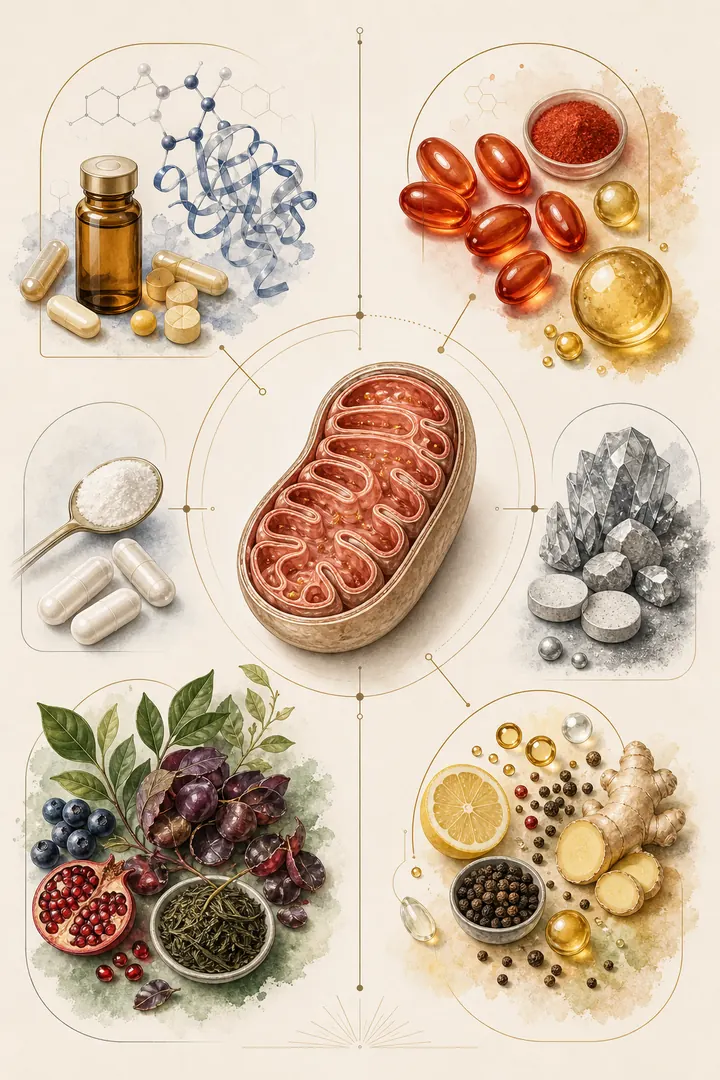
Ingredient-by-ingredient reading guide
| Ingredient | Plain-English role | What to verify before buying |
|---|---|---|
| Niacinamide | A form of vitamin B3 involved in NAD-related pathways. | Check the actual amount per serving and avoid assuming it works like every other NAD booster. |
| D-ribose | A five-carbon sugar connected to nucleotide and ATP-related metabolism. | Ask whether it fits your blood sugar and medication context, especially if you have diabetes or take related medications. |
| Itadori extract | A Polygonum cuspidatum extract often discussed because it can contain resveratrol-like polyphenols. | Botanical extracts vary; check standardization, dose, and medication cautions. |
| PQQ | A redox-active compound often marketed around mitochondrial biogenesis and healthy aging. | Look for dose transparency and avoid treating animal or mechanism research as guaranteed human outcomes. |
| CoQ10 | A cofactor involved in mitochondrial electron transport and redox balance. | Form, dose, and medication context can matter; people using blood thinners should ask a clinician. |
| Acetyl-L-carnitine | A carnitine form related to fatty-acid transport and energy metabolism. | Some users find carnitine energizing; timing and personal tolerance matter. |
| Alpha-lipoic acid | An antioxidant-oriented compound involved in redox and metabolic pathways. | Discuss use if you take glucose-lowering medication or have a complex medical history. |
| Curcumin and quercetin | Plant compounds commonly used for antioxidant and inflammation-adjacent positioning. | These can interact with medications or procedures for some people. |
| BioPerine | A black pepper extract used to increase absorption of some ingredients. | Absorption enhancement is not always a free benefit; it can also change exposure to drugs or other supplements. |
| Magnesium | A mineral involved in many enzyme systems, including energy-related processes. | Check the form and amount, especially if you have kidney disease or already use magnesium. |
Evidence levels: where the formula looks plausible and where certainty is lower
The strongest case for this kind of product is not that every ingredient has the same level of proof. It is that the formula clusters ingredients around related biological themes: NAD metabolism, mitochondrial cofactors, antioxidant pathways, and absorption. That theme is plausible, but plausibility should not be confused with a finished-product clinical trial.
Practical evidence grading for buyers
| Question | Reasonable answer |
|---|---|
| Are mitochondria real targets for energy metabolism research? | Yes. Mitochondria are central to cellular energy production, but supplement effects vary by ingredient and person. |
| Do individual ingredients have research backgrounds? | Many do, but research quality differs and may not match the exact dose, combination, or user population. |
| Does a broad ingredient list prove the product works? | No. Combining plausible ingredients does not automatically prove a specific result for every buyer. |
| Is it fair to compare this with single-ingredient products? | Yes, but compare the use case. This is a convenience stack; single ingredients offer more control. |
This is why the ingredient list should be read alongside the Advanced Mitochondrial Formula review, current price, guarantee terms, and your own tolerance for multi-ingredient products.
Buyer checklist: what to verify on the label and offer page
The ingredient list is only one part of the decision. A careful buyer should also look at serving size, amount per serving, total bottles needed, refund rules, and whether any ingredient conflicts with medications or health conditions.
Questions to answer before ordering
- Does the current Supplement Facts label show clear amounts for the ingredients you care about most?
- Are you comfortable with a broad stack, or would you prefer testing one ingredient at a time?
- Do any ingredients overlap with supplements you already take?
- Could BioPerine, curcumin, quercetin, alpha-lipoic acid, carnitine, magnesium, or CoQ10 be an issue with your medications?
- Is the current package price reasonable if you do not notice a meaningful effect?
- Do you understand the refund window and return process before buying multiple bottles?
Who the ingredient profile may fit
| May fit | May not fit |
|---|---|
| Adults who want one combined mitochondrial-support formula instead of several separate bottles. | People who want exact control over each individual ingredient dose. |
| Readers who already understand that supplement results are not guaranteed. | People looking for diagnosis or treatment of unexplained fatigue. |
| Buyers who value a refund policy and official ordering route. | People with medication, surgery, kidney, liver, pregnancy, breastfeeding, or cancer-related cautions who have not asked a clinician. |
Bottom line
The Advanced Mitochondrial Formula ingredient list makes the most sense as a broad, convenience-oriented mitochondrial-support stack. The formula includes ingredients that connect to NAD metabolism, ATP-related pathways, redox biology, polyphenols, minerals, and absorption support.
After checking ingredient fit, use the Advanced Mitochondrial Formula price guide to compare package cost, refund terms, and whether a larger bundle makes sense.
The cautious conclusion is simple: the ingredient strategy is coherent enough to compare, but it should not be treated as proof of guaranteed energy, age reversal, or disease treatment. If the ingredient list fits your situation and you understand the limits, the next step is to compare current pricing, guarantee terms, and safety cautions before deciding.
Frequently asked questions
What are the main Advanced Mitochondrial Formula ingredients?
The official offer page discusses niacinamide, D-ribose, itadori extract, PQQ, acetyl-L-carnitine, CoQ10, quercetin, alpha-lipoic acid, curcumin, BioPerine, and magnesium. Always check the current Supplement Facts label because formulas and package details can change.
Is niacinamide the same as NAD, NMN, or NR?
No. Niacinamide is a vitamin B3 form connected to NAD-related metabolism, but it is not the same ingredient as NAD, NMN, or NR. Do not assume all NAD-related products work the same way.
Why does the formula include BioPerine?
BioPerine is a black pepper extract often used to increase absorption of certain compounds. That can be useful, but it is also a reason to check medication and supplement interactions with a healthcare professional.
Do these ingredients prove the supplement will fix fatigue?
No. Some ingredients relate to cellular-energy pathways, but fatigue can have many causes. New, severe, persistent, or unexplained fatigue should be discussed with a qualified healthcare professional.
Should I buy a multi-ingredient mitochondrial formula or separate ingredients?
A multi-ingredient formula is more convenient, while separate ingredients give you more control over dose and tolerance. The better choice depends on your health context, budget, and how carefully you want to test individual ingredients.