Contents
- Quick verdict: choose the strategy before the supplement
- What NAD, NMN, and mitochondrial support mean on a label
- Use your goal to choose a starting path
- Evidence: pathway plausibility is not a finished-product result
- Labels, testing, and value matter more than category hype
- Safety: more ingredients create more questions
- Where Advanced Mitochondrial Formula fits
- A final buyer checklist
- Bottom line: the best fit is the most transparent strategy you can evaluate
- Frequently asked questions
Quick verdict: choose the strategy before the supplement
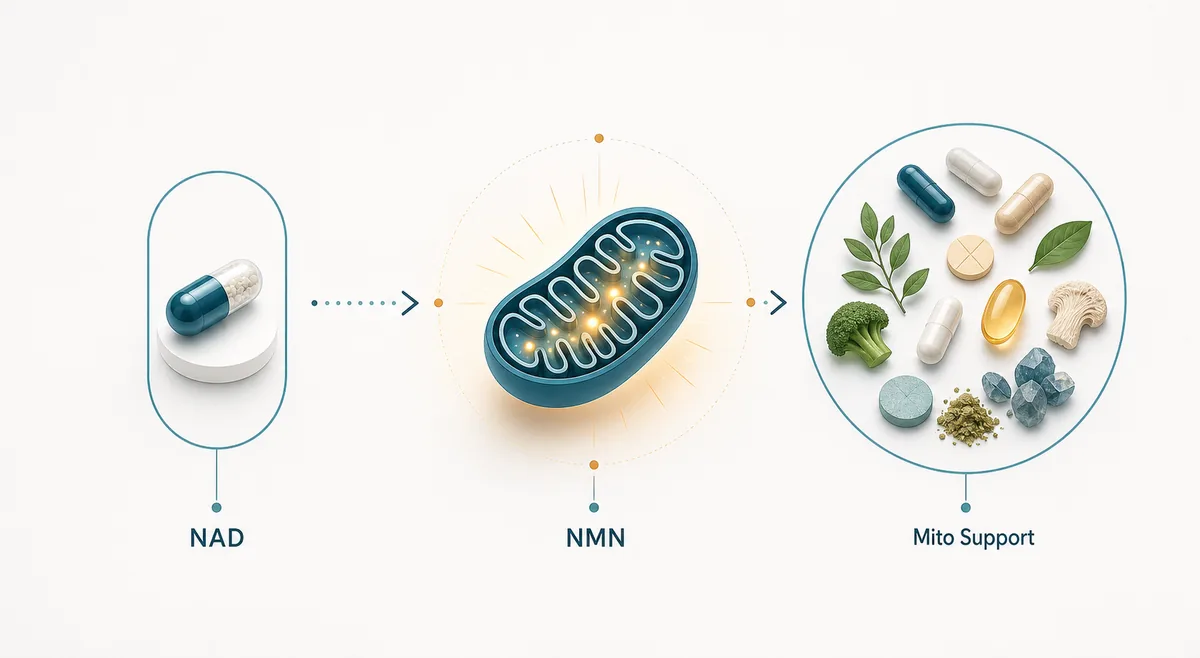
NAD vs NMN vs mitochondrial support is not a contest with one universal winner. Direct NAD products, NMN supplements, and broad mitochondrial formulas represent different strategies. Direct NAD is marketed around supplying NAD itself; NMN is marketed as a precursor that the body can use in NAD-related pathways; a broad formula combines several ingredient categories around cellular energy and mitochondrial support. The most sensible choice depends on the job you are trying to evaluate, the label you can verify, and the safety questions that apply to you.
For a focused molecule comparison, start with the existing NMN vs NAD guide. This page answers the next decision: should you stay with a targeted NAD-related product, compare NMN as a precursor, or step back and evaluate a broader mitochondrial-support formula? None of these categories should be treated as a diagnosis or as a treatment for new, severe, persistent, or unexplained fatigue.
The short version
- Choose direct NAD only when the finished product clearly explains its ingredient, route, amount, testing, and human evidence; a name alone does not prove delivery or benefit.
- Choose NMN when you want a narrower NAD+ precursor strategy and are prepared to compare dose, batch testing, safety, and realistic claims.
- Choose broad mitochondrial support when convenience and multiple ingredient categories matter more than isolating one precursor, while accepting that more ingredients create more overlap and more variables.
- If you have unexplained symptoms, take prescriptions, are pregnant or breastfeeding, have a chronic condition, or face surgery, ask a qualified healthcare professional before choosing any route.
At-a-glance comparison
| Approach | What it is | Main buyer advantage | Main limitation |
|---|---|---|---|
| Direct NAD | A finished product positioned around NAD or NAD+ itself. | It answers a very specific ingredient question. | Finished-product absorption, route, stability, and outcome evidence may be difficult to verify. |
| NMN | A precursor used in the NAD-related supplement conversation. | It offers a focused strategy with a clearer ingredient boundary than a blend. | Precursor biology and biomarker changes do not prove a noticeable real-world result. |
| Broad mitochondrial support | A multi-ingredient formula covering several cellular-energy or mitochondrial categories. | One product may be more convenient than assembling separate ingredients. | Overlap, interactions, dose comparisons, and side-effect attribution become harder. |
What NAD, NMN, and mitochondrial support mean on a label
NAD+ is a coenzyme involved in oxidation-reduction reactions, energy metabolism, and other cellular processes. That biological role is a reason to study NAD-related compounds, not proof that raising NAD in a particular tissue will make every person feel more energetic. Supplement labels use the word NAD loosely, so the Supplement Facts panel matters more than the front-of-bottle headline.
NMN, or nicotinamide mononucleotide, is generally discussed as a precursor to NAD+. NR, or nicotinamide riboside, is another NAD+ precursor and belongs in a complete targeted comparison even though it is not one of the three terms in this page's title. A direct NAD or NADH product is a different exposure again. Results from an NMN or NR study should not automatically be transferred to a direct NAD capsule, a patch, a liquid, or a multi-ingredient formula.
Mitochondrial support is broader category language. It may include ingredients such as CoQ10, PQQ, acetyl-L-carnitine, alpha-lipoic acid, magnesium, B vitamins, polyphenols, or NAD-adjacent compounds. The phrase can be useful for organizing a buyer question, but it does not identify one standard formula, dose, or evidence level. Compare the exact ingredients and amounts rather than treating broad mitochondrial support as a single active ingredient.
Do not carry one category's evidence into another
| What you read | What it can reasonably support | What it cannot establish |
|---|---|---|
| NAD is used by cells | A basic explanation for why NAD metabolism is studied. | That a particular oral product will improve energy or healthy aging. |
| NMN or NR changed a marker in a human study | Some ingredient- and study-specific evidence about a biomarker or short-term outcome. | That every dose, brand, route, or long-term outcome will behave the same way. |
| A formula contains many mitochondrial ingredients | A description of the formula's scope and the questions to ask about each ingredient. | That more ingredients create a stronger or clinically proven result. |
Use your goal to choose a starting path
The best way to use an NAD vs NMN supplement comparison is to define the decision before looking at discounts. Are you trying to evaluate one NAD-related ingredient? Are you comparing precursor research? Or do you want one broad formula that covers several categories without building a stack yourself? The answers do not prove which product will work, but they prevent a marketing term from choosing for you.
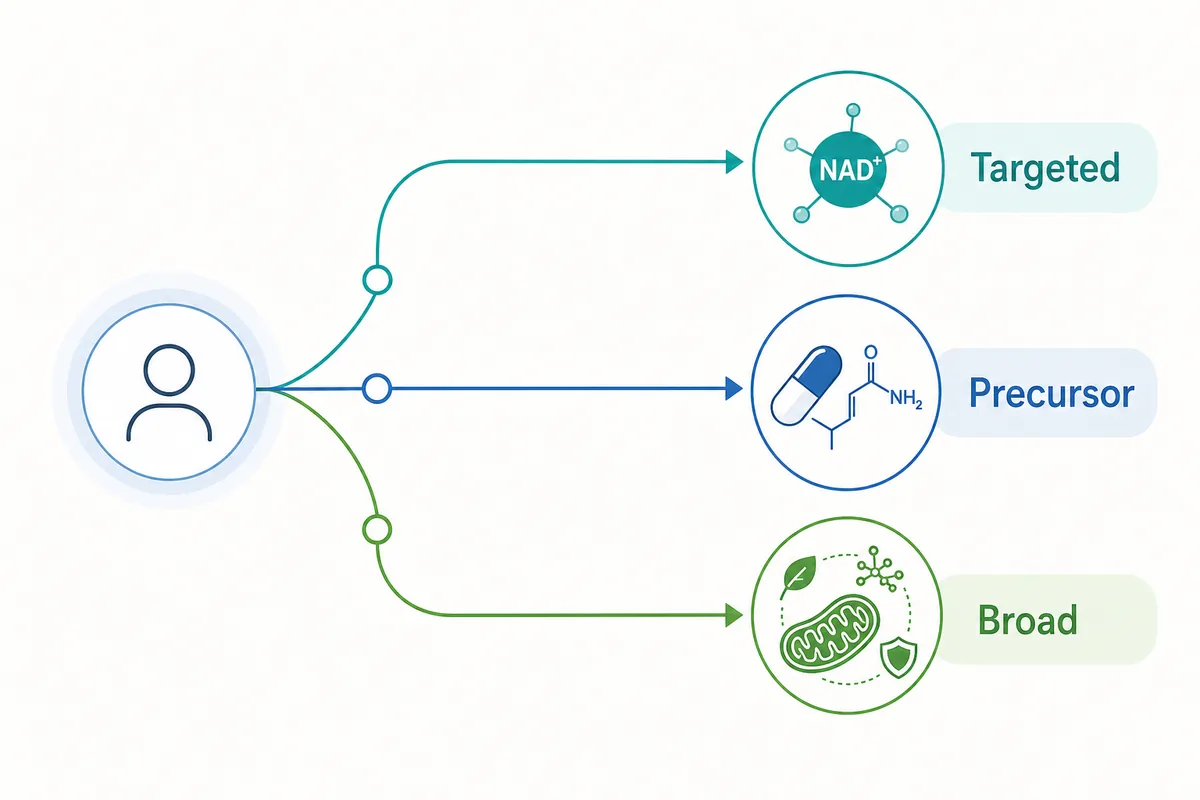
Which path deserves the closest look?
| If your priority is... | Start by checking... | Do not assume... |
|---|---|---|
| A narrow NAD-related trial | Whether the product is direct NAD, NMN, NR, or another form; the per-serving amount; and lot-specific testing. | That a high dose or premium delivery word is automatically better. |
| Understanding precursor evidence | The actual human study population, duration, outcome, and whether the product matches the study ingredient and dose. | That a higher NAD-related marker equals more energy, longer life, or disease protection. |
| Convenience across multiple categories | The complete broad-formula label, ingredient overlap, serving size, testing, and total monthly cost. | That a longer ingredient list means a more reliable or more suitable formula. |
Evidence: pathway plausibility is not a finished-product result
The central evidence mistake in this category is moving from mechanism to outcome in one sentence. NAD participates in important cellular reactions. NMN and NR can be studied as precursors. Mitochondrial ingredients can have plausible roles in energy metabolism or redox biology. Those facts justify careful research, but they do not establish that a supplement treats fatigue, restores youthful function, or changes lifespan.
Human trials are more useful when they match the question a buyer is asking. A study of a purified ingredient may tell you something about that ingredient in a defined population and time period. It does not validate a different blend. A biomarker study may show a biological change without showing a meaningful improvement in daily function. A study of a capsule does not prove the same result for a patch or a liposomal liquid.
A practical evidence ladder
| Evidence level | Useful question | Buyer boundary |
|---|---|---|
| Basic biology | Is there a plausible connection to NAD or mitochondrial metabolism? | Plausibility is a starting point, not proof of a consumer outcome. |
| Animal or cell research | What mechanism or safety question is being explored? | It cannot be treated as a human benefit claim. |
| Short human biomarker trial | Did the studied ingredient change a defined marker in a defined group? | It may not show a noticeable benefit, long-term safety, or finished-product performance. |
| Finished-product human evidence | Was the exact product tested for the outcome being marketed? | This is more relevant, but still needs attention to population, duration, and limitations. |
Labels, testing, and value matter more than category hype
A careful NAD supplement vs mitochondrial support comparison is partly a label audit. Start with the exact active form, not the marketing category. Then check the amount per serving, serving size, other active ingredients, allergen information, storage instructions, seller identity, and whether the company provides meaningful lot-specific testing. A certificate of analysis is most useful when it is tied to the product and lot you can actually buy.

Five checks before you compare prices
- Form: confirm whether the product contains direct NAD+, NMN, NR, niacinamide, NADH, or a blend, and do not treat those terms as interchangeable.
- Dose: calculate the amount per serving and the number of servings per container; a bottle price is not a daily value comparison.
- Testing: look for current, product-specific quality information rather than a generic manufacturing badge or an undated logo.
- Overlap: list other supplements and medicines so a broad formula does not quietly duplicate B vitamins, minerals, stimulants, or botanicals.
- Value: compare the monthly cost, shipping, subscription terms, return policy, and what you are paying for in terms of disclosed ingredients.
This is also where a targeted product and a broad formula make different value promises. A targeted product may be easier to test one variable at a time. A broad formula may be more convenient, but the added convenience is not the same as stronger evidence. The right comparison is the one you can understand and monitor, not the one with the most impressive front label.
Safety: more ingredients create more questions
NAD, NMN, and broad mitochondrial products should not be treated as one safety category. Possible concerns depend on the actual ingredient, amount, delivery format, other ingredients, medicines, health history, and the reason for taking the product. Short tolerance findings in a study group do not rule out an individual reaction or a problem caused by a different blend.
Ask a pharmacist or clinician before starting a supplement if you take prescription medicines, use several over-the-counter products, are pregnant or breastfeeding, have a cancer history, kidney or liver disease, a diagnosed metabolic or mitochondrial condition, or an upcoming procedure. If fatigue is new, worsening, severe, or unexplained, the medical question comes before the NAD vs NMN vs mitochondrial support buying question.
Stop and seek appropriate care for serious symptoms
- Do not keep increasing a product to test whether a new symptom will disappear.
- Record the product name, lot if available, serving, timing, other supplements, medicines, and the symptom before asking for advice.
- Trouble breathing, facial or throat swelling, fainting, chest pain, severe weakness, confusion, or uncontrolled bleeding needs urgent medical attention.
- Do not stop a prescribed medicine or use a supplement as a substitute for evaluation.
Where Advanced Mitochondrial Formula fits
Advanced Mitochondrial Formula belongs in the broad mitochondrial-support column, not the direct NAD or NMN column. The seller's current presentation discusses niacinamide, D-ribose, Itadori extract, PQQ, acetyl-L-carnitine, CoQ10, and other ingredients as part of a combined formula. That wider scope may appeal to someone who wants one product to cover several categories. It also means you should verify the current Supplement Facts panel, serving size, and amount of every active before deciding.
The product is therefore not a shortcut answer to NAD vs NMN. It is a separate strategy for readers who prefer a broad formula and accept the tradeoff of more ingredients. If you want to isolate a single NAD-related variable, an NMN, NR, or direct NAD product may be easier to evaluate. If you want broader coverage in one bottle, read the independent Advanced Mitochondrial Formula review and compare the label, evidence limits, cost, guarantee terms, and safety fit.
Questions to ask before considering a broad formula
| Question | Why it matters |
|---|---|
| Are all active amounts clearly listed? | Without amounts, it is difficult to compare research, overlap, or value. |
| Does the ingredient scope match my actual goal? | A broad formula is not automatically preferable to a targeted product. |
| Can I explain every ingredient to my pharmacist or clinician? | A complete list makes medication and condition questions easier to review. |
| Have I checked the current total cost and return terms? | Sales-page prices, shipping, packages, and policies can change. |
Affiliate disclosure: this page includes a link to Advanced Mitochondrial Formula. We may earn a commission if you buy through that link, at no extra cost to you. The relationship does not make the formula suitable for every reader, does not turn it into an NAD or NMN product, and does not replace label or clinician review.
A final buyer checklist
Before choosing between NAD, NMN, and broad mitochondrial support, write down the exact product category you intend to test and the outcome you are realistically evaluating. Keep the first question narrow: can I verify the ingredient, serving, quality information, cost, and safety context? If the answer is no, a discount does not solve the comparison problem.
Save this checklist
- Name the strategy: direct NAD, NMN or NR precursor, or broad mitochondrial support.
- Read the Supplement Facts panel and record the amount per serving.
- Check third-party testing, seller identity, storage, shipping, subscription, and refund information.
- Compare daily or monthly cost rather than bottle price alone.
- List medicines and supplements for a pharmacist or clinician review when relevant.
- Stop and seek medical guidance for serious symptoms or unexplained fatigue.
Bottom line: the best fit is the most transparent strategy you can evaluate
NAD vs NMN vs mitochondrial support is ultimately a choice between a targeted ingredient question and a broader formula question. Direct NAD products require finished-product and delivery scrutiny. NMN offers a focused precursor route but does not guarantee a real-world benefit. Broad mitochondrial support may be convenient and commercially appealing, but the wider ingredient list makes overlap, dose, value, and safety review more important.
Use the category to organize your research, not to make a promise about your health. Compare the exact label, match evidence to the claim, put symptoms and medication questions ahead of checkout, and choose a product only when the tradeoffs are clear enough to discuss with a healthcare professional.
Frequently asked questions
Is NAD better than NMN?
Not automatically. Direct NAD and NMN are different product strategies. Compare the exact ingredient, route, serving, finished-product evidence, testing, safety context, and price rather than assuming that the word NAD means a stronger result.
Is NMN the same as a mitochondrial support supplement?
No. NMN is generally positioned as a targeted NAD+ precursor. A mitochondrial support supplement is usually a broader multi-ingredient product category that may include NAD-adjacent ingredients along with CoQ10, PQQ, minerals, or other compounds.
Is Advanced Mitochondrial Formula an NAD or NMN product?
It is better described as a broad mitochondrial-support formula, not a standalone NAD or NMN product. Its seller materials discuss niacinamide and several other ingredients, so verify the current label and compare it with targeted products before buying.
Should I take NMN with a broad mitochondrial formula?
Do not assume that combining them is necessary or appropriate. Check every active ingredient for overlap and ask a healthcare professional, especially if you take medication, have a health condition, or already use several supplements.
What should I check first when comparing NAD and mitochondrial supplements?
Check the exact form, amount per serving, complete ingredient list, lot-specific quality information, total monthly cost, seller terms, and safety cautions. If the label is unclear, the product is difficult to evaluate regardless of its marketing category.
Sources and further reading
- NIH Office of Dietary Supplements: Dietary Supplements, What You Need to Know
- PMC review: Dietary Supplementation With NAD+-Boosting Compounds in Humans
- FDA: Label Claims for Conventional Foods and Dietary Supplements
- FTC: Health Products Compliance Guidance
- Advanced BioNutritionals official Advanced Mitochondrial Formula offer page