Contents
- Quick answer: CoQ10 has a real mitochondrial role, but energy claims need context
- How CoQ10 fits mitochondrial energy metabolism
- Ubiquinone vs ubiquinol: what the two forms mean
- What human evidence can and cannot show
- How to check a CoQ10 supplement label before buying
- Safety and medication questions to raise first
- Where standalone CoQ10 fits alongside Advanced Mitochondrial Formula
- Bottom line: use CoQ10 as a defined question, not a promise
- Frequently asked questions
Quick answer: CoQ10 has a real mitochondrial role, but energy claims need context
Coenzyme Q10, usually called CoQ10, is a fat-soluble compound found in cell membranes and mitochondria. It participates in electron transfer in the inner mitochondrial membrane and can act as an antioxidant in its reduced form. That biology explains why CoQ10 appears in mitochondrial support supplements, but it does not prove that a capsule will create a noticeable energy change for every healthy adult.
The useful buying question is narrower than asking whether CoQ10 works. Ask which form the product contains, how much is provided per day, what outcome the evidence studied, and whether the full label fits your medicines and existing supplements. CoQ10 has a larger human research record than many mitochondrial ingredients, yet results still vary by condition, dose, product, and outcome.
What to remember before comparing bottles
- CoQ10 is connected to mitochondrial electron transport, not a guaranteed energy boost.
- Ubiquinone and ubiquinol are different forms of CoQ10; the label should state which one is used.
- A higher milligram number is not automatically better because absorption, formulation, and personal context matter.
- Research on CoQ10 alone does not prove the same outcome for a broad multi-ingredient formula.
- New, severe, persistent, or unexplained fatigue deserves medical evaluation before supplement shopping.
CoQ10 at a glance
| Question | Practical answer |
|---|---|
| What is it? | A fat-soluble compound involved in mitochondrial electron transfer and redox activity. |
| Which forms appear on labels? | Ubiquinone (oxidized CoQ10) and ubiquinol (reduced CoQ10), plus product-specific formulations. |
| Does it treat fatigue? | No. Fatigue has many causes, and a supplement should not replace an assessment. |
| What matters most when buying? | Form, amount per daily serving, testing information, total cost, interactions, and overlap with other products. |
How CoQ10 fits mitochondrial energy metabolism
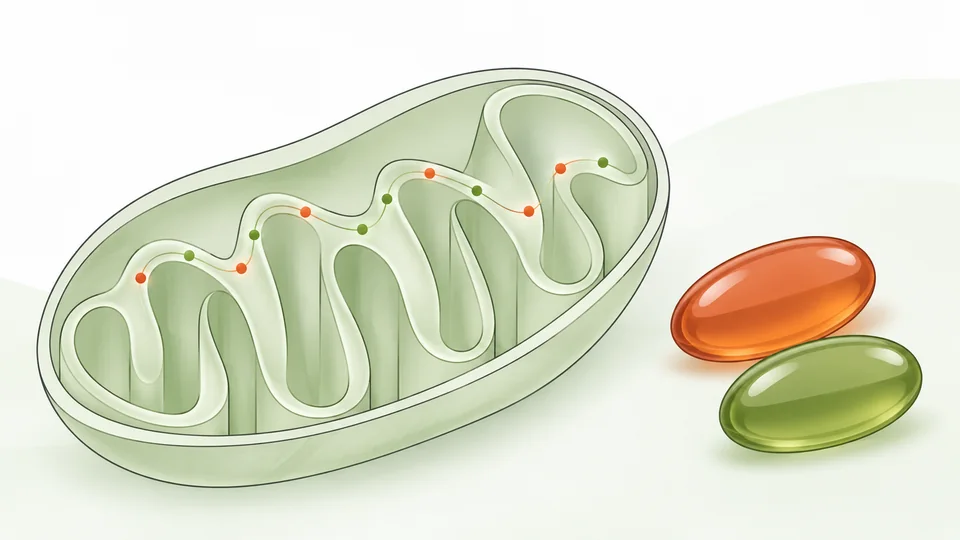
Mitochondria use a chain of protein complexes to transfer electrons and build a proton gradient that helps make ATP. CoQ10 sits in the inner mitochondrial membrane and transfers electrons between parts of that chain. The body also uses CoQ10 in other membranes and antioxidant systems. This is a defined biochemical role, which is different from proving that adding more CoQ10 improves an individual's daily stamina.
That distinction helps separate three claims that are often blended together. A product may contain a compound with a known cellular role, a trial may report a result in a defined group, and a marketing page may promise a broad wellness outcome. Each step requires its own evidence. CoQ10 research is more useful when the population and outcome are named rather than reduced to a generic mitochondrial energy promise.
Keep the evidence levels separate
- Biochemical role: CoQ10 participates in electron transfer and redox chemistry.
- Preclinical signal: cells or animals show a change under controlled conditions.
- Ingredient trial: a defined CoQ10 form and amount is tested in a selected group.
- Finished-product evidence: the exact commercial formula is tested for the outcome promoted to buyers.
- Personal result: one person's response cannot establish a predictable effect for another person.
Ubiquinone vs ubiquinol: what the two forms mean
Ubiquinone is the oxidized form of CoQ10, while ubiquinol is the reduced form. The body can convert between the forms as part of normal redox chemistry. Product discussions often treat ubiquinol as automatically superior, but a form comparison needs more than a conversion story. Dose, oil or powder delivery, stability, manufacturing quality, and the outcome being evaluated can all affect the practical choice.
How to read a CoQ10 form comparison
| Label question | What it tells you | What it does not prove |
|---|---|---|
| Does it say ubiquinone or ubiquinol? | The named chemical form used in the product. | That one form will work better for every buyer. |
| Is the amount stated per serving? | How much the product provides before personal absorption differences. | That a larger amount is needed or safe for a particular person. |
| Is it a softgel or oil-based formula? | A delivery detail that may affect how the product is taken and stored. | A guaranteed clinical result or superior absorption in real-world use. |
| Does the company cite a study? | The source of a claim and the population studied. | That the exact bottle was tested for the same outcome. |
A sensible comparison therefore starts with the whole label. If a product uses ubiquinol, check whether it clearly states the amount and storage requirements. If it uses ubiquinone, check the same details instead of assuming the lower-cost form is ineffective. The form is one decision variable, not a shortcut around evidence and safety.
What human evidence can and cannot show
CoQ10 has been studied in cardiovascular conditions, statin-associated muscle symptoms, exercise settings, migraine, and other areas. The results are not interchangeable. A study in people with a diagnosed condition may answer a different question from a supplement marketed to healthy adults who feel tired. Even a well-designed trial does not turn every CoQ10 product or dose into a general energy solution.
The National Center for Complementary and Integrative Health describes some CoQ10 evidence as inconclusive and notes that available studies do not support a meaningful reduction in statin-associated muscle pain. That is not a verdict that CoQ10 has no useful role. It is a reminder to name the outcome, population, product form, and length of follow-up before making a buying decision.
Translate common CoQ10 claims carefully
| Marketing language | More careful interpretation |
|---|---|
| Supports cellular energy | CoQ10 participates in energy-related mitochondrial chemistry; a noticeable daily change is not guaranteed. |
| Boosts stamina or exercise recovery | Some studies examine specific groups and outcomes, but evidence does not establish a universal effect. |
| Powerful antioxidant | CoQ10 has redox activity, but an antioxidant label does not show a health outcome or replace medical care. |
| Better absorption with ubiquinol | The product may use a different form or delivery system; compare the evidence and amount rather than accepting a blanket promise. |
| Works with every mitochondrial formula | Combination products require a complete label and overlap check; ingredient studies do not prove blend synergy. |
Customer reviews can still be useful for practical details such as capsule size, taste, shipping, or whether a seller honors its return policy. They cannot establish efficacy, rule out a medical cause of fatigue, or predict how a specific person will respond.
How to check a CoQ10 supplement label before buying
The front of a bottle is usually the least useful part of a supplement comparison. Turn it around and record the exact CoQ10 form, milligrams per serving, number of servings per day, other active ingredients, allergen information, storage instructions, seller identity, and any testing documentation. Then compare the daily cost with a focused product and with a broader formula rather than comparing bottle prices alone.

CoQ10 buyer checklist
| Check | Useful signal | Reason to slow down |
|---|---|---|
| Form | The panel identifies ubiquinone or ubiquinol and does not hide the active behind a proprietary blend. | The product relies on a form or absorption claim without naming the amount. |
| Daily amount | Milligrams per serving and servings per day are clear. | A study dose is quoted while the bottle's daily amount is unclear. |
| Other ingredients | Every active ingredient and amount is listed so overlap can be checked. | A blend adds PQQ, stimulants, minerals, or botanicals without dose transparency. |
| Testing | The company explains identity and contaminant testing with useful batch context. | Third-party tested is used as a slogan without laboratory or certificate details. |
| Value | Daily cost, shipping, servings, and return terms are easy to calculate. | A multi-bottle bundle is pushed before tolerance and fit are clear. |
If you already take a multivitamin, statin-support product, PQQ blend, or broad mitochondrial formula, check for duplicate CoQ10 and overlapping antioxidant ingredients. More products can make it harder to identify a side effect and do not automatically create better evidence.
Safety and medication questions to raise first
CoQ10 is often described as well tolerated, but mild digestive symptoms or insomnia can occur. The more important question for many people is interaction context. NCCIH notes possible interactions with warfarin and insulin and advises caution around some cancer treatments. Do not change an anticoagulant, diabetes medicine, or cancer treatment because of a supplement marketing claim.
Ask a clinician or pharmacist before use if you
- Take warfarin, insulin, glucose-lowering medicines, cancer treatment, or several prescription medicines.
- Have kidney, liver, heart, bleeding, or metabolic concerns, or need regular laboratory monitoring.
- Are pregnant or breastfeeding, are buying for a child, or have surgery planned.
- Already use CoQ10, ubiquinol, PQQ, a multivitamin, an antioxidant blend, or a broad mitochondrial formula.
- Have new, severe, persistent, worsening, or unexplained fatigue, weakness, chest symptoms, shortness of breath, fainting, or unexplained weight change.
When supplement shopping should stop
| Situation | Safer next step |
|---|---|
| New or rapidly worsening weakness, confusion, fainting, chest pain, or severe shortness of breath | Seek medical care according to the urgency of the symptoms. |
| Persistent fatigue that changes daily life | Arrange an assessment and bring the full medication and supplement list. |
| A product promises to repair mitochondria or reverse aging | Treat the claim as a reason to inspect evidence, not as a reason to buy quickly. |
Where standalone CoQ10 fits alongside Advanced Mitochondrial Formula
Advanced Mitochondrial Formula is positioned as a broad, multi-ingredient mitochondrial-support supplement. The offer materials discuss CoQ10 alongside PQQ, niacinamide, D-ribose, acetyl-L-carnitine, alpha-lipoic acid, curcumin, quercetin, magnesium, and BioPerine. That makes it a different buying strategy from testing standalone CoQ10: it may be more convenient, but it is harder to control dose and attribute a response.
Single ingredient or broad formula?
| Decision point | Standalone CoQ10 | Advanced Mitochondrial Formula |
|---|---|---|
| Main appeal | A narrower question and simpler label. | One routine spanning several mitochondrial-support categories. |
| Dose control | Higher, because one active ingredient is being evaluated. | Lower, because several ingredients share the serving. |
| Attribution | Easier to interpret if other variables stay stable. | Harder to identify which ingredient affects tolerance or results. |
| Overlap check | Focus on CoQ10 and related products already in the routine. | Review the complete label, including PQQ, minerals, botanicals, and absorption enhancers. |
| Best next step | Match the form, amount, evidence, and safety context to the question. | Read the independent review, verify current terms, and do not treat the blend as a guaranteed energy solution. |
If you are considering the broader formula, its strongest practical argument is convenience rather than proof of a superior CoQ10 outcome. Read the current Supplement Facts panel, compare it with your existing routine, and check package price and guarantee terms before deciding whether a multi-month supply makes sense.
Commercial disclosure: MitoEnergy Reviews may earn a commission if you buy through the clearly marked official offer link. That relationship does not change the evidence limits or the recommendation to involve a clinician when medication or symptom questions are present.
Bottom line: use CoQ10 as a defined question, not a promise
CoQ10 deserves a place in mitochondrial-energy research because it has a direct role in electron transfer and a substantial human literature. That record is still mixed, and it does not establish a predictable energy or healthy-aging result for every buyer. Ubiquinone and ubiquinol are useful label distinctions, not universal rankings.
A careful decision is straightforward: define the outcome, check for medical causes of persistent fatigue, compare form and daily amount, inspect testing and cost, review medication overlap, and avoid changing several products at once. If a broader formula is more convenient, judge it as a complete blend rather than borrowing certainty from CoQ10 research alone.
Frequently asked questions
Does CoQ10 increase mitochondrial energy?
CoQ10 has a direct role in mitochondrial electron transfer, but that biological role does not guarantee a noticeable energy increase. Human results depend on the population, outcome, form, amount, and product, and persistent fatigue should be assessed rather than self-treated.
Is ubiquinol better than ubiquinone?
Not automatically. Ubiquinol is the reduced form and ubiquinone is the oxidized form of CoQ10. Compare the exact amount, formulation, stability, evidence, cost, and personal context instead of treating one form as universally superior.
What should I look for in a CoQ10 supplement?
Check whether the label names ubiquinone or ubiquinol, states milligrams per serving and daily servings, lists every active ingredient, explains testing, gives storage directions, and makes daily cost and return terms easy to verify.
Can CoQ10 interact with medicines?
It may matter for people taking warfarin, insulin or glucose-lowering medicines, cancer treatment, or multiple prescriptions. Show the complete label to a clinician or pharmacist before starting, stopping, or combining products.
Is CoQ10 the same as Advanced Mitochondrial Formula?
No. CoQ10 is one ingredient. Advanced Mitochondrial Formula is positioned as a broader multi-ingredient product that discusses CoQ10 alongside PQQ, niacinamide, D-ribose, carnitine, plant compounds, magnesium, and other ingredients.
Should I take extra CoQ10 with Advanced Mitochondrial Formula?
Do not add extra CoQ10 casually because the formula may already include it. Check the current Supplement Facts panel for overlap and ask a qualified healthcare professional if you take medicines or manage a chronic condition.