Contents
- Quick answer: resveratrol is interesting biology, not a proven energy or anti-aging shortcut
- What resveratrol is and why mitochondria enter the discussion
- What human evidence says about resveratrol and mitochondrial support
- Food sources, extracts, and supplements are not interchangeable
- How to compare a resveratrol supplement label
- Resveratrol safety, interactions, and when to ask first
- Where Advanced Mitochondrial Formula fits in a resveratrol comparison
- Bottom line: use resveratrol as a question, not a promise
-
Frequently asked questions
- Does resveratrol improve mitochondrial function?
- Is resveratrol a proven anti-aging supplement?
- Is it better to get resveratrol from grapes or a supplement?
- What should I look for in a resveratrol supplement?
- Can resveratrol interact with medications?
- Is Advanced Mitochondrial Formula a resveratrol supplement?
Quick answer: resveratrol is interesting biology, not a proven energy or anti-aging shortcut
Resveratrol is a polyphenol found in foods such as grape skins and some berries. It is studied for effects on cellular signaling, inflammation, blood-vessel function, and mitochondrial pathways. That makes resveratrol and mitochondria a reasonable research question. It does not prove that a capsule will raise everyday energy, repair mitochondria, slow human aging, or treat a medical condition.
The practical answer is therefore qualified. Resveratrol may influence selected biomarkers or pathways in certain settings, while human trials have produced mixed results and often use different doses, formulations, and outcomes. If you are considering a supplement, read the complete label, check interaction questions, and keep persistent or unexplained fatigue in the healthcare system rather than trying to diagnose it with a polyphenol.
What to remember before you shop
- A mechanism such as sirtuin or AMPK signaling is a research rationale, not proof of a noticeable mitochondrial or longevity result.
- Grapes and berries provide resveratrol in a food pattern, but food amounts are not equivalent to concentrated capsules.
- Human studies in older adults and other populations do not establish that every product, dose, or buyer will see the same outcome.
- Product quality depends on the exact form, amount, serving, testing, and other active ingredients, not the word resveratrol on the front label.
- Blood-thinning medicines, surgery, pregnancy, chronic conditions, and complex supplement stacks are reasons to ask a clinician or pharmacist first.
What a resveratrol claim can and cannot mean
| Claim or observation | Reasonable interpretation | Conclusion to avoid |
|---|---|---|
| Resveratrol interacts with cellular pathways | It is biologically active and worth studying in defined experiments. | A pathway change guarantees more energy or slower aging. |
| A trial reports a biomarker change | The tested dose and population showed a measurable biological response. | The result proves a longer life or a universal health benefit. |
| A food contains resveratrol | It can be part of a varied eating pattern with other nutrients and plant compounds. | A food or extract can replace medical assessment or a balanced diet. |
| A supplement lists a large milligram amount | The product is concentrated enough to require a closer safety and evidence review. | More milligrams automatically means better mitochondrial support. |
What resveratrol is and why mitochondria enter the discussion
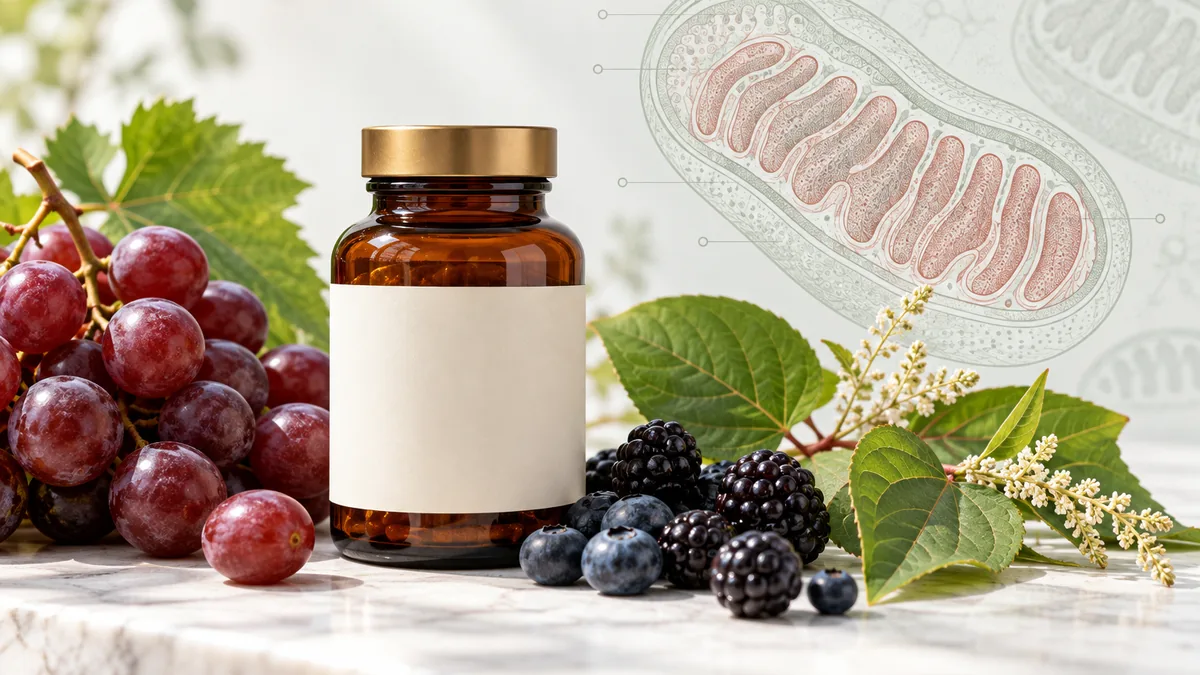
Resveratrol is a naturally occurring stilbene polyphenol. Plants can produce it as part of their response to stress, and people encounter small amounts in foods including grape skins, some berries, peanuts, and red wine. The food source matters because a whole food brings fiber, water, and many other compounds; it is not simply a low-dose version of a resveratrol capsule.
Laboratory research has examined resveratrol in relation to sirtuins, AMPK, endothelial signaling, inflammation, oxidative stress, and mitochondrial biogenesis. These pathways help explain why marketing language often uses terms such as cellular energy or healthy aging. They are useful hypotheses, but a cell pathway is not the same as a patient outcome. The body also absorbs, transforms, and clears resveratrol, so a dish, a standardized extract, and a branded blend are different interventions.
Keep the biological story in proportion
| Layer | What researchers may be asking | What a buyer still needs to know |
|---|---|---|
| Cell signaling | Can resveratrol influence pathways involved in stress response or energy regulation? | Whether the effect occurs at a safe oral dose in people and matters to the stated goal. |
| Mitochondrial biology | Can it affect mitochondrial number, function, or redox signaling under a defined model? | Whether an oral retail product produces a meaningful functional outcome. |
| Human biomarkers | Does a measured blood, metabolic, or vascular marker change after supplementation? | Whether the marker predicts better daily energy, mobility, or healthy aging. |
| Human experience | Do participants report a change in a defined symptom or performance measure? | Whether the result is durable, typical, and relevant to the finished product. |
What human evidence says about resveratrol and mitochondrial support
Human evidence is more useful when the question is narrow. A study may test insulin sensitivity, vascular function, inflammation, exercise adaptation, cognition, or a laboratory marker in a specific population. A positive result in one endpoint does not establish that resveratrol increases stamina or changes the course of aging. A null result may also reflect the chosen dose, duration, formulation, or population rather than answering every possible question.
A systematic review of resveratrol supplementation in older adults illustrates the problem: studies do not all point in the same direction, and the outcomes are not interchangeable. This is why a responsible resveratrol supplement guide should describe uncertainty instead of assigning a universal score. Research on an isolated compound also does not validate a blend that adds botanicals, vitamins, or a proprietary delivery system.
An evidence ladder for resveratrol claims
| Evidence level | What it can support | What remains open |
|---|---|---|
| Biochemical mechanism | A plausible reason to study signaling, redox, or mitochondrial pathways. | Whether a consumer dose changes a useful outcome. |
| Cell or animal research | How resveratrol might behave in a controlled model. | Whether the exposure, metabolism, and result translate to people. |
| Short human trial | Tolerability or a measured endpoint for the tested product and population. | Long-term safety, generalizability, and whether the result feels meaningful. |
| Systematic review | How several studies fit together and where results are inconsistent. | A guarantee for a new formulation, higher dose, or individual buyer. |
| Finished-product evidence | The most direct test of a specific label, serving, and outcome. | Whether the seller has made that evidence available and repeated it. |
The fair conclusion is that resveratrol remains a plausible research ingredient with uneven clinical evidence. It may be worth understanding for someone comparing healthy-aging or mitochondrial-support products, but the evidence does not justify promises to reverse aging, fix fatigue, increase ATP on demand, or prevent disease.
Food sources, extracts, and supplements are not interchangeable
Food-first advice is not a dismissal of supplement research. It is a way to avoid treating a concentrated extract as if it were a serving of grapes. Food amounts vary, while a capsule may deliver a standardized or very large quantity alongside excipients and other actives. The form may also differ: trans-resveratrol, cis-resveratrol, a grape extract, and a Japanese knotweed extract are not automatically equivalent label descriptions.
Questions to ask about the source
| Source | What it offers | What it does not answer |
|---|---|---|
| Grapes, berries, peanuts, and other foods | A practical way to add plant foods, fiber, fluids, and variety. | The exact resveratrol amount or a concentrated supplement effect. |
| Standardized resveratrol extract | A clearer target amount than an ordinary food serving. | Whether the amount is safe or effective for the buyer's goal. |
| Japanese knotweed or Polygonum cuspidatum extract | A botanical source that may be used to provide resveratrol-related compounds. | That every extract has the same identity, purity, or resveratrol content. |
| Multi-ingredient formula | Convenience when several ingredients are intentionally combined. | Which ingredient caused a benefit, side effect, or lack of change. |
A sensible first step
- Use a varied eating pattern before chasing a single polyphenol, especially if the goal is general health rather than a clinician-defined deficiency.
- Treat red wine as an alcohol choice, not as a resveratrol prescription. Drinking more is not a safe way to pursue a supplement claim.
- If a clinician recommends a supplement for a defined reason, compare the studied form and amount with the product you can actually buy.
- Keep a short list of every botanical, vitamin, medicine, and over-the-counter product so overlaps are visible.
How to compare a resveratrol supplement label
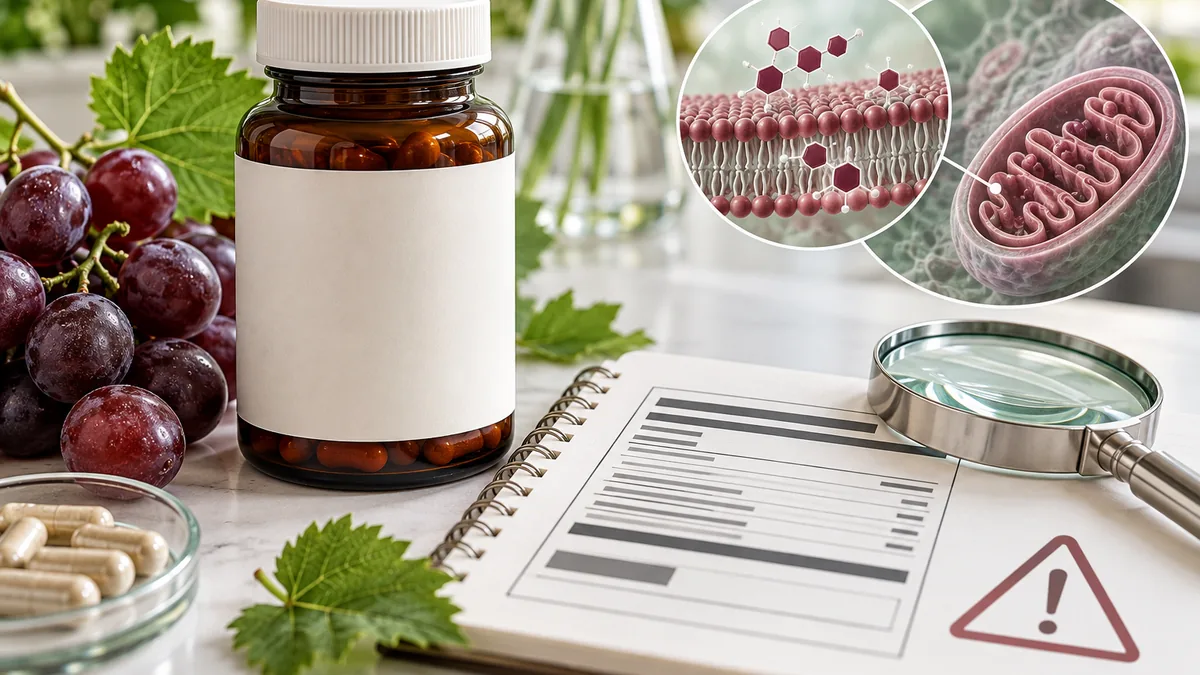
A resveratrol supplement should be judged by its complete Supplement Facts panel and seller information, not by a large word such as longevity on the front. Before comparing price, identify the exact active, chemical form, amount per serving, serving size, other ingredients, lot traceability, and directions. If the product uses a proprietary blend, the missing individual amounts make both evidence matching and safety review harder.
Label and quality questions
- Does the label name trans-resveratrol, cis-resveratrol, grape extract, Japanese knotweed extract, or another source, and is the actual amount clear?
- Is the amount listed per capsule, serving, or daily direction, and does that match the dose used in the study being cited?
- Are other botanicals, piperine, vitamins, or stimulants listed separately with individual amounts?
- Can the seller explain identity, purity, contaminant testing, lot number, expiry, storage, and who is responsible for manufacture?
- Does the total cost include shipping, a subscription, or a recurring charge, and is the refund process easy to verify?
- Would the product duplicate an existing healthy-aging stack or create a new interaction question?
Slow down when the label is vague
| Label signal | Why it matters | Better question |
|---|---|---|
| A proprietary blend | The buyer cannot match an individual amount to human evidence. | What is the amount of each active per serving? |
| A high percentage or large milligram headline | The number may describe an extract rather than resveratrol itself. | What compound is standardized, and how was it verified? |
| Mitochondrial or anti-aging promise | A marketing outcome may be broader than the supporting study. | Which finished-product human trial measured that outcome? |
| No lot or testing information | Identity and contamination questions remain unresolved. | Can the seller provide a current lot-specific certificate or test summary? |
Resveratrol safety, interactions, and when to ask first
Resveratrol is often marketed as a natural antioxidant, but natural does not mean interaction-free. The relevant risk depends on amount, formulation, other ingredients, medicines, and the person's health context. Reported supplement effects can include digestive upset, headache, or other intolerance; the more important practical question is whether a concentrated product could affect bleeding, procedures, medication levels, or an existing condition.
Situations that deserve clinician or pharmacist review
| Situation | Why it matters | Practical next step |
|---|---|---|
| Warfarin, antiplatelet drugs, or a bleeding disorder | Concentrated botanicals may complicate bleeding-risk decisions, especially in combinations. | Show the full label and medication list before starting or changing a product. |
| Upcoming surgery, dental procedure, or biopsy | Supplement use can affect the perioperative plan even when the product seems routine. | Tell the procedural team what you take and follow their instructions. |
| Pregnancy, breastfeeding, or trying to conceive | Evidence and appropriate amounts may be limited, and concentrated extracts are not ordinary foods. | Do not self-prescribe a high-dose botanical; ask a qualified professional. |
| Liver, kidney, bleeding, or hormone-sensitive condition | The condition and medication context can change the risk-benefit question. | Ask whether the ingredient is appropriate before buying. |
| Multiple supplements or cancer treatment | Overlapping botanicals and treatment interactions can be difficult to predict. | Bring every product, dose, and prescription to the treating team. |
Stop and seek appropriate help for
- Unusual or heavy bleeding, black or bloody stools, severe bruising, fainting, or marked weakness.
- Trouble breathing, facial swelling, widespread hives, or another possible severe allergic reaction.
- Persistent vomiting, severe abdominal pain, jaundice, confusion, or a rapidly worsening reaction.
- New, severe, or unexplained fatigue, shortness of breath, weight change, numbness, or exercise intolerance.
Do not adjust a prescription, stop a cancer treatment, or delay an evaluation because a product is described as mitochondrial or natural. A symptom diary can help: record the product, serving, timing, other medicines, and what changed. Then take that record and the actual label to a healthcare professional.
Where Advanced Mitochondrial Formula fits in a resveratrol comparison
Disclosure: MitoEnergy Reviews may earn a commission if you buy Advanced Mitochondrial Formula through the clearly marked official offer link. That relationship does not turn resveratrol into a proven treatment or make the formula a resveratrol product. The page is included because readers comparing healthy-aging and mitochondrial-support ingredients may also encounter a broader formula.
The official sales page reviewed for this site discusses an Itadori extract and several other mitochondrial-support ingredients. That is a different product hypothesis from buying a defined resveratrol supplement. Before treating the two as alternatives, verify the current Supplement Facts panel, serving directions, total cost, guarantee terms, and any ingredient overlap with your existing routine.
A category-level comparison
| If your priority is | A resveratrol product may offer | A broad mitochondrial formula may offer |
|---|---|---|
| Testing one named polyphenol | A narrower ingredient hypothesis and simpler attribution. | Less control because several active ingredients are introduced together. |
| Convenience across several ingredient categories | A limited answer unless the label includes other actives. | One product that may combine NAD-support, ATP-support, antioxidant, and absorption-support ingredients. |
| Evidence matching | A closer match is possible when form and dose are disclosed. | Finished-formula evidence is still needed; individual ingredient studies are not enough. |
| Safety review | The interaction list may be narrower, but dose and form still matter. | The complete ingredient list and overlap review become more important. |
For a detailed product decision, start with the independent review rather than treating a comparison table as a recommendation. A broad formula can be reasonable for someone who values convenience, while a single ingredient can be easier to audit. Neither choice proves a mitochondrial or anti-aging outcome.
Bottom line: use resveratrol as a question, not a promise
Resveratrol has a credible research story and a large marketing story. The credible part is that it is a biologically active polyphenol with plausible links to several cellular pathways. The marketing leap is that any capsule will increase energy, repair mitochondria, reverse aging, or prevent disease. Human evidence remains mixed, product forms vary, and safety depends on the person's context.
A sensible decision sequence is simple: build a varied food and movement routine, define the outcome you actually want, match the product form and dose to evidence, check testing and interactions, and involve a clinician when symptoms or medication questions are present. If a multi-ingredient formula still fits, compare it by its complete label and terms rather than borrowing certainty from resveratrol research.
Frequently asked questions
Does resveratrol improve mitochondrial function?
Resveratrol affects pathways connected to mitochondrial biology in laboratory and some human research, but that does not establish a reliable improvement in everyday energy or mitochondrial function for every person. The answer depends on the form, amount, population, outcome, and finished product.
Is resveratrol a proven anti-aging supplement?
No. Resveratrol has interesting mechanistic, animal, and human research, but studies vary and it has not been shown to extend human lifespan. Treat anti-aging language as a reason to inspect evidence, dose, testing, and safety rather than as a result guarantee.
Is it better to get resveratrol from grapes or a supplement?
They are different choices. Grapes and other plant foods provide a broader food pattern with fiber and other nutrients, while a supplement provides a concentrated and more standardized amount. A supplement is not automatically better, and wine is not a safe prescription for resveratrol.
What should I look for in a resveratrol supplement?
Look for the exact chemical form or botanical source, amount per serving, complete active list, lot traceability, testing information, directions, storage, seller identity, and total cost. Be cautious when a proprietary blend hides individual amounts or the product makes broad mitochondrial, energy, or longevity promises.
Can resveratrol interact with medications?
It may be relevant to bleeding risk, procedures, and other medication questions, especially in a concentrated multi-ingredient product. People taking warfarin or antiplatelet drugs, preparing for surgery, receiving cancer treatment, or managing a chronic condition should show the full label to a clinician or pharmacist before use.
Is Advanced Mitochondrial Formula a resveratrol supplement?
No. It is positioned as a broader, capsule-based mitochondrial-support formula. Its sales page discusses an Itadori extract and other ingredients, but the current Supplement Facts panel should be checked before ordering. Compare the whole formula, not a single resveratrol claim, and verify the current price and guarantee.
Sources and further reading
- PubMed: Resveratrol supplementation in older adults - systematic review
- PMC: Resveratrol - A Double-Edged Sword in Health Benefits
- NIH NCCIH: Using Dietary Supplements Wisely
- NIH Office of Dietary Supplements: Dietary Supplements - What You Need to Know
- FDA: FDA 101 - Dietary Supplements
- FTC: Health Products Compliance Guidance