Contents
- Quick answer: D-ribose is part of ATP biology, not instant energy
- What D-ribose is, and why ATP appears in the marketing
- What human studies actually tell us
- Dose questions start with the label, not a study headline
- D-ribose side effects and who should ask before using it
- Where D-ribose fits in Advanced Mitochondrial Formula
- Bottom line
- Frequently asked questions
Quick answer: D-ribose is part of ATP biology, not instant energy
D-ribose is a five-carbon sugar the body uses to build ribose-containing molecules, including the backbone of adenosine triphosphate, or ATP. ATP transfers usable energy inside cells, so the ingredient has a real connection to cellular-energy biology. The important limit is that being a building block does not prove that an oral D-ribose supplement will make a healthy person feel more energetic.
Human research is small and highly context-dependent. One crossover study in 26 healthy young adults found some exercise and recovery differences in participants with lower aerobic fitness, but not in the higher-fitness group. Other studies examine people with specific health conditions or combine D-ribose with ingredients such as niacinamide, ubiquinol, or creatine. Those results cannot be assigned to D-ribose alone or generalized to everyday fatigue.
The practical verdict
- Biology: D-ribose is a legitimate component of nucleotide and ATP pathways.
- Evidence: plausible mechanism and a few small human studies do not establish a reliable everyday energy benefit.
- Product choice: compare the disclosed amount, complete formula, testing, daily cost, and claim quality rather than buying the pathway story alone.
- Safety: blood-glucose context, medications, pregnancy, health conditions, and persistent fatigue deserve professional review.
Claim check at a glance
| Claim | What is reasonable | What is not established |
|---|---|---|
| D-ribose is involved in ATP biology | Yes. Ribose is part of ATP and other important cellular molecules. | That more oral ribose automatically creates more useful energy in every person. |
| D-ribose improves exercise recovery | A small study found benefits in a lower-fitness subgroup during a specific repeated-exercise protocol. | A consistent effect for trained adults, casual walkers, or people with unexplained fatigue. |
| D-ribose supports NAD | Ribose chemistry intersects with nucleotide pathways, and one pilot studied D-ribose with niacinamide. | That D-ribose alone works like NMN, NR, NAD, or the tested combination. |
| A multi-ingredient formula supplies D-ribose | The label can confirm whether it is present and disclose the serving amount. | That research on isolated D-ribose proves the finished formula's results. |
What D-ribose is, and why ATP appears in the marketing
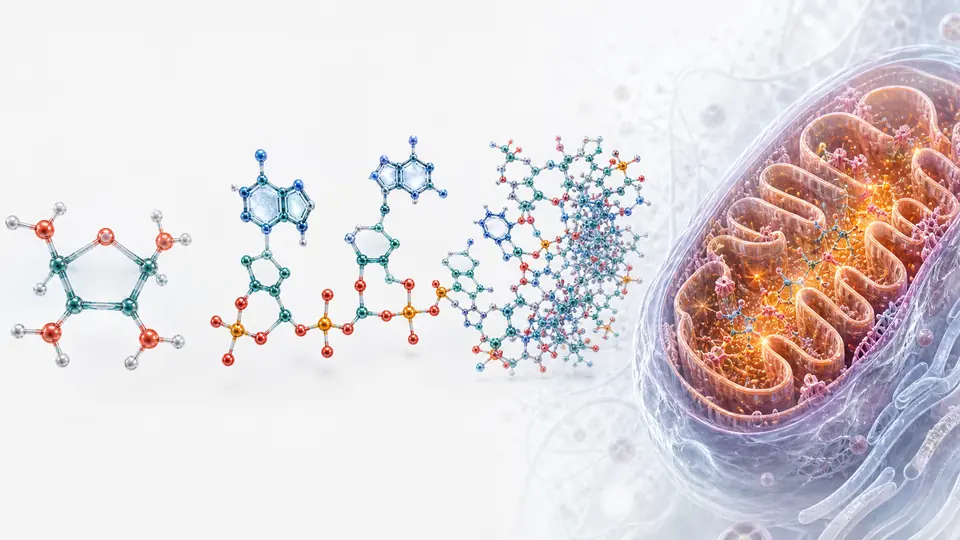
D-ribose is a pentose, meaning a sugar with five carbon atoms. The body can make ribose through the pentose phosphate pathway and use ribose-derived structures in nucleotides, nucleic acids, coenzymes, and ATP. This is different from the familiar claim that a sweet ingredient simply provides calories for quick energy.
ATP consists of adenosine attached to three phosphate groups. The adenosine portion contains adenine and ribose. Cells continually make, use, and recycle ATP rather than storing a large reserve. Mitochondria are central to aerobic ATP production, but ATP turnover is regulated by oxygen delivery, fuel availability, enzymes, training status, tissue demand, health, and many other factors. Supplying one structural component does not bypass that system.
Three ideas that are easy to confuse
- Ingredient identity: the powder in a product is D-ribose.
- Pathway role: ribose structures are used in ATP and other molecules.
- Consumer outcome: a person reports better energy, recovery, or function after taking a defined product.
What human studies actually tell us
The most relevant healthy-adult study used a double-blind crossover design with 26 participants. They took 10 grams per day of D-ribose or dextrose around a multi-day high-intensity cycling protocol. The lower-fitness subgroup maintained power better and reported lower perceived exertion with D-ribose, while the higher-fitness subgroup showed no differences in the reported performance, exertion, heart-rate, muscle-enzyme, kidney-marker, or glucose outcomes.
That study is interesting, but it is not a broad proof of energy support. The sample was small, the participants averaged about 28 years old, the exercise challenge was specific, the dose was measured in grams, and the subgroup result matters. It does not tell us whether a lower amount inside a multi-ingredient capsule improves ordinary afternoon tiredness in an adult over 40.
How to interpret the main evidence buckets
| Evidence bucket | What it can suggest | Why it does not settle the purchase |
|---|---|---|
| Biochemistry | Ribose is needed for ATP and nucleotide synthesis. | Mechanism alone does not establish absorption, dose response, or felt energy. |
| Healthy-adult exercise study | A lower-fitness subgroup may respond differently during repeated intense exercise. | Only 26 young adults were studied, and the higher-fitness subgroup did not show the same differences. |
| Niacinamide plus D-ribose pilot | The combination changed several blood markers over seven days and produced exploratory questionnaire findings. | It was a small, short combination study and cannot isolate D-ribose or prove lasting clinical benefit. |
| Studies in diagnosed conditions | They may generate condition-specific hypotheses under medical supervision. | They should not be used to market self-treatment of heart disease, chronic fatigue, or mitochondrial disease. |
| Testimonials | They describe individual experiences. | Expectation, routine changes, other ingredients, and natural symptom variation are uncontrolled. |
A 2022 pilot in healthy middle-aged adults studied a proprietary combination of niacinamide and D-ribose for seven days. It reported changes in the blood NAD metabolome and exploratory fatigue, concentration, motivation, cortisol, and glucose measures. The useful reading is narrow: that exact combination deserves further study. It does not show that D-ribose alone, niacinamide alone, or a different finished formula produces the same result.
Dose questions start with the label, not a study headline
D-ribose research often uses gram amounts, while a capsule blend may contain a smaller quantity or may not make the individual amount easy to compare. Do not borrow a research dose from a different product, population, or purpose. Instead, record the amount per serving, servings per day, total daily amount, other active ingredients, and whether the panel uses a proprietary blend.
D-ribose label checklist
| Check | Useful signal | Reason to pause |
|---|---|---|
| Exact ingredient | D-ribose is named clearly on the Supplement Facts panel. | Only a cellular-energy blend name appears. |
| Amount | The amount per serving and suggested daily servings are visible. | A study dose is advertised without showing the product's dose. |
| Formula context | Every active ingredient can be reviewed for overlap and interactions. | D-ribose evidence is used as proof for a large proprietary blend. |
| Testing | The seller explains identity and contaminant testing and can provide useful documentation. | Purity claims are prominent but batch information is unavailable. |
| Outcome language | The page uses support language and acknowledges evidence limits. | The product promises to fix fatigue, restore youth, or treat a disease. |
| Value | You can calculate daily cost and compare a single ingredient with a broad formula. | A large bundle is pushed before fit, tolerance, and return terms are clear. |
D-ribose side effects and who should ask before using it
D-ribose may sound gentle because it is naturally present in human biology, but natural does not mean risk-free at supplemental amounts. Reported tolerability concerns include gastrointestinal discomfort, nausea, diarrhea, headache, and dizziness. Blood glucose deserves particular attention because ribose intake has lowered glucose measurements in some research settings. A front-label statement that D-ribose is not the same as ordinary table sugar is not a personalized safety assessment.
Get professional guidance before use if
- You have diabetes, recurrent low blood sugar, an eating pattern that makes glucose control difficult, or you take glucose-lowering medication.
- You use prescription medicines, are preparing for surgery, or plan to combine several energy, NAD, pre-workout, or mitochondrial products.
- You are pregnant or breastfeeding, are buying for a child, or have kidney, liver, heart, or other chronic health conditions.
- Your fatigue is new, severe, persistent, worsening, or accompanied by chest pain, shortness of breath, fainting, weakness, fever, bleeding, or unexplained weight change.
European food-safety reviewers also treated hypoglycemia as a central uncertainty when evaluating supplemental D-ribose intake. That does not mean every user will experience low glucose; it means dose and individual context matter. Starting multiple new ingredients together further complicates the picture because a benefit or side effect cannot be attributed confidently to D-ribose.
Where D-ribose fits in Advanced Mitochondrial Formula
The official Advanced Mitochondrial Formula offer page presents D-ribose as one part of a broader ingredient strategy. The formula also discusses niacinamide, PQQ, CoQ10, acetyl-L-carnitine, alpha-lipoic acid, magnesium, plant compounds, and BioPerine. This makes the product a convenience stack, not a standalone D-ribose experiment.
That distinction cuts both ways. A broad formula may appeal to someone who does not want to manage many bottles, and it may cover several mitochondrial-support categories in one routine. It also gives less control over testing one ingredient at a time and makes product-specific evidence, dose transparency, medication overlap, and tolerance more important.
Standalone D-ribose vs a broad mitochondrial formula
| Decision point | Standalone D-ribose | Advanced Mitochondrial Formula |
|---|---|---|
| Main reason to consider | You specifically want to evaluate D-ribose. | You prefer one product spanning several ingredient categories. |
| Dose visibility | Usually easier to compare with D-ribose research. | Review the current label and serving instructions for every component. |
| Attribution | A response is easier to connect to one new ingredient. | Benefits or side effects may be difficult to assign. |
| Interaction review | Narrower, though personal health context still matters. | Broader because several ingredients and BioPerine must be considered. |
| Evidence question | Does this D-ribose dose fit the evidence and your goal? | Is there finished-product evidence, and are claims proportional to it? |
Bottom line
D-ribose has a clear biological relationship to ATP, but the consumer evidence is narrower than the marketing story. Small studies can justify further research and careful product comparison; they do not justify guaranteed energy, recovery, anti-aging, or disease claims.
For a purchase decision, verify the amount, complete formula, testing, daily cost, claim quality, and return terms. If D-ribose appears inside a broad formula, judge the finished stack rather than crediting one ingredient with the whole sales promise. If low blood sugar, medications, health conditions, or unexplained fatigue are part of the picture, ask a qualified healthcare professional before experimenting.
Frequently asked questions
Does D-ribose give you energy?
D-ribose is a structural part of ATP-related biology, but that does not mean a supplement reliably creates noticeable energy. Human evidence is small, uses specific doses and populations, and has produced context-dependent results.
Is D-ribose the same as sugar?
D-ribose is a five-carbon sugar, but it is not the same molecule as table sugar or glucose. Its different metabolism does not make supplemental amounts automatically risk-free, especially for people with blood-glucose concerns.
How is D-ribose connected to ATP?
The adenosine portion of ATP contains adenine attached to ribose. The body makes and recycles ATP through regulated pathways, so providing ribose is not equivalent to directly adding usable cellular energy.
Can D-ribose lower blood sugar?
Some research has observed lower blood-glucose measurements after ribose-containing interventions. People with diabetes, low-glucose episodes, restricted food intake, or glucose-lowering medications should discuss D-ribose with a healthcare professional.
Is Advanced Mitochondrial Formula a D-ribose supplement?
It contains D-ribose according to the official offer page, but it is better classified as a broad multi-ingredient mitochondrial-support formula. Evidence on D-ribose alone does not prove the effects of the complete product.
Should I choose standalone D-ribose or a multi-ingredient formula?
Standalone D-ribose offers simpler dose and tolerance tracking. A multi-ingredient formula offers convenience but requires a broader interaction and evidence review. Neither option should replace evaluation of persistent or unexplained fatigue.
Sources and further reading
- Journal of the International Society of Sports Nutrition: The influence of D-ribose ingestion and fitness level on performance and recovery
- Nutrients: Pilot trial of a nicotinamide and D-ribose combination in healthy middle-aged adults
- EFSA Journal: Safety of D-ribose as a novel food
- FDA: FDA 101 - Dietary Supplements
- Advanced BioNutritionals official Advanced Mitochondrial Formula offer page