Contents
- Quick verdict: convenience is clear, delivery and benefit are not
- What is actually inside an NAD patch?
- Do NAD patches work? Use a route-matched evidence test
- Why the word supplement may be misleading on a skin patch
- NAD patches vs capsules: compare the whole decision
- How to review an NAD patch before buying
- NAD patch side effects and safer-use questions
- Where Advanced Mitochondrial Formula fits, and where it does not
- Bottom line
- Frequently asked questions
Quick verdict: convenience is clear, delivery and benefit are not
NAD patches are adhesive products marketed to release NAD, NADH, NAD-related precursors, or vitamin blends through the skin over several hours. The format may be discreet and easier than swallowing capsules, but a patch on the skin does not by itself prove that its active ingredient crosses the skin in a useful amount, raises NAD where it matters, or improves energy, focus, recovery, or healthy aging.
As of July 19, 2026, a targeted PubMed title-and-abstract search for the exact phrase 'NAD patch' returned no results. That search cannot prove that no relevant research exists, but it does mean buyers should not assume that studies of oral NMN, NR, intravenous NAD, nicotine patches, or general transdermal technology validate a consumer NAD patch. The seller should be able to show evidence for the exact ingredient, patch design, wear time, and finished product.
The 60-second decision
- Choose the route first: a patch, an oral NAD-related product, and a broad mitochondrial formula are different strategies.
- Look for the exact active ingredient and amount delivered, not only a front-label NAD+ claim.
- Ask for finished-patch release, stability, adhesion, and human delivery data rather than borrowing evidence from unrelated patches.
- Treat guaranteed energy, detox, anti-aging, or disease claims as reasons to leave the page.
- Put unexplained or persistent fatigue through medical evaluation before supplement shopping.
NAD patch claims at a glance
| Claim | What it may describe | What still needs evidence |
|---|---|---|
| Slow release | The patch is designed to hold an ingredient against the skin over time. | Release rate, skin penetration, delivered dose, and consistency across the wear period. |
| Bypasses digestion | The product is used on skin rather than swallowed. | That the named ingredient crosses the skin barrier in a useful amount. |
| Supports cellular energy | A structure/function-style marketing concept tied to NAD biology. | A meaningful human outcome from the exact finished patch. |
| All-day effect | A proposed wear window or customer impression. | Validated delivery over time and a reliable benefit rather than expectation or normal variation. |
What is actually inside an NAD patch?
The search term NAD patches hides several product categories. One label may name nicotinamide adenine dinucleotide, another may use NADH, and another may combine niacinamide, botanical extracts, caffeine, vitamins, or minerals under NAD-support language. These are not interchangeable. Copy the exact ingredient list before comparing reviews or prices.
Translate the label before judging the patch
| Label wording | What it means | Question to ask |
|---|---|---|
| NAD or NAD+ | The oxidized coenzyme is named as an active. | How much is released from the patch and how much crosses human skin? |
| NADH | The reduced form is named. | Is evidence for NADH matched to this route, dose, and finished patch? |
| NMN, NR, or niacinamide | A precursor or vitamin B3-related ingredient is used instead of direct NAD. | Does the front label make the active and amount clear? |
| NAD support blend | The name may cover multiple ingredients or a proprietary mixture. | Can you verify every active amount and identify likely interactions? |
| Matrix, adhesive, or penetration enhancer | Materials control contact, release, adhesion, and potentially skin transport. | Are all non-active materials disclosed, and is irritation testing available? |
A number printed on the pouch is not necessarily the amount that reaches circulation. It might describe ingredient loaded into the patch, a blend total, or a marketing strength. Stronger labeling distinguishes load, release over the stated wear time, and any measured systemic exposure. If the company does not define the number, cost-per-milligram comparisons are unreliable.
Do NAD patches work? Use a route-matched evidence test
Skin is a protective barrier, not an open doorway. Successful prescription patches are engineered around compounds with suitable properties, controlled release, adhesion, stability, and extensive testing. FDA guidance for transdermal and topical delivery systems discusses product design, manufacturing, adhesion, release, and other quality issues because a patch has to perform as a complete system. That general technology does not show that any molecule can be delivered by adding it to an adhesive square.
NAD biology and oral precursor research answer different questions. A study in which NMN or NR changes a blood NAD-related marker cannot establish that direct NAD crosses intact skin. Likewise, intravenous NAD bypasses both skin and digestion, so an infusion result cannot be used as proof for a patch. Evidence should follow the route.
Evidence ladder for an NAD patch
| Evidence shown | What it supports | What it does not prove |
|---|---|---|
| Ingredient mechanism or NAD pathway diagram | The ingredient relates to a biological pathway. | Skin delivery, dose, product performance, or benefit. |
| Laboratory release test | The patch releases material under the tested conditions. | Absorption through living human skin or a clinical outcome. |
| Skin permeation study | The ingredient crossed the tested skin model under defined conditions. | Consistent real-world exposure, safety, or noticeable benefit. |
| Blood measurement after use | The patch may affect a measured marker or exposure level. | That the change improves energy, cognition, recovery, or aging. |
| Randomized finished-product trial | Stronger evidence for the exact patch, wear schedule, participants, and outcomes. | All NAD patches, other doses, or long-term use beyond the study. |
Questions that expose borrowed evidence
- Was the exact retail patch tested, or does the citation study an oral capsule, injection, unrelated drug patch, or isolated ingredient?
- Did researchers measure patch release, skin permeation, blood exposure, or only a self-reported feeling?
- Was there a control group, enough participants, a prespecified outcome, and a complete report?
- Does the tested wear time and amount match the product being sold today?
- Are adverse events, dropouts, funding, and conflicts reported as clearly as the positive result?
Why the word supplement may be misleading on a skin patch
FDA's consumer guidance says a dietary supplement is a product intended for ingestion. A product worn on the skin is not automatically regulated as a dietary supplement simply because a seller calls it a supplement or uses familiar wellness ingredients. Its legal status can depend on composition, intended use, claims, and how it is marketed. This guide is not legal advice, but the distinction matters when a seller leans heavily on supplement language.
Do not treat a Supplement Facts-style panel, facility badge, or 'FDA registered' phrase as FDA approval. Ask the company to explain the product category, responsible business, manufacturing location, lot traceability, complaint process, and the evidence behind its delivery claims. Registration language is not a substitute for finished-product authorization, quality, or effectiveness.
Regulatory and seller transparency checks
- A physical U.S. business address and a working customer-service channel.
- Lot or batch identification, expiration date, storage conditions, and sealed individual packaging.
- A complete active and inactive ingredient list, including adhesive and penetration-enhancing materials where applicable.
- Clear instructions for placement, wear time, rotation, missed use, removal, and disposal.
- No suggestion that facility registration, a disclaimer, or a laboratory logo means FDA approved.
NAD patches vs capsules: compare the whole decision
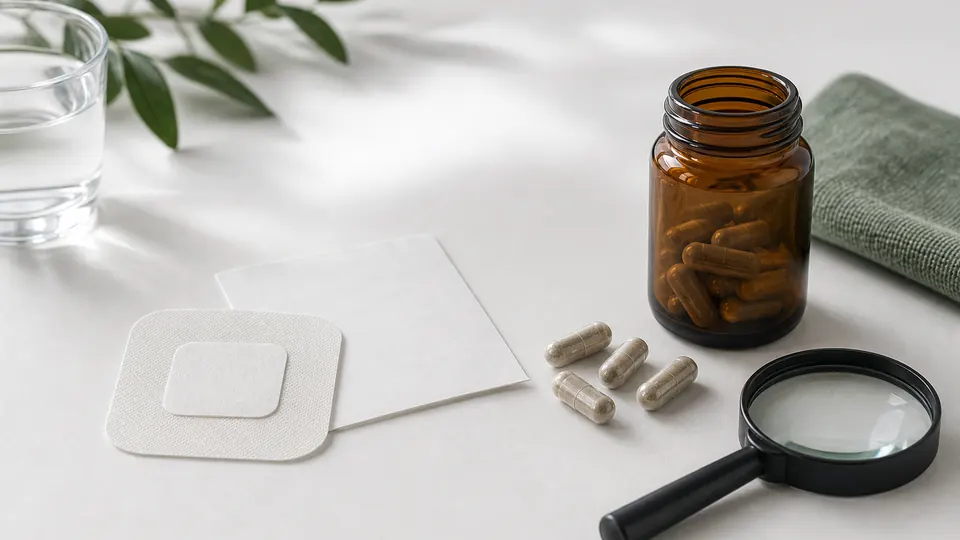
Patches may appeal to people who dislike swallowing pills or want a format that does not interrupt the day. Capsules are usually easier to compare by ingredient amount, serving count, and published oral research. Neither route wins automatically: the useful question is which product makes its identity, delivered dose, evidence, safety, and total cost easier to verify.
Patch and capsule tradeoffs
| Decision factor | NAD patch | Oral capsule |
|---|---|---|
| Convenience | No swallowing; can be worn during routine activities if it adheres well. | Quick to take but may be unsuitable for people with swallowing difficulty. |
| Dose transparency | Loaded amount may not equal released or absorbed amount. | Amount swallowed is usually clearer, though absorption still varies. |
| Evidence match | Needs patch-specific release, permeation, exposure, and outcome evidence. | More oral NAD-precursor research exists, but it still may not validate a retail bottle. |
| Tolerability | Adhesive reactions, redness, itching, poor adhesion, or skin sensitivity are possible. | Digestive effects, ingredient intolerance, and capsule excipient issues are possible. |
| Use consistency | Heat, sweat, placement, skin products, and partial lifting may affect performance. | Food timing, missed servings, and routine adherence may affect use. |
| Value comparison | Compare cost per patch and verified wear period, not only package price. | Cost per labeled daily serving is usually easier to calculate. |
How to review an NAD patch before buying
A useful NAD patches review should inspect the current pouch, instructions, seller, and supporting documents rather than repeat testimonials. Save a screenshot of the label and terms because formulations, package counts, subscriptions, and return policies can change. Then calculate the cost for the actual labeled wear schedule.

NAD patch buyer checklist
| Check | Stronger signal | Reason to pause |
|---|---|---|
| Active identity | Every active and inactive ingredient is named clearly. | Only a proprietary NAD energy matrix appears. |
| Delivered amount | The seller distinguishes patch load, release, and measured exposure. | A large milligram number is shown with no definition. |
| Finished-product evidence | Methods and results match the current patch and wear instructions. | Citations concern oral NAD precursors, injections, or unrelated patches. |
| Quality records | Lot traceability, stability, packaging, and relevant testing are documented. | A generic certificate has no patch name, lot, date, methods, or specifications. |
| Instructions | Placement, rotation, wear time, heat, water, removal, and disposal are covered. | The pouch offers a slogan but no usable directions. |
| Commercial terms | Patch count, daily cost, subscription, cancellation, and refund rules are clear. | A trial silently converts to recurring shipments or returns are impractical. |
| Claims | The seller separates mechanism, delivery measurements, and experienced outcomes. | Guaranteed energy, age reversal, detox, or treatment language. |
Customer comments are most useful for observable issues such as patch lifting, residue, odor, skin irritation, damaged pouches, shipment delays, cancellation, and refunds. They cannot establish absorption or show that a change in energy came from the patch. Reviews are a service-quality signal, not a substitute for route-matched clinical evidence.
NAD patch side effects and safer-use questions
A patch adds skin and adhesive questions to the ingredient's usual safety questions. Possible problems include redness, itching, burning, swelling, blistering, residue, or worsening of an existing skin condition. Systemic effects depend on what the patch contains and how much is delivered. Multi-ingredient patches may make it difficult to identify the cause of a reaction.
Ask a clinician or pharmacist before use if
- You take prescription medicines, use another medicated patch, or combine several NAD, B-vitamin, stimulant, or energy products.
- You are pregnant or breastfeeding, are under 18, have significant allergies or skin disease, or have kidney, liver, cardiovascular, metabolic, or cancer-related concerns.
- You are preparing for surgery or a procedure, or your care team has told you to limit supplements.
- The reason for trying a patch is new, severe, persistent, worsening, or unexplained fatigue, weakness, shortness of breath, dizziness, chest symptoms, or cognitive change.
Follow the product's instructions rather than improvising. Do not cut a patch unless the manufacturer explicitly says it is designed to be cut. Do not apply it to broken or irritated skin, add external heat, stack patches, extend wear time, or reuse one to chase a stronger effect. Rotate sites and keep used and unused patches away from children and pets. Remove the patch and seek appropriate care for a significant skin reaction, breathing difficulty, facial swelling, fainting, severe palpitations, or other concerning symptoms.
Where Advanced Mitochondrial Formula fits, and where it does not
Advanced Mitochondrial Formula is not an NAD patch, a transdermal product, or a direct NAD supplement. It is a capsule-based, multi-ingredient mitochondrial-support formula. Its offer discusses niacinamide alongside D-ribose, PQQ, CoQ10, acetyl-L-carnitine, alpha-lipoic acid, magnesium, and plant compounds. That makes it a broader strategy for readers who value one combined label, not a substitute for someone specifically seeking skin delivery.
The tradeoff is scope. A focused product is easier to evaluate one ingredient at a time; a broad formula may reduce the number of bottles but creates more potential overlap and makes effects harder to attribute. Neither approach should be used to self-treat unexplained fatigue or replace medical care.
Affiliate disclosure: MitoEnergy Reviews may earn a commission if you use the clearly marked offer link below, at no extra cost to you. This relationship does not change the evidence standard applied to NAD patches, and it does not make Advanced Mitochondrial Formula a patch recommendation. Verify the current label, price, package terms, and 90-day guarantee on the seller's page before deciding.
Bottom line
NAD patches solve a format preference more clearly than they solve an evidence problem. A credible seller should identify every ingredient, define the dose language, document release and human skin delivery for the finished patch, explain adhesion and stability, provide complete instructions, and avoid turning NAD biology into guaranteed energy or anti-aging results.
For most buyers, the hardest comparison is not which patch has the best reviews. It is whether a patch-specific evidence package is strong enough to justify its price over a transparent oral precursor, a simpler vitamin strategy, or no supplement at all. Make that route decision before choosing a brand.
Frequently asked questions
Do NAD patches actually work?
A patch can hold an ingredient against the skin, but that does not prove useful delivery or a health benefit. Look for finished-product evidence covering release, human skin permeation or exposure, the labeled wear schedule, safety, and meaningful outcomes. Evidence for oral NMN, NR, intravenous NAD, or unrelated drug patches cannot validate an NAD patch by itself.
Are NAD patches FDA approved?
Do not infer FDA approval from the words supplement, laboratory tested, or FDA registered. FDA defines dietary supplements as products intended for ingestion, while a skin patch may fall into a different regulatory category depending on its ingredients, intended use, and claims. Ask the seller to state the product category and provide verifiable authorization or compliance details.
Are NAD patches better than capsules?
Patches avoid swallowing and may feel more convenient, while capsules usually make the swallowed amount and cost per serving easier to compare. Better depends on route-matched evidence, delivered dose, tolerability, ingredient transparency, adherence, and price, not on the format alone.
How long should you wear an NAD patch?
Use only the wear time and placement instructions provided for the exact product. Do not assume all patches share one schedule, and do not extend wear time, stack patches, cut them, or add heat to increase delivery unless the manufacturer explicitly provides validated instructions.
What are common NAD patch side effects?
Skin redness, itching, burning, swelling, blistering, residue, and poor adhesion are practical concerns. Other effects depend on the active and inactive ingredients and the amount delivered. Remove the patch and seek appropriate care for a significant reaction or concerning systemic symptoms.
Is Advanced Mitochondrial Formula an NAD patch alternative?
It is an alternative only at the broader decision level. Advanced Mitochondrial Formula is a capsule-based, multi-ingredient mitochondrial-support product with niacinamide and other ingredients; it is not a patch or direct NAD product. Compare it only if broad mitochondrial support fits your goal better than transdermal delivery.
Sources and further reading
- FDA: Questions and Answers on Dietary Supplements
- FDA: Transdermal and Topical Delivery Systems - Product Development and Quality Considerations
- PubMed: Exact title and abstract search for NAD patch
- NIH Office of Dietary Supplements: Dietary Supplements - What You Need to Know
- Cleveland Clinic: NAD+ Supplements - Benefits and Risks
- FTC: Health Products Compliance Guidance