Contents
- Quick answer: NMN has the deeper human track record; NMNH is the newer question
- NMN and NMNH share a pathway, but they are not the same molecule
- What human and preclinical evidence actually says
- Does NMNH raise NAD+ better than NMN?
- How to inspect an NMNH or NMN supplement label
- Safety: early human tolerability is not long-term proof
- Which one makes more sense for a real buyer?
- Where Advanced Mitochondrial Formula fits - and where it does not
- A calm checklist before you compare NMN and NMNH prices
- Bottom line: NMNH is interesting, not yet a proven upgrade
- Frequently asked questions
Quick answer: NMN has the deeper human track record; NMNH is the newer question
NMN and NMNH are related NAD+ precursor compounds, but they are not interchangeable names for the same ingredient. NMN is nicotinamide mononucleotide. NMNH is a reduced form of beta-NMN that has been studied in cells, animals, and, more recently, a small early human trial reported as a preprint. The difference matters because a newer molecule can sound more advanced while still having less evidence behind it.
As of September 2026, NMN has the more established human research base, although it still has not become a proven anti-aging or guaranteed-energy supplement. NMNH has a plausible biochemical rationale and encouraging preclinical findings, plus a 2026 randomized phase I preprint of NMNH-Ca in healthy adults. That is meaningful new information, but it is not a head-to-head NMN versus NMNH result, not long-term safety evidence, and not proof that a retail product will improve how every buyer feels.
The practical takeaway
- Choose NMN when you want the more mature human-evidence trail and can find a product with a clear dose, identity, testing, and storage information.
- Treat NMNH as an emerging ingredient rather than a superior version of NMN; the human evidence is still early and product-specific.
- Do not compare a cell or mouse result for NMNH with a separate human NMN trial and call that a fair winner-takes-all comparison.
- Do not stack NMN and NMNH simply because both are linked to NAD+ metabolism; combining them adds cost and makes tolerance or outcomes harder to interpret.
- If the real concern is new, severe, persistent, or unexplained fatigue, medical evaluation comes before either supplement category.
NMN vs NMNH at a glance
| Question | NMN | NMNH |
|---|---|---|
| What is it? | Nicotinamide mononucleotide, commonly marketed as a NAD+ precursor. | Reduced beta-nicotinamide mononucleotide, an emerging reduced NAD+ precursor. |
| Evidence maturity | Several small controlled human studies plus a growing review literature. | Preclinical studies and a recent early human NMNH-Ca preprint; much less independent evidence. |
| What can be measured? | Some studies measure whole-blood NAD+ or selected physiological outcomes. | The early human report measured whole-blood NAD+ and exploratory outcomes, not proof of lasting health benefit. |
| Main buyer question | Is the exact product transparent and does its evidence match the claim? | Is the exact chemical or salt form stable, tested, and worth trying despite greater uncertainty? |
| What is not established? | A universal increase in energy, lifespan, or healthy-aging outcomes. | A human superiority advantage over NMN or long-term safety for routine consumer use. |
NMN and NMNH share a pathway, but they are not the same molecule
NAD+ is a coenzyme involved in redox reactions and energy metabolism. The body also uses NAD-related molecules in processes that involve cellular stress responses, DNA repair, and signaling. That basic biology explains why researchers study NAD+ precursors, but it does not tell a shopper which capsule will produce a noticeable result.
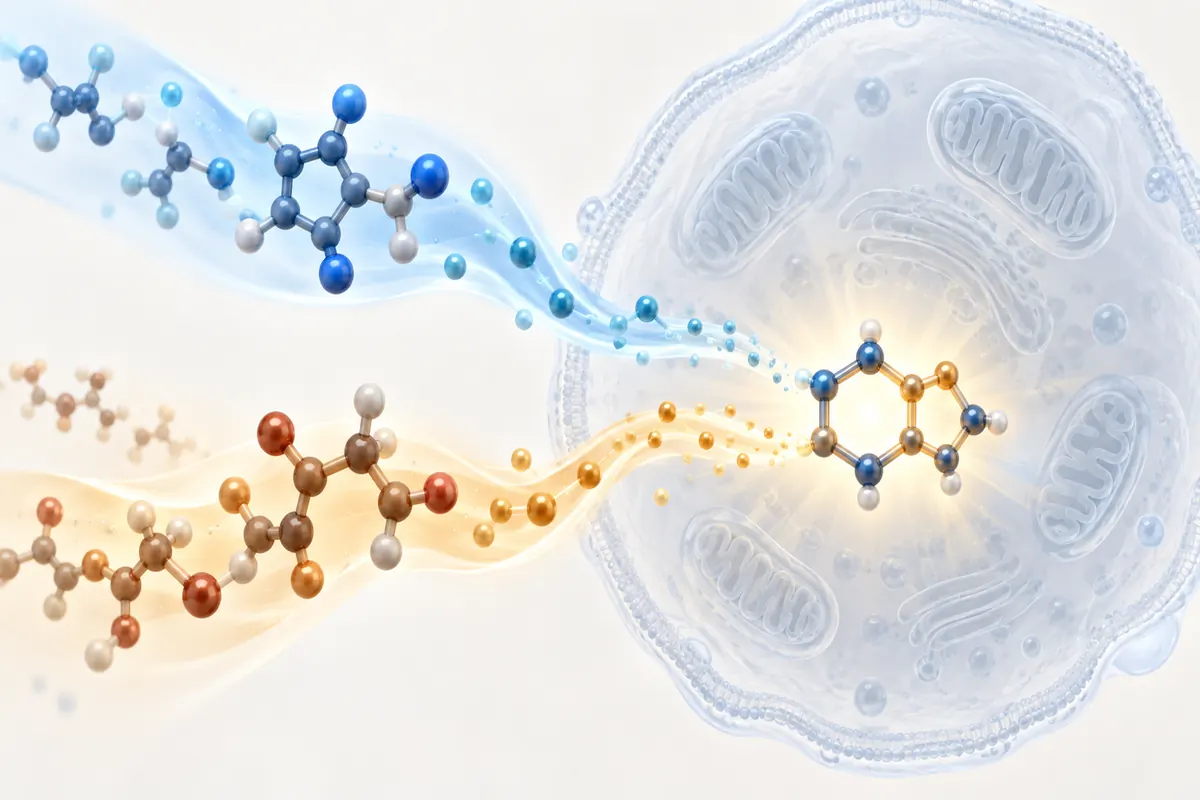
NMN is the oxidized form most consumers see on a supplement label. NMNH is the reduced form. In plain English, the molecules have a related backbone but a different redox state, so it is inaccurate to describe NMNH as simply a stronger serving of ordinary NMN. The salt or delivery form can add another difference: NMNH-Ca, for example, refers to a calcium salt used in the recent human preprint rather than to a generic NMNH powder.
Plain-English label translation
| Label term | What it usually signals | What to verify |
|---|---|---|
| NMN | A nicotinamide mononucleotide ingredient marketed for NAD+ precursor support. | Whether the label identifies beta-NMN, amount per serving, purity, lot, and storage instructions. |
| NMNH | A reduced form of NMN being developed as an NAD-related precursor. | Exact chemical identity, stability information, independent testing, and human evidence for the finished product. |
| NMNH-Ca | A calcium salt form of reduced beta-NMN used in the 2026 early human study. | Whether the product uses the same salt, how the amount is expressed, and whether the study product matches the retail product. |
| NAD+ booster | A marketing category that may include NMN, NR, niacinamide, direct NAD, or a blend. | The actual Supplement Facts panel instead of relying on the category name. |
This is why the words reduced, advanced, bioavailable, or next-generation should not settle the purchase. A buyer needs the ingredient identity, amount, quality controls, stability, and evidence for the product in hand. A pathway diagram is useful context, not a substitute for a trial.
What human and preclinical evidence actually says
The evidence gap between NMN and NMNH is not just a matter of publication count. Researchers have used different doses, chemical forms, populations, time periods, and endpoints. A change in whole-blood NAD+ can show pharmacodynamic activity, but it does not automatically show better stamina, cognition, mobility, lifespan, or protection from disease.
Evidence snapshot
| Evidence layer | NMN | NMNH |
|---|---|---|
| Cells and animals | Preclinical work supports a plausible NAD-related mechanism, but animal outcomes do not predict a retail human result. | A 2021 study reported rapid NAD+ increases in cells and mice and described a different metabolic route; this is useful biology, not a consumer outcome trial. |
| Controlled human research | Small randomized studies have examined safety, blood NAD+, and selected metabolic or physical outcomes over weeks or months. | Controlled human evidence remains sparse. The most relevant current report is an early phase I NMNH-Ca trial available as a preprint. |
| Real-world health outcomes | No universal proof that NMN produces more energy, reverses aging, or treats a condition. | No reliable evidence that NMNH improves everyday energy or healthy aging beyond exploratory signals in one early report. |
The 2026 NMNH-Ca preprint is worth reading because it moves the conversation beyond cells and mice. It randomized 80 healthy adults aged 40 to 65 to placebo or 125, 250, or 500 mg once daily for 90 days. The report says the primary objective was safety and tolerability; it also measured whole-blood NAD+ and explored blood phenotypic age, six-minute walk distance, BMI, and SF-36 domains.
According to the preprint, no serious adverse events, treatment-related adverse events, or discontinuations were reported, and whole-blood NAD+ increased in a dose-related pattern. Those findings are encouraging but bounded. The work is a preprint rather than a completed peer-reviewed consensus, the sample is small, the duration is 90 days, and the authors disclose that the investigational product came from Effepharm, with several authors employed by or advising the company. The exploratory walking, age, and quality-of-life signals are hypothesis-generating, not established benefits.
What this new study does and does not change
- It means it is no longer accurate to say that NMNH has no controlled human data at all.
- It does not create a head-to-head comparison with NMN, NR, or a typical retail NMNH product.
- It supports the need for larger, longer, independently replicated trials with prespecified clinical outcomes.
- It does not establish a personal dose, a safe duration beyond the study, or a reason to self-treat fatigue.
Does NMNH raise NAD+ better than NMN?
The honest answer is not known in humans. The 2021 NMNH paper reported larger and faster NAD+ increases than NMN or NR in its experimental models. That result explains the excitement around NMNH, but a cell or mouse comparison does not prove a proportional advantage in people. It also does not tell us whether a bigger blood NAD+ change translates into a meaningful outcome.
The 2026 preprint adds a human NMNH signal, but its NMN comparison still has to be made indirectly against separate studies. Separate trials are not a fair race: participants, baseline NAD+, assays, salt forms, adherence, diet, dose, and study design can all differ. Even within one trial, a biomarker result can be real without predicting how an individual will feel.
Marketing claim versus evidence needed
| Claim you may see | Evidence that would make it meaningful | Why the shortcut is weak |
|---|---|---|
| NMNH raises NAD+ faster | A randomized, adequately sized, direct human comparison using matched forms, doses, assays, and time points. | A cell or mouse result cannot establish a consumer dose or a human advantage. |
| NMNH gives more energy | A blinded human trial with a prespecified, reliable functional or patient-reported endpoint. | Blood NAD+ is not the same as a noticeable or clinically important energy outcome. |
| NMNH is more bioavailable | Finished-product pharmacokinetic or pharmacodynamic testing that compares the relevant products. | A technical word can describe a delivery idea without proving better absorption or benefit. |
| NMNH is safer because it is newer | Independent safety data across larger populations, longer follow-up, and relevant medication contexts. | Novelty usually means less accumulated safety experience, not more. |
How to inspect an NMNH or NMN supplement label
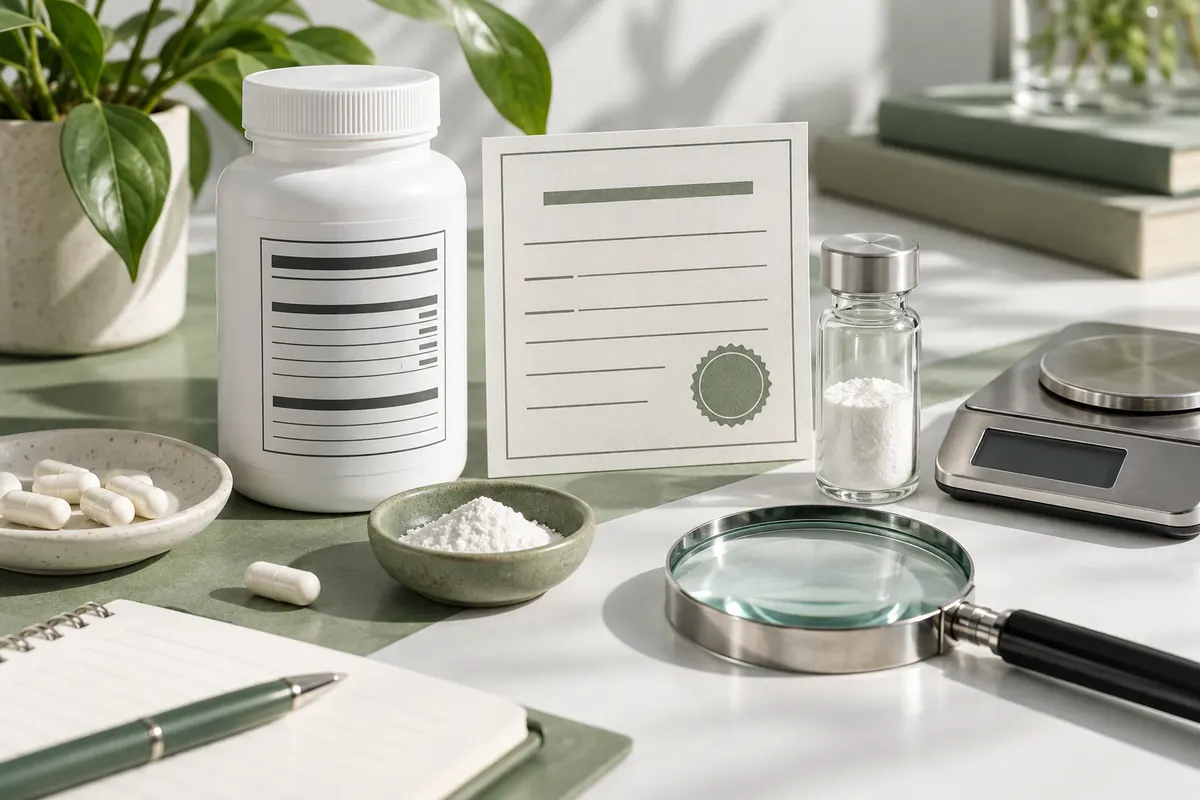
For an emerging ingredient, the label is part of the evidence. A product can use the right acronym and still leave buyers unable to judge identity, stability, amount, contamination risk, or value. The more novel the ingredient, the less useful a generic star rating or influencer recommendation becomes.
The label questions that matter most
| Check | What a stronger product page should show | Why it matters |
|---|---|---|
| Exact identity | NMN, beta-NMN, NMNH, or NMNH-Ca stated clearly rather than hidden inside a NAD blend. | Related acronyms can describe different molecules or salt forms. |
| Amount per serving | A defined amount, serving size, capsule count, and total supply. | You cannot compare value or research relevance from a front-label slogan. |
| Lot-specific testing | A certificate of analysis tied to the lot, with identity, potency or purity, date, lab, and relevant contaminant testing. | A generic sample certificate may not describe the bottle being sold. |
| Stability and storage | Expiry or retest information plus clear protection from heat, light, air, or moisture when relevant. | A reduced compound may create additional questions about oxidation and finished-product stability. |
| Finished-product evidence | A clear explanation of whether the human study used the same form and product, not just the same family name. | Ingredient research cannot automatically validate every blend, capsule, or salt. |
| Seller terms | Manufacturing contact, shipping, subscription, refund, and customer-service information that can be checked before checkout. | A novel ingredient deserves a traceable seller and a low-pressure purchase decision. |
Do not compare milligrams alone
- A milligram amount may refer to the active molecule, a salt, a blend, or a serving that contains more than one ingredient.
- The study form and the retail form should be compared before using a research dose as a shopping benchmark.
- A smaller transparent product can be easier to assess than a larger proprietary blend with no lot-level documentation.
- Storage instructions are not decoration when a product is sensitive to air, moisture, heat, or light.
Safety: early human tolerability is not long-term proof
The recent NMNH-Ca preprint reported good tolerability during its 90-day study, but that result should be read as study-specific. It does not prove that every NMNH product is equivalent, that higher amounts are appropriate, or that uncommon and delayed problems cannot occur. NMN also should not be treated as risk-free simply because it has been studied longer.
There is no universal personal dose for NMN or NMNH in this article. Retail serving sizes, research amounts, age, health conditions, medications, and product forms differ. Dietary supplements are not pre-approved by the FDA for safety and effectiveness in the same way as approved drugs, so the presence of a product on a sales page is not a regulatory endorsement.
When clinician or pharmacist input should come first
| Situation | Why the question is different | Practical step |
|---|---|---|
| Prescription or over-the-counter medicines | Interactions may depend on the exact ingredient, dose, condition, or other products rather than the NMN acronym. | Show the complete label and medication list to a qualified professional. |
| Pregnancy, breastfeeding, or trying to conceive | Evidence and appropriate use may be limited or different from healthy-adult study populations. | Do not self-start an emerging ingredient. |
| Cancer history or active treatment | NAD biology and supplement use can raise individualized questions that a sales page cannot answer. | Ask the oncology or primary-care team before considering a product. |
| Kidney, liver, metabolic, or diagnosed mitochondrial condition | The condition and treatment plan may change the risk-benefit discussion. | Use the diagnosis and current care plan as the starting point. |
| Upcoming surgery or procedure | Supplements can affect perioperative decisions even when they seem routine. | Tell the procedural team everything you take and follow their instructions. |
| New, severe, persistent, or unexplained fatigue | Fatigue can have sleep, nutritional, medication, mood, endocrine, cardiovascular, infectious, or other causes. | Seek an appropriate medical evaluation instead of escalating a supplement trial. |
Stop and seek appropriate help for warning signs
- Trouble breathing, facial or throat swelling, fainting, chest pain, confusion, or severe weakness.
- A rapidly worsening reaction, persistent vomiting, severe abdominal symptoms, or symptoms that feel urgent.
- New unexplained bruising, bleeding, or a major change after starting a supplement, especially when medicines may be involved.
- Any symptom that makes you wonder whether the product is causing harm rather than supporting a wellness goal.
Which one makes more sense for a real buyer?
The best choice depends on the question behind the search. Someone who wants the most established human evidence may reasonably start by comparing transparent NMN products. Someone curious about the newest NAD-related chemistry may investigate NMNH, but that is an early-adopter decision with more uncertainty. Someone who wants fewer variables may prefer a simpler ingredient and a clearly documented trial.
A scenario-based decision guide
| Your priority | More sensible starting point | Reasonable expectation |
|---|---|---|
| I want the deeper human research trail. | NMN, after checking the exact product and current evidence. | More published experience does not guarantee noticeable energy or healthy-aging results. |
| I want to follow an emerging ingredient closely. | NMNH only if you understand that evidence and retail quality are still developing. | You are evaluating uncertainty, not buying a proven upgrade over NMN. |
| I want to isolate one variable. | A single-ingredient product with a clear amount and batch testing. | Fewer ingredients make tolerance and attribution easier to assess. |
| I want a broad cellular-energy supplement in one bottle. | A broader mitochondrial-support formula is a separate category to compare. | Convenience comes with more ingredients, overlap, and dose-attribution questions. |
| I am trying to solve unexplained fatigue. | A qualified healthcare professional before either product. | A supplement should not substitute for finding the cause of a symptom. |
A useful rule is to match the strength of the claim to the strength of the evidence. NMN can be described as the more established of these two consumer categories, not as a guaranteed winner. NMNH can be described as promising but early, not as a breakthrough that makes ordinary NMN obsolete.
Where Advanced Mitochondrial Formula fits - and where it does not
Advanced Mitochondrial Formula is not an NMN or NMNH product. The official offer reviewed for this site positions it as a broader mitochondrial-support formula that includes niacinamide, D-ribose, PQQ, CoQ10, acetyl-L-carnitine, plant-derived compounds, magnesium, and other ingredients. That makes it a different buying strategy from choosing one reduced or oxidized NAD+ precursor.
The broader formula may be relevant to a reader who prefers one combined product instead of comparing separate NMN or NMNH bottles. It is not a direct substitute for a dedicated NMN or NMNH product, and the presence of several pathway-related ingredients does not prove that the finished formula delivers the result of any individual study. Check the current Supplement Facts panel, price, guarantee, and safety context before making a decision.
Choose the category before the product
| If you want | The relevant comparison | What to keep clear |
|---|---|---|
| A focused NMN or NMNH experiment | Exact molecule, form, dose, stability, testing, and human evidence. | Do not treat a broad formula as a direct substitute. |
| One product with several mitochondrial-support ingredients | Full label, ingredient overlap, cost, finished-product evidence, and tolerability. | A multi-ingredient formula is not a clinical trial of each ingredient. |
| A product for a symptom under medical evaluation | The clinician's advice and the underlying condition first. | Neither NMN, NMNH, nor a broad formula should delay care. |
Disclosure: MitoEnergy Reviews may earn a commission if you buy Advanced Mitochondrial Formula through the official-offer link below, at no extra cost to you. The commercial relationship does not turn the formula into an NMN or NMNH recommendation, change the evidence limits, or replace label and clinician review.
A calm checklist before you compare NMN and NMNH prices
The purchase decision becomes clearer when you separate four questions: what molecule is in the bottle, what the human evidence actually measured, whether the product is documented well enough to evaluate, and whether the category fits your health context. A discount should come after those questions, not before them.
Use this order
- Define the goal: learning about NAD metabolism, testing one ingredient, supporting a general wellness routine, or responding to a symptom.
- Confirm the exact form: NMN, NMNH, NMNH-Ca, a different salt, or a blend using NAD language loosely.
- Match the study to the product: population, dose, duration, endpoint, chemical form, and whether the result was peer-reviewed.
- Check the label and lot documents: amount, purity or identity, stability, storage, contaminants, manufacturing traceability, and seller terms.
- Ask a clinician or pharmacist first when medication, pregnancy, cancer history, chronic disease, surgery, or unexplained fatigue changes the risk question.
Questions worth writing down
| Question | A useful answer looks like |
|---|---|
| Does the product match the ingredient studied? | The form and salt are stated clearly, with no leap from a related molecule to a different one. |
| Is the claim about a biomarker or a real-world outcome? | The product page distinguishes blood NAD+ changes from energy, mobility, cognition, or disease claims. |
| Can I check this exact batch? | The seller can provide traceable identity and quality information rather than a generic purity badge. |
| Would a simpler product reduce uncertainty? | Fewer ingredients and a clear serving make it easier to identify tolerance and avoid overlap. |
Bottom line: NMNH is interesting, not yet a proven upgrade
NMN vs NMNH is an emerging comparison, not a settled product ranking. NMN currently has the deeper human research trail and may be the easier starting point for a buyer who values more accumulated evidence. NMNH has a credible biochemical rationale, strong preclinical interest, and a new early human preprint, but it still needs direct comparisons, longer follow-up, independent replication, and clearer finished-product quality data.
The sensible choice is the product and category you can verify, understand, and use in an appropriate health context. No acronym guarantees more energy or reverses aging. If a symptom is new, severe, persistent, or unexplained, put the supplement comparison aside and get qualified medical guidance first.
Frequently asked questions
Is NMNH better than NMN?
Not on the evidence currently available. NMNH has interesting preclinical findings and a recent early human NMNH-Ca preprint, but there is no robust direct human comparison showing that it is better than NMN for energy, healthy aging, or another everyday outcome.
What does NMNH stand for?
NMNH refers to reduced beta-nicotinamide mononucleotide, a reduced form of NMN studied as an NAD+ precursor. It is related to NMN but should not be treated as the same molecule or the same supplement dose.
What is NMNH-Ca?
NMNH-Ca is a calcium salt form of reduced beta-NMN. A 2026 phase I study used NMNH-Ca in healthy adults, but a study product and its amount should not automatically be assumed to match every NMNH retail supplement.
Does NMNH increase NAD+?
Preclinical studies reported NAD+ increases, and a 2026 NMNH-Ca preprint reported dose-related increases in whole-blood NAD+ over 90 days. That shows a measured biomarker response in the reported study; it does not prove a guaranteed increase in everyday energy or a clinical benefit for every buyer.
Can I take NMN and NMNH together?
There is no established buyer benefit to combining them, and doing so increases cost and makes effects, reactions, and total exposure harder to interpret. Ask a qualified healthcare professional before combining NAD-related products, especially if you take medicines or have a chronic condition.
Is Advanced Mitochondrial Formula an NMN or NMNH supplement?
No. The formula reviewed on this site is positioned as a broader multi-ingredient mitochondrial-support product rather than a standalone NMN or NMNH supplement. Check the current Supplement Facts panel before buying because formulas and offers can change.
Sources and further reading
- PubMed: Reduced nicotinamide mononucleotide is a new and potent NAD+ precursor in mammalian cells and mice
- Frontiers in Nutrition: Oral NMN in healthy subjects
- Nutrients review: Dietary supplementation with NAD+-boosting compounds in humans
- medRxiv preprint: Safety and exploratory efficacy of NMNH-Ca in healthy adults
- ClinicalTrials.gov: NMNH-Ca study NCT06889740
- NIH Office of Dietary Supplements: Dietary Supplements - What You Need to Know
- FDA: FDA 101 - Dietary Supplements
- FTC: Health Products Compliance Guidance